 CryptoChain Blog

In the ever-evolving world of layer 1 blockchains, Solana and Avalanche (AVAX) stand out as high-performance contenders. As we look toward 2026, these networks promise blistering speeds, low costs, and thriving DeFi ecosystems. This head-to-head comparison dives into transaction speed, fees, DeFi landscapes, real-world adoption, key upgrades, market performance, and investment potential. Altcoin enthusiasts, buckle up—which one will dominate?
Transaction Speed and Scalability: The Need for Speed
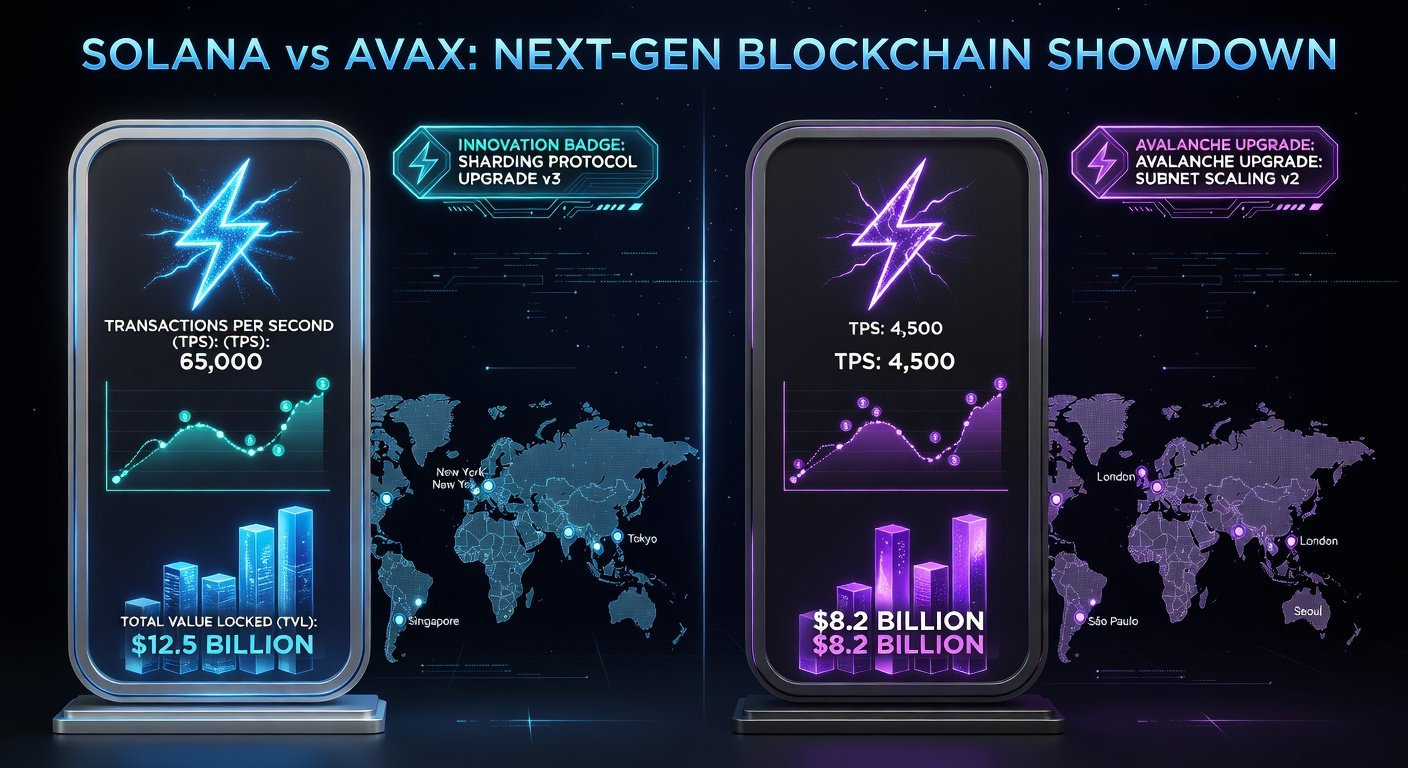
Solana has long been synonymous with speed, boasting theoretical throughput of 65,000 transactions per second (TPS) via its Proof-of-History (PoH) consensus combined with Proof-of-Stake (PoS). By 2026, post-Firedancer upgrade and further optimizations, real-world TPS could hit 100,000+, handling peak loads without breaking a sweat. Its parallel processing via Sealevel runtime allows smart contracts to execute simultaneously, making it ideal for high-frequency trading and gaming dApps.
Avalanche counters with its unique subnet architecture, enabling customizable blockchains that scale horizontally. Primary network TPS hovers around 4,500, but subnets push effective scalability to millions of TPS across the ecosystem. The 2026 Avalanche9000 upgrade enhances cross-subnet communication, reducing latency to sub-second finality. While Solana edges in raw mainnet speed, AVAX shines in modular scalability for enterprise use.
Both networks prioritize low latency, but Solana's Gulf Stream mempool-less forwarding gives it a slight edge in consumer-facing apps.
Transaction Fees: Keeping Costs Microscopic
Fee wars define L1 battles. Solana's average fee remains under $0.00025 in 2026, thanks to dynamic priority fees and congestion controls from the QUIC protocol upgrades. During bull runs, spikes are mitigated by stake-weighted QoS, ensuring retail users aren't priced out.
AVAX keeps fees at $0.01-$0.10, with Warpspeed (post-2026) burning fees to deflate supply. Subnets allow fee customization, perfect for high-volume DeFi or NFTs. Solana wins for everyday micropayments, but AVAX offers predictability for institutional apps.
DeFi Ecosystems: TVL Titans
DeFi is the killer app for L1s. Solana's ecosystem explodes with Jupiter DEX aggregator, Drift perpetuals, and Kamino lending—total value locked (TVL) projected at $50B+ by 2026. Innovations like state compression slash storage costs, fueling memecoin mania and real yield farms.
Avalanche's DeFi, anchored by Trader Joe, Benqi, and Pangolin, hits $30B TVL. HyperSDK enables lightning-fast orderbooks, attracting CEX-like liquidity. For real-time metrics, check DeFiLlama, the go-to for chain TVL rankings.
- Solana strengths: Viral memecoins, perps volume.
- AVAX strengths: RWA tokenization, institutional yield.
Real-World Adoption: Beyond Crypto Hype
Solana powers Helium mobile networks and Render GPU rendering, with partnerships in payments via Solana Pay. By 2026, Shopify integrations and Visa pilots cement its retail footprint.
Avalanche leads in RWAs with Securitize and KKR tokenizations, plus gaming via Shrapnel. Its C-Chain EVM compatibility draws Ethereum devs, while subnets host compliant chains for banks. Visit the official sites for updates: Solana and Avalanche.
Key Upgrades Shaping 2026
Solana's 2026 roadmap includes ZK compression for cheaper NFTs and full Firedancer client diversity to prevent outages. AVAX rolls out Durango for 1M+ TPS subnets and Avalanche Warp Messaging for seamless interoperability.
- Firedancer (Solana): Multi-client resilience.
- Avalanche9000: Subnet hyper-scaling.
- Both: ZK proofs for privacy/scalability.
Market Performance: Price Action and Tokenomics
As of late 2025 projections into 2026, SOL trades at $300-$500, buoyed by ETF approvals and burns. AVAX at $100-$200, with strong staking yields (7-10%) and deflationary mechanics. Track live data on CoinMarketCap. Solana's higher volatility suits traders; AVAX's stability appeals to HODLers.
Investment Potential for Altcoin Enthusiasts
Solana offers explosive upside from consumer adoption—think 10x potential in bull markets. AVAX provides steady growth via enterprise plays, with lower risk. Diversify: 60/40 SOL/AVAX portfolio hedges beta exposure.
Risks? Solana's outage history (mitigated now) vs. AVAX's slower retail hype. Fundamentals favor both, but liquidity and dev activity tilt toward Solana.
Predictions: Who Leads in Scalability and Innovation?
By 2026, Solana leads in raw speed and DeFi volume, dominating retail and Web3 gaming. AVAX excels in enterprise scalability and RWAs, carving a blue-chip niche. For pure innovation, Solana's edge in parallel VMs wins, but AVAX's subnets future-proof modularity.
Ultimate pick? Solana for growth chasers; AVAX for value investors. The real winner: A multi-chain world where both thrive. Stay tuned—2026 will redefine L1 supremacy.

No comments yet. Be the first!