 CryptoChain Blog

Introduction to DeFi DAO Governance
Decentralized Finance (DeFi) has revolutionized how we interact with money, and at its core lies DAO governance—community-driven decision-making powered by blockchain. In 2026, DAOs like Uniswap and MakerDAO are more influential than ever, managing billions in assets. This guide takes you from beginner basics to advanced strategies, covering token acquisition, voting, proposals, delegation, risks, and future-proof tactics.
Whether you're a newbie holding your first governance token or a seasoned DeFi user aiming to maximize impact, understanding DAO mechanics is key to shaping protocols that billions rely on.
What is DeFi DAO Governance?
DAOs (Decentralized Autonomous Organizations) are on-chain entities where token holders vote on upgrades, treasury spends, and parameter changes. Unlike traditional companies, there's no CEO—power is distributed via tokens like UNI (Uniswap) or MKR (MakerDAO).
- Key Components: Governance tokens grant voting power proportional to holdings.
- On-Chain vs. Off-Chain: Votes often use tools like Snapshot for gas-free signaling, settling on-chain via Ethereum or L2s.
- Major Protocols: Uniswap (UNI) governs liquidity pools and fees; MakerDAO (MKR) controls DAI stability.
In 2026, with Ethereum's scaling solutions like Optimism and Arbitrum, participation is faster and cheaper, drawing millions into governance.
Step 1: Acquiring Governance Tokens
To participate, you need tokens. Here's how for top DAOs:
Uniswap (UNI)
- Buy on DEXes: Swap ETH for UNI on Uniswap itself or centralized exchanges like Coinbase.
- Airdrop Farms: Stake in liquidity pools for potential retroactive rewards—check Uniswap.org.
- L2 Bridges: Move UNI to Base or Optimism for lower fees.
MakerDAO (MKR)
- Purchase MKR: Available on major DEXes; hold for voting on collateral types or liquidation ratios.
- Earn via DAI Savings Rate: Lock DAI to accrue rewards, indirectly supporting governance.
- Visit Official Site: Track auctions at MakerDAO.com.
Tip: Use hardware wallets like Ledger for security. In 2026, soulbound tokens may tie reputation to holdings, boosting long-term incentives.
Step 2: Participating in Voting
Voting is straightforward but strategic.
Tools and Processes
- Snapshot.org: Off-chain voting hub—connect wallet, vote with token balance snapshots. Ideal for beginners.
- On-Chain Execution: Approve transactions via Tally.xyz or DAO dashboards; pay gas.
- Uniswap Example: Proposals on governance.uniswap.org—vote YES/NO/ABSTAIN on fee switches.
- MakerDAO: Executive votes on spell.casting.makerdao.com adjust risk parameters.
Beginner Checklist:
- Connect wallet to Snapshot or Tally.
- Review proposal: Read forum discussions (e.g., forum.uniswap.org).
- Vote early—many have quorum requirements.
- Track via Dune Analytics dashboards.
Step 3: Creating Proposals
Advanced users influence by submitting ideas.
How to Submit
Temperature Checks: Post on forums first for feedback.
- Uniswap: Draft on forum, then Snapshot temperature check. If passes, on-chain via IPFS.
- MakerDAO: MIP (Maker Improvement Proposal) process—collaborative docs on Ethereum.org governance pages or Maker's forum.
Best Practices:
- Quantify impact: Use data (e.g., 'This increases TVL by 20%').
- Collaborate: Rally co-authors.
- Simulate: Fork mainnet to test changes.
Delegation: Maximize Your Influence
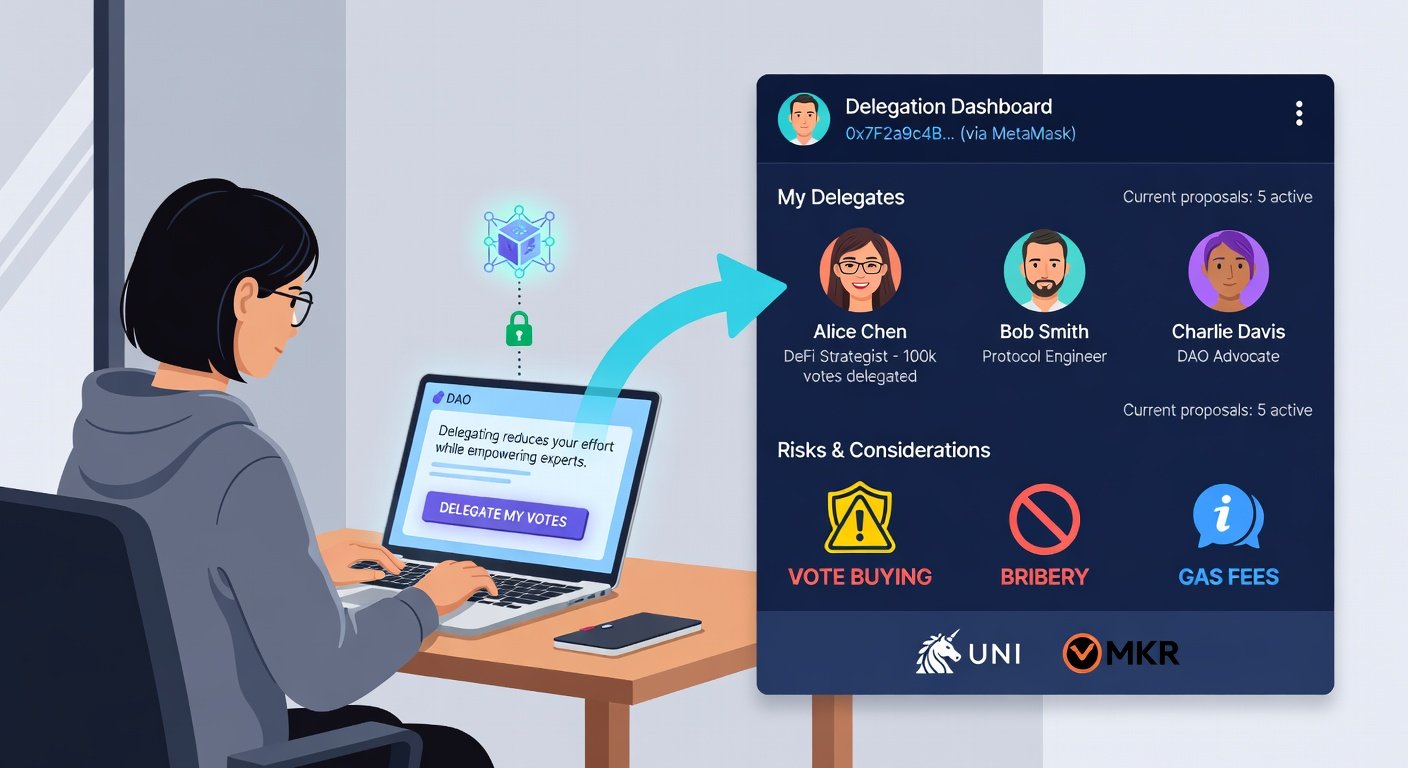
Not voting? Delegate to amplify power.
- What is it? Transfer voting rights to delegates without losing tokens.
- Uniswap: Delegate via app.uniswap.org/governance.
- MakerDAO: Set delegate in voting contract.
- Advanced: Vote as a Service (VaaS) platforms track delegates' performance via on-chain history.
In 2026, AI delegates and quadratic voting may emerge, weighting engaged users more.
Risks in DAO Governance
Governance isn't risk-free.
Vote Buying and Bribery
Flash loan attacks or token incentives can sway votes. Mitigate by checking voter history on Nansen or spotting whale dumps.
Other Risks
- Smart Contract Bugs: Audit proposals rigorously.
- Low Turnout: Apathy lets minorities decide—participate!
- Regulatory Scrutiny: 2026 SEC rules may classify tokens as securities.
Strategies for Effective Participation in 2026
Beginner: Vote consistently on 5+ proposals/month.
Intermediate: Delegate to aligned experts (e.g., track via DeepDAO).
Advanced:
- Meta-Governance: Vote in Lido or Aave to influence Ethereum-wide changes.
- Prediction Markets: Use Polymarket to gauge proposal outcomes.
- Multi-DAO Coordination: Join alliances like SafeDAO for cross-protocol power.
Future Trends: ZK-proofs for private voting, AI proposal generators, and restaking for governance yield.
Conclusion
DeFi DAO governance empowers you to steer the future of finance. Start small: Acquire UNI or MKR, vote today, and scale to proposals. Stay informed, mitigate risks, and in 2026, your voice could redefine DeFi. Dive in— the blockchain awaits.
No comments yet. Be the first!