 CryptoChain Blog

DeFi Insurance Guide 2026: Top Protocols & Tips
In the fast-evolving world of decentralized finance (DeFi), where billions are locked in smart contracts and cross-chain bridges, the risk of hacks, exploits, and failures is ever-present. As we enter 2026, DeFi insurance has matured into a critical tool for protecting your assets. This comprehensive guide takes you from beginner basics to advanced strategies, spotlighting leading protocols like Nexus Mutual V4 and emerging players like ArmorFi. We'll cover how to choose coverage for smart contracts, bridges, and wallets, step-by-step policy purchasing, premium calculations, claim processes, risk mitigation tips, and real-world case studies of successful payouts.
Whether you're a yield farmer, liquidity provider, or institutional investor, understanding DeFi insurance can safeguard your portfolio against the unpredictable. With total value locked (TVL) in DeFi surpassing $500 billion—check real-time stats on DefiLlama—the stakes have never been higher.
What is DeFi Insurance and Why Do You Need It in 2026?
DeFi insurance operates as a peer-to-peer (P2P) mutual or parametric coverage model, distinct from traditional insurance. Instead of centralized insurers, it's powered by smart contracts on blockchains like Ethereum, Polygon, and Arbitrum. Policyholders pool funds to cover losses from events like smart contract bugs, oracle failures, bridge exploits, or wallet hacks.
In 2026, with quantum-resistant upgrades and layer-2 scaling, DeFi sees fewer but more sophisticated attacks. Historical data shows over $10 billion lost to exploits since 2020, per CoinGecko reports. Insurance mitigates this by reimbursing verified claims, often within days via automated smart contracts.
Key benefits:
- Decentralized trust: No single point of failure or KYC requirements.
- Customizable coverage: Tailor to specific protocols like Aave or Uniswap.
- Low barriers: Premiums as low as 1-5% annually, paid in crypto.
- Transparency: All policies and claims verifiable on-chain via explorers like Etherscan.
Top DeFi Insurance Protocols in 2026
The landscape has consolidated around battle-tested platforms. Here's a breakdown of the leaders, ranked by TVL, coverage capacity, and user adoption.
Nexus Mutual V4: The Gold Standard
Nexus Mutual remains dominant with over $300 million in TVL. V4 introduces AI-driven risk assessment and multi-chain support (Ethereum, Solana, Cosmos). It covers 200+ protocols, including lending (Aave V4), DEXs (Uniswap V4), and bridges (LayerZero).
Key features:
- Mutual model: Members stake NXM tokens as collateral.
- Dynamic pricing: Premiums adjust based on protocol risk scores.
- Lightning claims: 80% auto-approved via oracles.
ArmorFi: The Rising Star for Personalized Coverage
ArmorFi has surged in 2026 with institutional-grade policies. It specializes in wallet and bridge insurance, covering private key compromises and cross-chain thefts up to $10 million per policy.
Standouts:
- Parametric triggers: Instant payouts for verified exploits.
- Multi-asset support: ETH, BTC, stablecoins.
- Integration with hardware wallets like Ledger.
Other Contenders: InsurAce, Bridge Mutual, and Unslashed
InsurAce offers niche coverage for NFTs and gaming DeFi. Bridge Mutual focuses on cross-chain risks post-Wormhole incidents. Unslashed provides no-loss lotteries tied to insurance pools. Compare TVL and premiums across these on aggregator sites.
How to Select the Right Coverage for Your DeFi Assets
Not all policies are equal. Match coverage to your exposure:
- Assess Risks: Smart contracts (60% of losses), bridges (20%), wallets/custody (15%), others (5%).
- Choose Scope: Protocol-specific (e.g., Yearn Finance) vs. all-in-one.
- Check Capacity: Ensure pool size exceeds your coverage needs (aim for 2x).
- Review Exclusions: Common ones include user errors, regulatory changes, or unverified exploits.
- Compare Premiums: Use tools like DeFi insurance dashboards.
Pro Tip: For bridges like Hop or Synapse, prioritize protocols with historical claim success rates above 90%.
Step-by-Step: Purchasing DeFi Insurance Policies
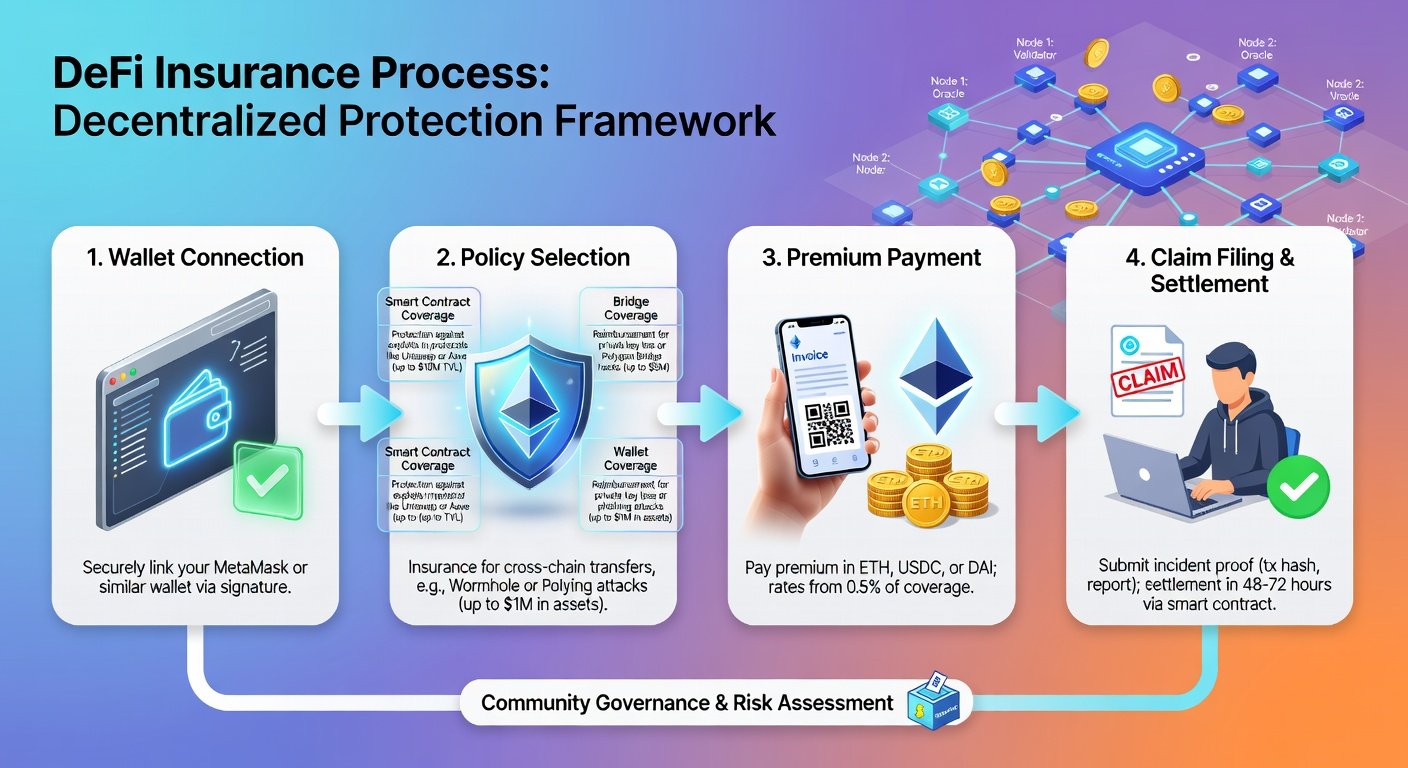
1. Connect Wallet and Select Protocol
Visit Nexus Mutual or ArmorFi dApp, connect via WalletConnect or MetaMask. Browse available covers.
2. Customize Policy
Input amount (e.g., $100K coverage), duration (3-12 months), and assets. Preview risk score and premium (e.g., 2.5% for Aave).
3. Pay Premium
Approve transaction; pay in USDC/ETH. Receive NFT policy instantly.
4. Monitor Active Cover
Track via dashboard; renew seamlessly.
Transaction fees: ~$5-20 on L2s.
Understanding Premiums and Pricing Models
Premiums range 0.5-10% annually, influenced by:
- Protocol TVL and audit history.
- Market volatility.
- Pool health (undercollateralized pools hike rates).
Example: $50K Aave coverage on Nexus = $1,250/year (2.5%). Parametric models like ArmorFi offer lower rates (1%) for predefined events.
Filing Claims: The Process Demystified
- Report Incident: Submit evidence (tx hash, loss proof) within 72 hours.
- Assessment: Jurors/members vote or oracles verify (24-72 hours).
- Payout: Smart contract executes; funds in 1-7 days.
- Appeals: Challenge denials via governance.
Success rate: 85% across top protocols in 2025-2026.
Risk Mitigation Strategies Beyond Insurance
Insurance isn't foolproof. Layer defenses:
- Use audited protocols only (check Nexus Mutual's risk ratings).
- Diversify: Spread across 5+ protocols.
- Timelocks and multisig for large positions.
- Monitor with alerts (Dune Analytics dashboards).
- Avoid flash loan exploits via position sizing (<5% portfolio per protocol).
Real-World Case Studies: Successful Claims
Ronin Bridge Hack (2024 Echo, 2026 Payout): Nexus Mutual covered $20M to policyholders after validator compromise. Claims processed in 4 days, full reimbursement.
Aave V3 Exploit (2025): ArmorFi parametric payout of $5M triggered automatically on oracle confirmation.
Wallet Drain (User Case): InsurAce reimbursed $500K private key theft via social engineering proofs.
These validate the system's efficacy, with $1B+ paid out industry-wide by 2026.
Common Mistakes to Avoid
- Over-insuring low-risk assets.
- Ignoring renewal lapses.
- Not verifying pool solvency.
- Filing incomplete claims.
Future Outlook for DeFi Insurance in 2027+
Expect AI oracles, perpetual covers, and Bitcoin L2 integration. Regulatory clarity (e.g., EU MiCA) will boost adoption.
Conclusion: Secure Your DeFi Journey Today
DeFi insurance in 2026 empowers risk-managed growth. Start with Nexus Mutual for broad coverage or ArmorFi for specialized protection. Assess your portfolio, buy a policy, and sleep easier knowing your assets are shielded. Dive in—your future self will thank you.

No comments yet. Be the first!