 CryptoChain Blog

As Ethereum continues its evolution into 2026, privacy has emerged as one of the most critical focus areas for Layer 2 solutions. Developers and users searching for the latest ethereum news on data protection are increasingly interested in how these networks can deliver both scalability and confidentiality. This comprehensive guide examines the emerging privacy enhancements across major Ethereum L2 platforms, covering zk-based protocols, regulatory implications, integration challenges, and hands-on implementation advice.
Understanding Privacy Needs in Ethereum L2 Ecosystems
Ethereum's base layer is intentionally transparent, recording every transaction on a public ledger. While this design promotes trustlessness and auditability, it creates significant privacy risks for applications handling sensitive financial data, user identities, or proprietary strategies. Layer 2 solutions were primarily built to solve scalability, yet by 2026 the demand for built-in privacy tools has grown dramatically. Private transactions help protect against front-running, MEV extraction, and data leaks that could expose trading positions or wallet balances. Without robust privacy layers, DeFi users and institutions remain vulnerable in an increasingly regulated environment.
zk-Based Privacy Protocols Explained
Zero-knowledge proofs form the backbone of modern L2 privacy enhancements. zk-SNARKs and zk-STARKs allow one party to prove the validity of a transaction or computation without revealing the underlying inputs. In 2026, recursive zk-proofs have become more efficient, enabling entire batches of private transactions to be verified with minimal on-chain data. These protocols support shielded addresses, confidential token transfers, and even private smart contract execution. Developers can now write applications where balances and transaction details remain hidden while still allowing selective disclosure for compliance purposes when required by auditors or regulators.
Comparing Privacy Tools Across Major L2s
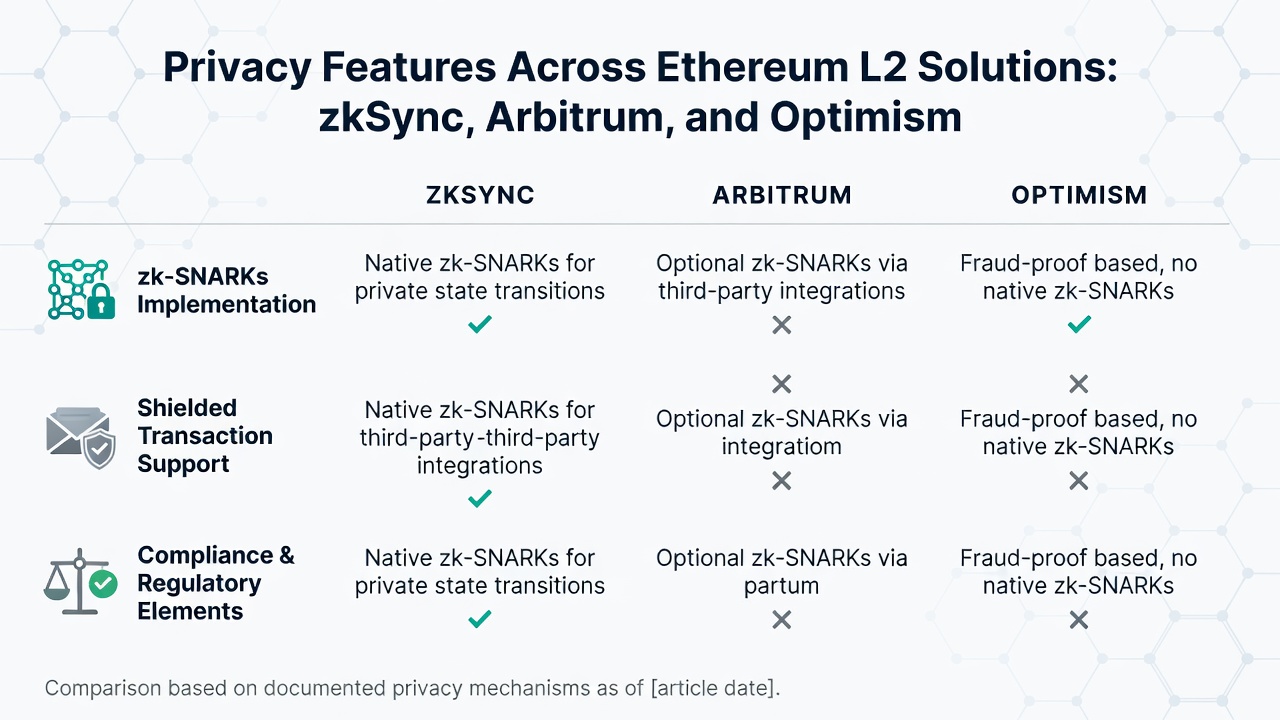
Each major Layer 2 platform approaches privacy differently, creating distinct trade-offs for developers and users. zkSync has prioritized native privacy through its zk-rollup architecture and account abstraction features, allowing seamless shielded transactions. Arbitrum has introduced hybrid optimistic-zk solutions that add optional privacy layers for oracles and batch processing. Optimism focuses on modular design, integrating external zk-privacy middleware for flexible deployment. Polygon zkEVM offers EVM-equivalent private contract capabilities via advanced circuit design. Choosing the right platform often depends on whether full shielding, selective privacy, or developer tooling is the priority.
- zkSync: Offers comprehensive transaction shielding, developer SDKs for private dApps, and strong performance on mainnet as of mid-2026.
- Arbitrum: Provides emerging private oracle support and batch privacy tools suitable for complex DeFi protocols.
- Optimism: Leverages external zk layers for customizable privacy without rebuilding core infrastructure.
- Polygon zkEVM: Delivers EVM-compatible private smart contracts ideal for teams migrating existing codebases.
Real-World Use Cases for Private DeFi Transactions
Private DeFi use cases have expanded significantly by 2026. Traders can execute large swaps on decentralized exchanges without revealing their positions, reducing sandwich attacks and front-running. Lenders and borrowers benefit from confidential loan terms that protect sensitive financial strategies. Yield farmers can participate in liquidity pools while keeping allocation details private from competitors. Institutional participants particularly value these features for treasury management and OTC-style settlements on-chain. One practical example involves a hedge fund using zk-based private swaps on zkSync to rebalance a portfolio without alerting other market participants, achieving better execution prices and lower slippage.
Step-by-Step Guide to Setting Up Privacy-Enabled Wallets
Implementing privacy features requires careful configuration. Follow these detailed steps to get started with privacy-enabled transactions on Ethereum L2s:
- Select a compatible wallet such as MetaMask, Rabby, or Frame that supports multiple L2 networks and account abstraction.
- Connect to your preferred L2 network (for example zkSync) and install any required privacy extensions or plugins from official sources.
- Generate shielded addresses using the wallet's built-in zk-proof tools or integrated protocols like Aztec or Penumbra bridges where available.
- Fund a test account via official testnet faucets and perform several private transfers to verify shielding works correctly before moving to mainnet.
- Configure gas settings and proof generation parameters to balance speed with privacy strength, monitoring metrics through block explorers.
- Document your key management procedures and enable recovery options to avoid loss of shielded funds due to misplaced credentials.
Regulatory Implications for L2 Privacy
Privacy features must coexist with global regulatory frameworks including AML and KYC requirements. Leading L2 projects incorporate optional disclosure mechanisms that allow users to reveal transaction details to authorized parties without compromising everyday privacy. Guidance from the Ethereum Foundation emphasizes responsible innovation that supports both user confidentiality and legal compliance. Developers should design applications with auditability hooks so institutions can meet reporting obligations while retail users retain strong default privacy protections.
Integration Challenges with Existing L2 Stacks
Integrating advanced privacy tools into existing L2 infrastructure presents several technical hurdles. zk-circuit generation adds computational overhead that can increase latency during transaction finality. Legacy smart contracts often require significant refactoring to become privacy-compatible. Hardware acceleration and optimized proof systems have reduced these delays in 2026, yet thorough testnet validation remains essential. Teams should also consider storage costs for encrypted data and plan for potential upgrades as proof systems continue to evolve rapidly.
Performance Trade-offs and Optimization Strategies
Privacy enhancements inevitably introduce trade-offs between confidentiality and speed. Proof generation can add seconds to transaction times compared to fully transparent L2 activity. However, recent optimizations using GPU clusters and recursive proof aggregation have narrowed this gap significantly. Developers are advised to benchmark specific use cases on testnets and choose lighter privacy modes for high-frequency trading while reserving full shielding for larger or more sensitive transfers. Monitoring tools provided by each L2 help identify bottlenecks early in the development cycle.
Frequently Asked Questions
How do privacy features impact transaction speeds on Ethereum L2s?
Optimized implementations in 2026 maintain near-instant finality for most interactions, though complex private computations may add minor delays of a few seconds depending on proof size and network congestion.
Are L2 privacy features compliant with current regulations?
Many protocols include selective transparency options that allow compliance with AML/KYC rules while preserving core privacy for standard user activity, aligning with guidance from major Ethereum ecosystem organizations.
What common mistakes should be avoided when implementing L2 privacy?
Overlooking secure key management, failing to audit zk-circuit code thoroughly, and neglecting testnet validation are frequent errors that can lead to fund loss or vulnerabilities.
Which L2 offers the best privacy tooling for new developers in 2026?
zkSync currently provides the most mature developer SDKs and documentation for building private applications, though teams should evaluate all platforms based on their specific technical requirements.
Conclusion
Ethereum L2 privacy advancements in 2026 mark a major step forward for secure and scalable decentralized applications. By understanding zk-protocols, platform comparisons, real-world use cases, and practical setup processes outlined in this article, developers and users can confidently adopt these tools. Ongoing collaboration across the ecosystem, supported by resources from the Consensys team and the broader Ethereum community, will continue refining these capabilities for wider adoption and stronger data protection standards.


No comments yet. Be the first!