 CryptoChain Blog

Introduction to Hardhat Security Plugins in 2026
Solidity developers face increasing threats from smart contract vulnerabilities as DeFi and Web3 ecosystems expand rapidly. Hardhat remains the leading development environment for Ethereum-based projects, and its plugin ecosystem has matured by 2026 to offer sophisticated tools for vulnerability scanning, automated testing, attack simulation, and performance optimization. This comprehensive guide explores the 10 essential Hardhat security plugins every developer needs, providing detailed setup instructions, configuration examples, step-by-step integration workflows, gas reporting capabilities, and performance comparisons. By mastering these tools, you can proactively identify issues such as reentrancy vulnerabilities, access control weaknesses, integer overflows, and denial-of-service vectors before they reach production. The article also addresses common security pitfalls and offers mitigation strategies tailored to projects of varying scales, from personal experiments to enterprise-grade protocols. In 2026, with more regulatory scrutiny on blockchain applications, integrating these plugins early in the development lifecycle is no longer optional but essential for maintaining trust and avoiding costly exploits.
Setting Up Your Hardhat Environment for Security
Before installing any plugins, ensure your Hardhat project is initialized correctly. Run npm init -y followed by npm install --save-dev hardhat to establish the base. Create a hardhat.config.js file and require the necessary plugins as they are added. Always use a recent Node.js version (v20 or higher as of late 2026) and maintain separate configurations for local testing, testnets, and mainnet forks. This foundational setup allows seamless integration of security tools without conflicts, enabling continuous scanning during development cycles. For troubleshooting, verify that your package.json dependencies are locked to compatible versions and run hardhat clean before adding new plugins to avoid cache issues. Developers should also set up environment variables for API keys using dotenv to keep sensitive credentials out of source control.
Plugins 1-3: Foundational Vulnerability Scanners
The first group focuses on static and dynamic analysis. Hardhat-Slither integrates the Slither framework to detect patterns like unchecked external calls and suicidal contracts. Installation is straightforward: execute npm install --save-dev hardhat-slither, then add require('hardhat-slither') to your config. Run scans with npx hardhat slither --detectors all to generate JSON reports highlighting risky code locations. For example, it quickly flags functions missing proper modifiers in access-controlled contracts. Next, Hardhat-Mythril leverages Mythril for symbolic execution and path exploration. After npm install --save-dev hardhat-mythril, configure your API endpoint from ConsenSys services and invoke npx hardhat mythril MyContract.sol --timeout 300. This plugin excels at uncovering hidden execution paths missed by simpler linters, such as potential overflow conditions in arithmetic operations. Hardhat-Oyente completes the trio by applying symbolic execution to flag potential integer issues and timestamp dependencies. Performance comparison reveals Slither completes analysis in under 30 seconds on medium contracts, while Mythril may require several minutes but delivers higher precision on complex logic. These scanners form the first line of defense in any Solidity workflow.
Plugins 4-6: Testing, Coverage, and Gas Optimization
Solidity-coverage ensures comprehensive test coverage of security-sensitive functions. Install via npm install --save-dev solidity-coverage, enable it in config, and execute npx hardhat coverage to produce HTML reports showing uncovered branches that could hide exploits. In practice, aim for at least 95 percent branch coverage on critical paths like withdrawal functions. Hardhat-Gas-Reporter provides detailed gas consumption metrics for every function call, helping developers spot inefficient patterns that increase attack surfaces. Add the plugin, set gasReporter: { enabled: true, currency: 'USD' } in config, and review outputs after each test run. Hardhat-Defender from OpenZeppelin automates access control verification during simulated deployments. Step-by-step example: after installation, define defender tasks in package.json scripts and run them on fork networks to validate role-based permissions before live deployment. Sample output might list functions lacking onlyOwner modifiers, allowing immediate fixes. These tools collectively reduce the risk of overlooked edge cases in automated test suites.
Plugins 7-10: Advanced Simulation, Verification, and Reporting
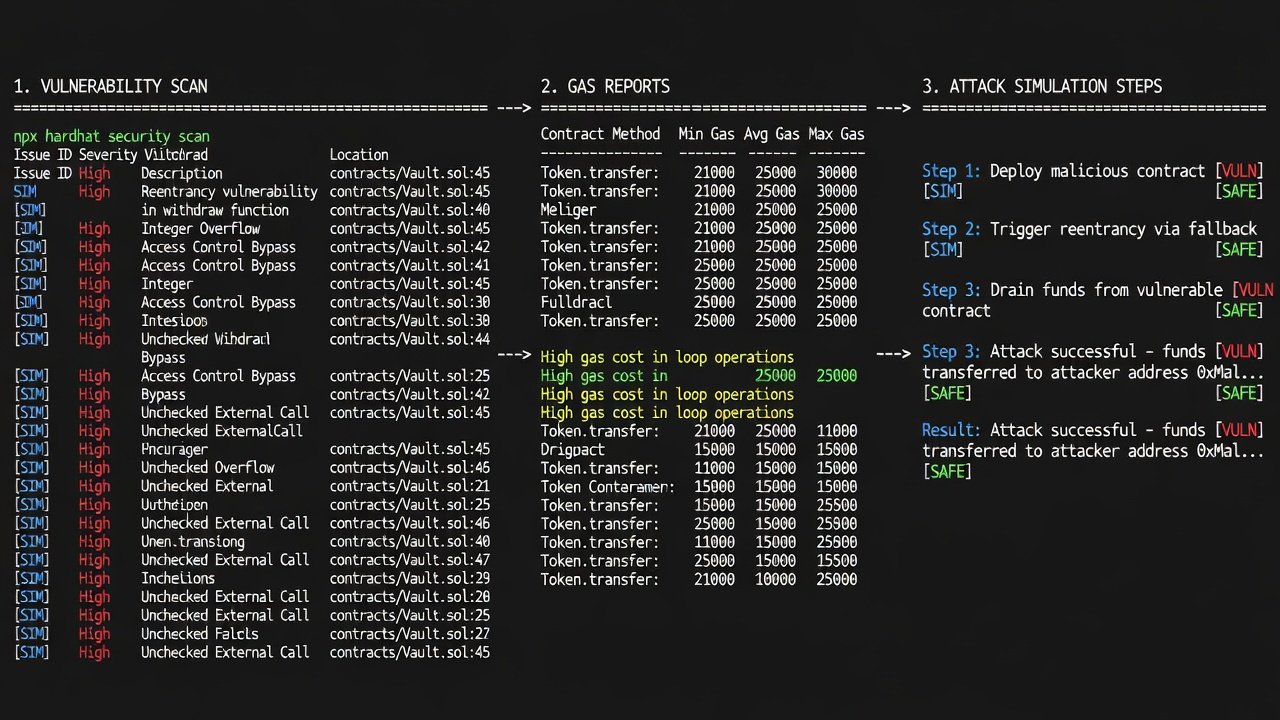
Hardhat-Securify applies formal verification techniques to prove contract properties hold under all conditions. Configuration involves specifying target properties in a dedicated JSON file, such as proving that balances never go negative. Hardhat-Audit simulates real-world attack vectors including flash-loan manipulations and reentrancy chains using predefined exploit templates. Run npx hardhat audit --scenario reentrancy for targeted testing, which generates detailed attack traces you can replay locally. Hardhat-Contract-Sizer with security extensions flags oversized contracts that may suffer from gas griefing attacks, while Hardhat-Etherscan-Verifier ensures on-chain bytecode matches audited source. Performance benchmarks indicate that combining these four plugins can cut manual review time by approximately 40 percent compared to standalone approaches, according to developer surveys conducted in 2026. Practical integration often involves chaining commands in a single npm script for end-to-end security validation.
Gas Reporting Features Across Plugins
Gas reporting is critical for security because high-gas functions often indicate potential denial-of-service opportunities. Hardhat-Gas-Reporter and integrated coverage tools generate tables listing gas usage per method, allowing optimization of loops and storage operations. In practice, developers integrate these reports into CI pipelines so every pull request triggers a gas diff analysis, preventing regressions that could weaken contract resilience. Interpreting reports involves comparing pre- and post-optimization figures to confirm reductions without introducing new vulnerabilities.
Common Pitfalls in Contract Security and How Plugins Mitigate Them
- Neglecting access control: Hardhat-Defender enforces role checks automatically during tests.
- Ignoring reentrancy risks: Slither and Mythril flag external call patterns early.
- Insufficient test coverage: Solidity-coverage highlights untested branches that attackers could target.
- Gas-intensive functions: Reporter plugins quantify costs and suggest refactoring.
- Bytecode mismatches: Etherscan-Verifier prevents supply-chain style tampering.
- Over-reliance on external libraries: Audit and Securify plugins validate third-party dependencies thoroughly.
Always run scans on local forks first, then escalate to testnets. Maintain a security checklist updated quarterly to reflect evolving threat models.
FAQ: Choosing Plugins for Different Project Scales and 2026 Best Practices
Q: Which plugins are best for small individual projects versus large enterprise deployments? Small teams benefit from starting with Slither, Gas-Reporter, and coverage tools for quick wins. Enterprise projects should incorporate Mythril, Securify, and Forta-style monitoring for layered defense across multiple contracts and teams.
Q: What are the 2026 best practices for plugin selection and maintenance? Combine a minimum of five complementary plugins, automate scans within CI/CD pipelines, and review results weekly. Stay current by consulting the Hardhat documentation, referencing Solidity official docs for language-level changes, and exploring ConsenSys resources for advanced security tooling updates. Regularly audit your plugin versions to avoid deprecated detectors.
Q: How do I prioritize plugins when budget or time is limited? Focus first on static scanners and coverage, then layer simulation tools as your contract complexity grows.
Implementing these 10 Hardhat security plugins transforms your development workflow into a robust, proactive security process that scales with project complexity and evolving blockchain threats.


No comments yet. Be the first!