 CryptoChain Blog

Introduction to 2026 SOL and AVAX Tokenomics
As altcoin investors navigate the evolving landscape in 2026, understanding the tokenomics of Solana (SOL) and Avalanche (AVAX) is essential for maximizing yields. This analysis focuses on practical applications, comparing staking rewards, token burns, and emerging mechanisms like restaking to help long-term holders build balanced portfolios. Tokenomics encompasses supply dynamics, inflation schedules, and utility in DeFi protocols. Both networks have matured with unique approaches to sustainability and growth, making them attractive for yield-focused strategies. Investors must consider how inflation interacts with reward rates, the impact of network activity on burns, and opportunities in decentralized finance that extend beyond simple holding. This guide provides concrete examples and decision frameworks rather than surface-level summaries, targeting those seeking to apply tokenomics data directly to portfolio decisions.
Solana Tokenomics in 2026
Solana's high-throughput blockchain emphasizes speed and low costs, with SOL serving as the native token for fees, staking, and governance. The network's inflationary model gradually decreases over time, supporting long-term holders through predictable reward structures. Key features include a deflationary pressure from transaction fee burns, which offsets new issuance. This design encourages network usage while providing staking participants with consistent incentives. In practice, holders benefit when transaction volume rises because burns reduce effective supply growth. Validators and delegators receive rewards proportional to stake, but participants should track epoch schedules and commission rates to optimize entry points. Solana's tokenomics also support governance proposals that can adjust parameters affecting yields over multi-year horizons.
Avalanche Tokenomics in 2026
Avalanche uses a multi-subnet architecture for scalability, with AVAX powering transactions, staking, and platform fees. Its tokenomics feature a capped supply with ongoing burns from transaction activity and subnet launches. The primary staking mechanism rewards validators and delegators, aligning incentives for security and participation across its primary network and custom blockchains. Subnet creation introduces additional demand drivers for AVAX as projects launch dedicated environments. This creates layered utility that can stabilize or enhance yields compared to single-chain models. Holders evaluating Avalanche should examine subnet-specific metrics and how they influence overall token velocity and burn rates.
Comparing Staking APYs and Inflation
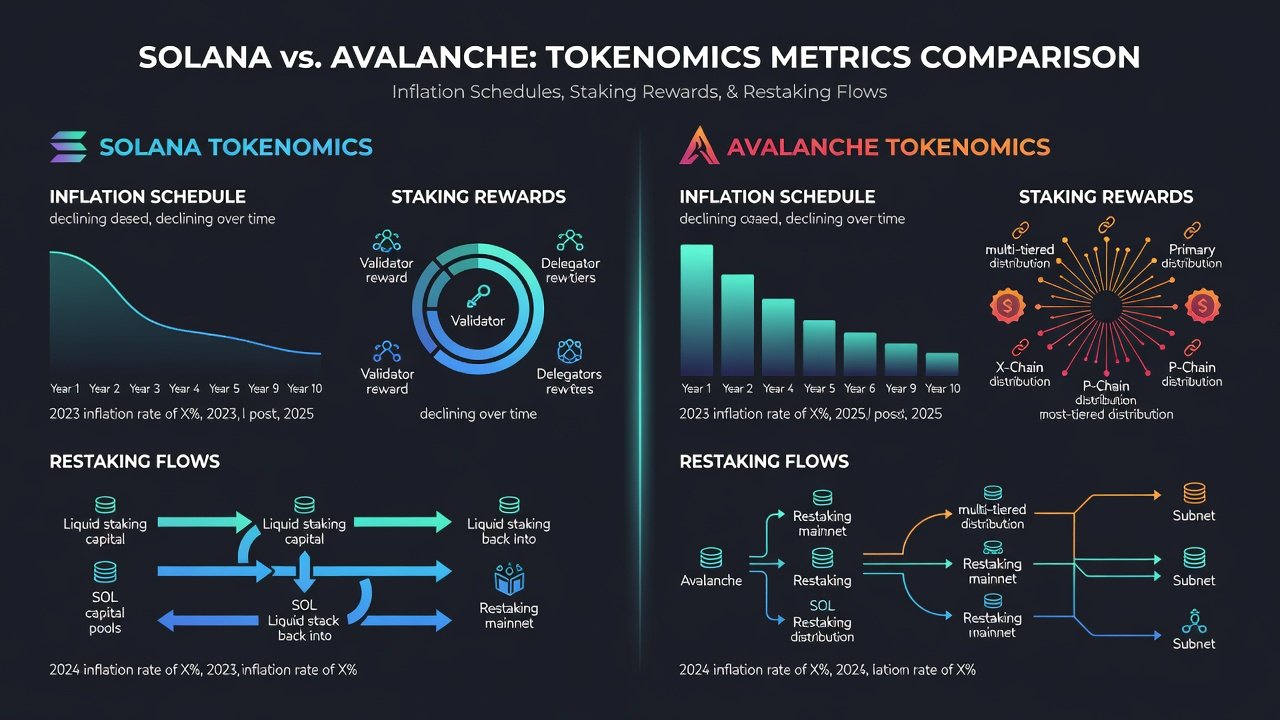
Investors often evaluate real yields by contrasting inflation rates against reward distributions. Below is a comparison highlighting key metrics for SOL and AVAX as of 2026-10-01.
| Metric | SOL | AVAX |
|---|---|---|
| Annual Inflation Rate | Moderate decreasing schedule | Fixed with burn offsets |
| Base Staking Rewards | Variable based on participation | Competitive validator yields |
| Net Real Yield Potential | Enhanced by fee burns | Supported by subnet activity |
| Delegation Flexibility | High through liquid staking options | Strong across multiple subnets |
These figures evolve with network usage, so monitoring on-chain data remains critical. Real yields improve when burns accelerate during high activity periods, but investors must factor in opportunity costs of locking tokens versus deploying them elsewhere.
DeFi Utility Across Protocols
Both tokens integrate deeply with decentralized finance. Solana benefits from its ecosystem of lending, perpetuals, and automated market makers, allowing holders to deploy SOL in liquidity pools for additional fees. Avalanche's subnets enable specialized DeFi applications, with AVAX often used in cross-chain bridges and yield aggregators. Liquidity provision on established platforms can generate trading fee revenue alongside base staking. Advanced users explore leveraged positions or options strategies, but these require careful position sizing. Solana and Avalanche continue to expand these utilities through developer incentives and protocol upgrades. Understanding protocol-specific risks, such as smart contract vulnerabilities or liquidity fragmentation, helps investors select venues that align with their risk tolerance.
Emerging Passive Income: Restaking and Liquidity Provision
Restaking allows SOL or AVAX holders to reuse staked assets for additional security services, potentially boosting yields without new capital. Liquidity provision involves pairing tokens in DEX pools, earning from swaps while managing impermanent loss. Step-by-step strategy for restaking: 1) Select a supported restaking protocol on your chosen chain. 2) Assess slashing risks and reward multipliers. 3) Allocate a portion of holdings gradually. 4) Monitor performance via dashboards and rebalance quarterly. For liquidity provision, begin by identifying high-volume pairs, calculating expected fee income versus potential loss scenarios, and setting alerts for pool imbalances. These mechanisms add complexity but can meaningfully enhance baseline staking returns when executed with discipline.
Real-World Portfolio Case Studies
Consider a hypothetical balanced portfolio of SOL and AVAX initiated in early 2026. By combining native staking with selective liquidity provision, investors achieved compounded returns exceeding baseline staking alone through consistent rebalancing. One case involved allocating 60 percent to SOL staking and 40 percent to AVAX across two subnets, capturing both primary rewards and subnet-specific incentives. Another example demonstrates the impact of restaking a portion of SOL holdings on a secondary protocol, resulting in layered yield streams while maintaining core security contributions. These studies highlight the value of quarterly reviews and diversification across mechanisms rather than concentrating in a single strategy. Tracking performance against benchmarks helps identify when adjustments are warranted.
Risk Management and Practical Steps
Effective risk management starts with understanding slashing conditions, smart contract exposure, and market volatility. Investors should implement the following practical steps: diversify across chains to reduce exposure to one ecosystem's volatility; begin with core staking before layering advanced strategies; review tax implications annually, as yields may trigger taxable events in many jurisdictions; use hardware wallets and enable multi-factor security for all DeFi interactions; and maintain separate wallets for experimental protocols. Common mistakes include over-leveraging in liquidity pools or ignoring smart contract audits. Sustainable yields prioritize principal protection alongside income generation. Regular education on protocol changes and governance proposals further reduces downside risks.
FAQs on Tax Implications and Yield Sustainability
How are staking rewards taxed?
Staking income is typically treated as ordinary income at the time of receipt in most regions. Consult local regulations and maintain detailed records of acquisition dates and values. Some jurisdictions allow cost-basis adjustments when tokens are later sold.
Are current yields sustainable long-term?
Yields depend on network participation and usage. Token burns and growing DeFi adoption support sustainability, but investors should expect gradual adjustments as ecosystems mature and competition increases.
What happens if inflation outpaces rewards?
Monitor net APY after inflation. Both networks incorporate mechanisms like burns to counteract this, but diversification remains key to managing outcomes. Historical data shows periods where burns meaningfully offset issuance during high activity.
How does restaking affect tax reporting?
Restaking rewards may create additional taxable events depending on jurisdiction. Track all reward distributions separately and consult a tax professional familiar with crypto-specific rules.
In conclusion, 2026 offers compelling opportunities for SOL and AVAX holders through informed tokenomics strategies. Focus on balanced approaches combining staking, DeFi participation, and ongoing education for optimal results. Continuous monitoring and disciplined risk controls help sustain performance across market cycles.
No comments yet. Be the first!