 CryptoChain Blog
Introduction to AI Fuzz Testing for RWA Tokenization
Real-world asset (RWA) tokenization on blockchain demands rigorous security to handle regulated assets. In 2026, AI-powered fuzz testing has emerged as a critical method for securing Solidity contracts built with ERC-1155 and ERC-4626 standards. This tutorial demonstrates how machine learning models enhance traditional fuzzing to detect compliance violations and reentrancy vulnerabilities in production-grade tokenization flows. Developers building tokenized securities, real estate, or commodities must address both smart contract bugs and regulatory requirements simultaneously. AI fuzzing bridges this gap by learning from historical exploit patterns and generating inputs that expose subtle issues traditional random fuzzers overlook.
The growth of RWA protocols has increased the attack surface for reentrancy attacks that bypass compliance layers. ERC-1155 multi-token contracts manage multiple asset classes, while ERC-4626 vaults handle yield-bearing tokenized assets. Both require storage safety patterns that prevent unauthorized state changes. AI models trained on verified contract datasets can predict risky call sequences and flag potential compliance breaches before deployment.
Selecting ML Models for Compliance and Reentrancy Detection
Choosing the right ML architecture begins with curating datasets from public exploit repositories and on-chain transaction histories. Transformer models such as CodeBERT or custom fine-tuned GPT variants process Solidity source and bytecode to identify sequences leading to reentrancy. Reinforcement learning agents, implemented via libraries like Stable-Baselines3, simulate adversarial actors attempting to drain vaults while evading KYC checks. Feature engineering focuses on storage slot access frequency, external call graphs, and modifier execution paths specific to regulated assets.
For compliance detection, models are trained on labeled examples of unauthorized transfer attempts. Reentrancy models emphasize call stack depth and callback patterns. Integration with Python-based training pipelines allows periodic retraining using newly disclosed vulnerabilities. Evaluation metrics include precision on synthetic test sets and false positive rates on mainnet-forked environments. This selection process ensures the model generalizes across different L2 implementations and contract upgrade patterns common in 2026 RWA deployments.
Foundry CI Integration for Automated Fuzzing
Foundry provides the ideal environment for continuous fuzz testing due to its fast execution and cheatcode capabilities. Integrate ML models into CI by creating a dedicated fuzz workflow in GitHub Actions. The pipeline first loads the trained model, generates thousands of adversarial inputs targeting compliance and reentrancy vectors, then executes them against the contract suite using Foundry's fuzzing primitives.
A complete workflow file includes steps for model inference, input serialization, and result aggregation. Logs capture gas usage, state changes, and any assertion failures. This automation catches regressions early. Teams can schedule nightly runs on mainnet forks to validate against live RWA market conditions. The result is a robust feedback loop where discovered issues feed back into model retraining.
Gas-Optimized Benchmarks and Storage Safety Patterns
Gas optimization remains essential for RWA contracts handling high-frequency transfers. Benchmarks compare standard ERC-4626 implementations against versions using packed storage slots for compliance metadata. ML-generated test cases expose expensive paths such as repeated external calls during batch operations. Storage safety patterns include using immutable variables for regulatory parameters and role-gated access to critical mappings.
Practical examples involve structuring asset ownership data with nested mappings protected by custom modifiers. These patterns reduce reentrancy risk by minimizing state mutability during external interactions. Benchmarks conducted on recent L2 networks demonstrate measurable savings in complex tokenization scenarios while maintaining audit-friendly readability.
Step-by-Step Code Examples and Adversarial Test Generation
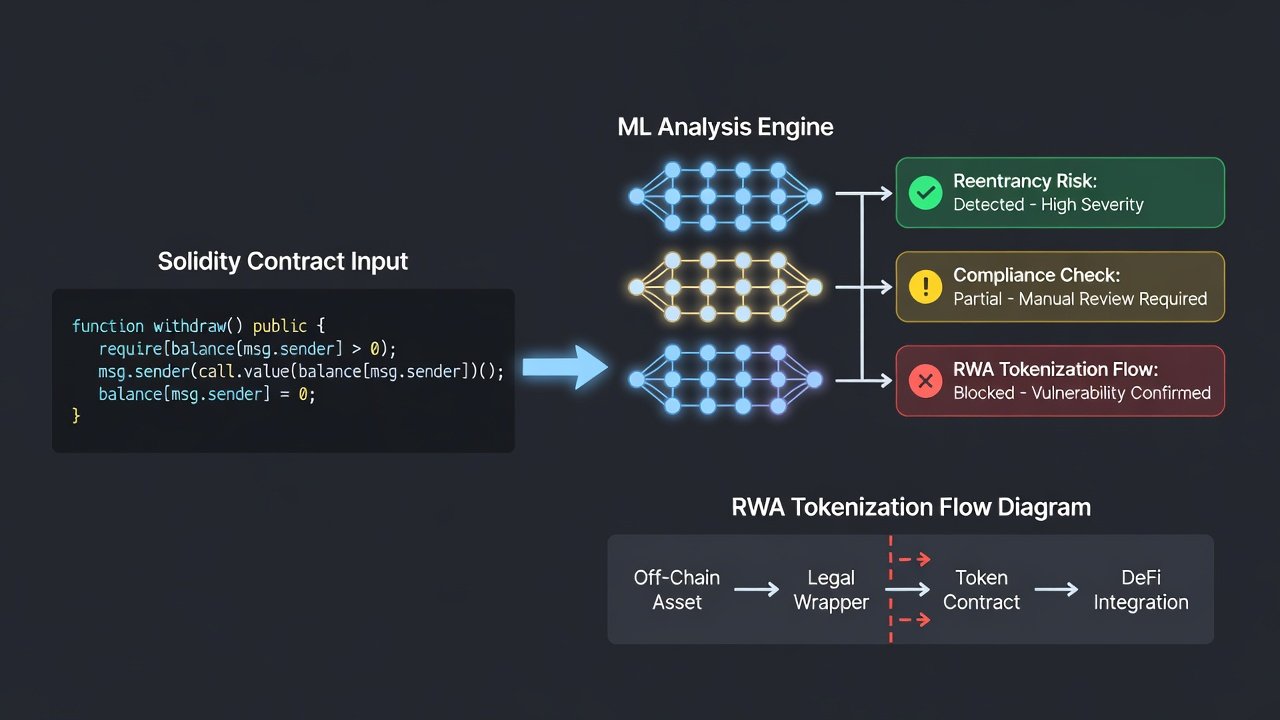
Start with a base ERC-4626 contract augmented with compliance hooks. Define a function that pauses operations on detected policy violations. Next, implement an ML inference step in the test harness that outputs calldata sequences designed to trigger reentrancy.
function testMLDrivenReentrancy() public {
    bytes memory attackPayload = mlModel.generateAdversarialInput(currentState);
    vm.startPrank(attacker);
    (bool success,) = address(vault).call(attackPayload);
    assertFalse(success);
    vm.stopPrank();
}
For ERC-1155, generate batch transfer tests that attempt to bypass per-asset compliance rules. Extend coverage by parameterizing tests over multiple L2 chain IDs and simulating message delays. Adversarial generation iterates over model outputs, mutating them slightly to increase coverage of edge cases like zero-balance deposits or invalid receiver contracts.
L2 Deployment Considerations
Deploying RWA contracts on L2 introduces unique considerations including sequencer behavior and cross-chain messaging delays. ML fuzzers should simulate delayed finality and forced transaction inclusion scenarios. Test storage consistency across optimistic and zero-knowledge rollups to ensure compliance logs remain verifiable. Specific chains like Arbitrum and Base require tailored test environments that account for their distinct gas metering and bridge security models.
Logging for Regulatory Audits and Tool Comparisons
Comprehensive logging captures every compliance decision and state transition using structured events. These logs must be exportable in machine-readable formats for external auditors. When comparing AI fuzzing against traditional tools, AI approaches reveal deeper reentrancy chains involving multiple contract hops. Traditional static analyzers miss dynamic state-dependent issues that ML models surface through targeted input generation.
Side-by-side evaluations on identical contract sets show AI fuzzing achieving higher detection coverage for regulated asset flows. Developers should maintain both tool categories in their pipeline for complementary strengths.
Mistakes to Avoid When Implementing AI Fuzz Testing
- Training models on insufficiently diverse datasets that omit recent exploit variants.
- Neglecting to validate generated inputs against actual contract ABIs before CI execution.
- Ignoring L2-specific gas and timing differences during benchmarking.
- Storing sensitive compliance data in unprotected storage slots.
- Failing to version control both model weights and test generation scripts.
Practical Checklist for Secure RWA Flows
- Validate ML model training data against latest exploit databases.
- Integrate fuzzing into every CI stage with automated reporting.
- Optimize storage layouts for both gas efficiency and audit readability.
- Simulate full L2 latency and finality scenarios in test suites.
- Implement tamper-evident logging for all regulatory events.
- Run comparative benchmarks between AI and conventional fuzzers quarterly.
FAQ
How does AI improve over traditional fuzzing? AI generates context-aware inputs that target regulatory and reentrancy patterns more efficiently by learning from real exploit data rather than relying on random mutation.
What L2 chains are recommended for RWA tokenization? Arbitrum and Optimism provide mature tooling and proven security for ERC-4626 deployments with reliable cross-chain messaging support.
Where to find authoritative Solidity references? Consult Solidity documentation and Foundry Book for up-to-date implementation guidance and best practices.
No comments yet. Be the first!