 CryptoChain Blog
Introduction to Token Burns in 2026 Crypto Markets
As the cryptocurrency landscape evolves into 2026, token burns have emerged as a critical factor influencing long-term holder value in major layer-1 blockchains. Solana (SOL) and Avalanche (AVAX) both employ deflationary mechanisms that reduce circulating supply over time, potentially enhancing scarcity and supporting price appreciation for dedicated investors. This article examines these dynamics through supply schedules, real-world burn data patterns, and their interplay with staking rewards and DeFi utility. Token burns serve as a counter to inflationary token issuance, creating a net deflationary pressure that rewards patient holders who maintain positions across market cycles.
Understanding these elements helps investors build resilient altcoin portfolios amid market volatility. Token burns interact with inflationary pressures from staking emissions, creating a net effect that determines whether holdings appreciate in real terms. Beyond basic price speculation, the mechanics of burns influence everything from transaction economics to ecosystem growth incentives, making them essential for anyone evaluating SOL or AVAX as core holdings.
Solana Tokenomics and Burn Mechanisms
Solana's fee-burning model prioritizes network efficiency while introducing deflation. Transaction fees are partially burned, directly reducing the SOL supply. This mechanism scales with network activity, meaning high usage periods accelerate scarcity. In contrast to fixed schedules, Solana's burns are usage-driven, rewarding holders during bull markets or DeFi surges. The protocol's high throughput enables thousands of transactions per second, which in turn can lead to substantial cumulative burns when decentralized applications see heavy engagement.
Staking rewards on Solana provide yields that offset any residual inflation, but burns add a counterbalancing force. Long-term holders benefit when burn rates exceed new issuance from validator incentives. Supply schedules on Solana follow a disinflationary path overall, with burns acting as an additional accelerator toward lower total supply. For example, periods of intense meme coin trading or NFT minting on the network have historically demonstrated how burns can remove meaningful percentages of daily issuance.
Real-Time Burn Data Examples in Solana
On-chain observers track SOL burns through public explorers that aggregate fee data across validators. During high-activity windows, daily burns can represent a notable fraction of new tokens entering circulation from staking rewards. This dynamic encourages holders to stake rather than sell, as the combined yield plus scarcity effect compounds value over multi-year horizons. Investors monitoring these metrics often adjust exposure based on whether burns are trending upward alongside transaction counts.
Avalanche Tokenomics and Burn Mechanisms
Avalanche incorporates burns through its transaction fee structure and subnet economics. A portion of fees is burned, contributing to AVAX scarcity, while the platform's multi-chain design allows for flexible utility across DeFi and gaming applications. Supply schedules emphasize gradual reduction tied to economic activity rather than aggressive halving events. Subnets can implement custom fee models, some of which direct additional burns back to the primary AVAX token, amplifying the deflationary impact across the broader ecosystem.
AVAX staking offers competitive yields, yet burns play a pivotal role in maintaining holder value by curbing excess supply growth. The network's consensus mechanism and primary network fees create consistent burn pressure even during moderate usage periods, providing a steadier scarcity signal compared to burstier models.
Real-Time Burn Data Examples in Avalanche
Similar to Solana, Avalanche burns are visible via blockchain analytics tools that display fee distributions. Subnet launches and cross-chain DeFi activity often correlate with spikes in burned AVAX, illustrating how ecosystem expansion directly benefits token holders through reduced supply. Long-term participants review these patterns to assess whether the network's growth trajectory supports sustained deflation.
Side-by-Side Inflation and Burn Rate Comparison
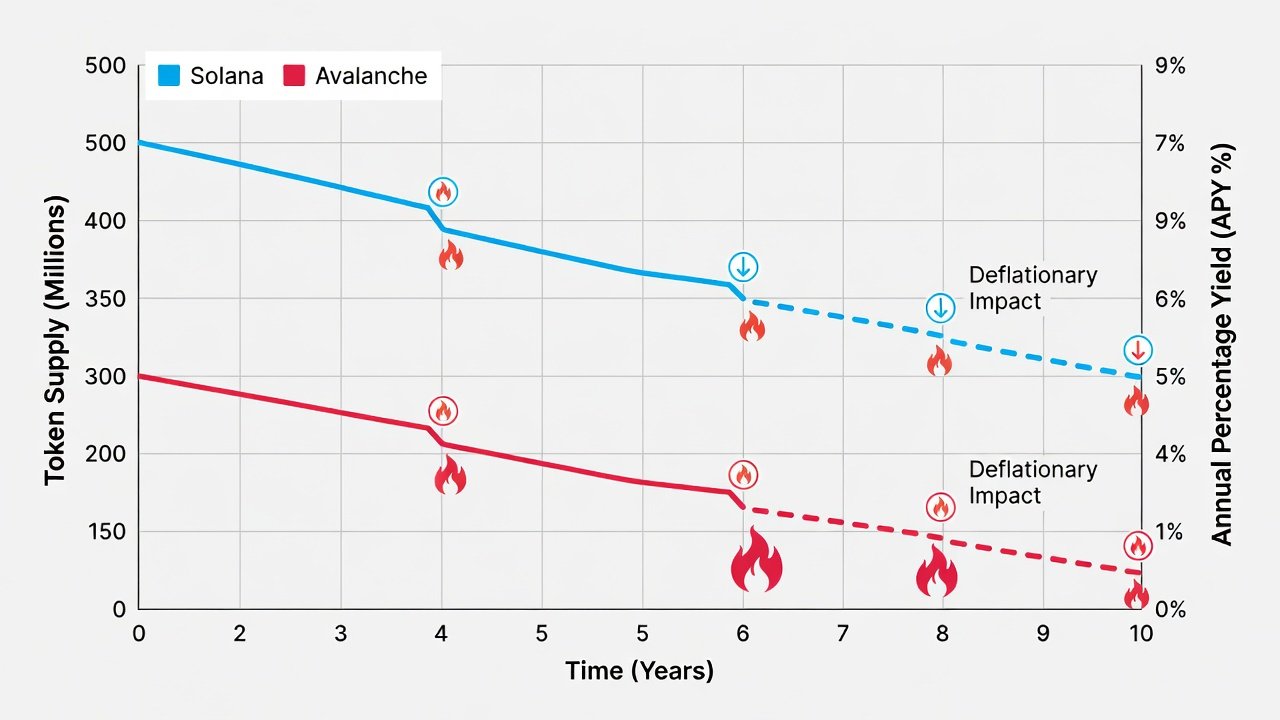
Comparing the two reveals distinct profiles. Solana's high-throughput design often leads to elevated burn volumes during peak usage, while Avalanche's modular architecture supports steadier but lower-volume burns. Both projects balance these against staking emissions to achieve net deflationary trends in active periods. Real-time examples from on-chain analytics illustrate how daily burns fluctuate with transaction volumes, directly impacting projected supply curves through 2026 and beyond.
Side-by-side analysis shows Solana potentially achieving faster scarcity in high-adoption scenarios due to its speed, whereas Avalanche offers more predictable burn accumulation across diverse use cases like institutional subnets. Inflation comparisons highlight that both chains aim for eventual net reduction in supply when burns consistently outpace rewards, though the timing and magnitude differ based on usage intensity.
Impact on Long-Term Holder Value
Burns enhance scarcity, which can amplify value for holders who stake consistently. When combined with DeFi utility—such as lending SOL or AVAX in protocols—the reduced supply creates compounding effects. However, this value accrual depends on sustained network adoption. Over multi-year periods, the interaction between burns and staking can transform a simple hold into a yield-generating position with built-in supply contraction.
Long-term holders also gain from secondary effects, including improved token velocity control and stronger incentives for developers to build on networks with visible deflationary trends. This positions both SOL and AVAX favorably against purely inflationary alternatives in diversified portfolios.
Practical Holding Strategies and Scenarios
Investors can implement several approaches to capitalize on these mechanics. One scenario involves allocating to both assets proportionally and rebalancing quarterly based on observed burn-to-issuance ratios. Another focuses on maximizing staking participation while holding through volatility, allowing burns to gradually enhance per-token value.
Step-by-Step Yield and Scarcity Modeling
- Review historical burn data from network explorers to establish baseline trends.
- Calculate net supply change by subtracting estimated burns from staking emissions.
- Factor in DeFi yields from lending or liquidity provision on top of base staking returns.
- Simulate multi-year outcomes under low, medium, and high adoption scenarios.
- Adjust portfolio weights if one chain demonstrates consistently superior burn dynamics.
These steps help quantify the advantage of holding through cycles rather than trading frequently.
Risk Assessments for Altcoin Portfolios
While burns support value, risks remain. Reduced network activity could slow burn rates, diminishing the scarcity effect. Regulatory developments or technical issues might also impact adoption and therefore burn volumes. Portfolio risk assessments should include stress tests for scenarios where staking participation drops or competing chains capture market share.
Diversification across SOL and AVAX reduces single-chain exposure, while maintaining liquidity reserves allows opportunistic additions during dips. Monitoring governance proposals that could alter fee structures or burn allocations provides an early warning system for mechanism changes.
Conclusion
Token burns represent a powerful lever for long-term value in Solana and Avalanche ecosystems. By understanding their interaction with staking and utility, investors position themselves for scarcity-driven gains. Data-driven monitoring remains essential for optimizing altcoin strategies in 2026. For further reference, explore official resources at Solana and Avalanche to stay updated on evolving tokenomics.
No comments yet. Be the first!