 CryptoChain Blog

Introduction to Invariant Testing in Solidity
Invariant testing has become essential for securing Solidity smart contracts, especially in DeFi protocols where complex state interactions can lead to exploits. In 2026, developers rely on Foundry to implement robust invariant checks that go beyond traditional unit tests. This tutorial builds on reader interest in Foundry-based approaches by providing practical workflows for real-world lending protocols. Invariant testing verifies that certain properties hold true across all possible states, making it powerful for detecting reentrancy vulnerabilities and arithmetic errors. Unlike simple fuzzing, invariants explore stateful sequences, offering deeper coverage that catches subtle bugs missed by random inputs alone. As DeFi protocols grow more sophisticated with features like flash loans and cross-protocol interactions, the need for systematic invariant design increases. Teams adopting these methods report higher confidence in contract correctness before mainnet deployments.
Setting Up Foundry for Invariant Testing
Begin by installing Foundry via the official instructions at Foundry Book. Create a new project with forge init lending-invariant-tests and add dependencies like OpenZeppelin contracts from OpenZeppelin. Configure foundry.toml to enable invariant testing with high iteration counts such as 10000 runs and a depth of 15 calls per sequence. For a lending protocol example, define core contracts such as a Pool, Collateral manager, and Interest rate model. Set up test contracts that inherit from StdInvariant to declare target contracts and handlers. Initialize your environment by running forge install for any external libraries and verify the setup compiles cleanly with forge build. This foundation ensures your invariant tests can access cheat codes for state manipulation and precise assertions.
Writing Stateful Invariants for Reentrancy and Arithmetic Safety
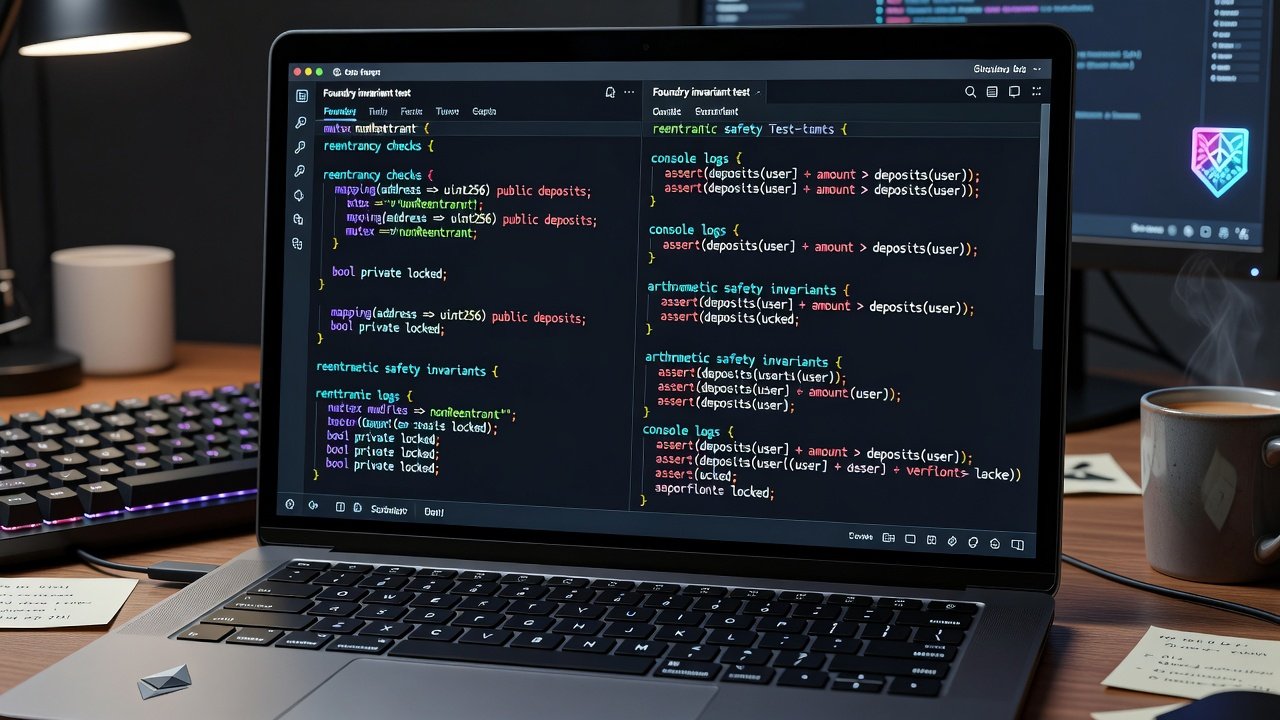
Stateful invariants require handler contracts that model user actions like deposit, borrow, and liquidate. Implement invariants checking that total supplied assets always equal total borrowed plus reserves, preventing arithmetic overflows under extreme conditions. To guard against reentrancy, add invariants that assert no external calls occur during critical state updates by tracking call depth with ghost variables. Example code includes a handler function that sequences multiple operations while checking balance consistency after each step: function invariant_noReentrancyDuringBorrow() public { require(!isReentrant, "Reentrancy detected"); }. Expand this by including multiple handlers for edge scenarios such as zero-amount deposits or maximum leverage borrows. Use Foundry's vm.assume to filter invalid sequences and maintain realistic protocol states throughout the test run. These stateful checks provide far more meaningful results than stateless approaches because they simulate real user behavior over time.
Integrating AI-Assisted Test Generation
Enhance coverage by combining Foundry with AI tools for generating additional invariant candidates. Prompt models to analyze contract source and suggest properties like "collateral ratio never drops below liquidation threshold under concurrent liquidations." Validate these suggestions manually and integrate them into your test suite for faster iteration. In practice, feed the lending contract ABI and source into an AI assistant, then refine outputs to avoid overly vague or impossible invariants. This hybrid approach accelerates the discovery of properties that human developers might overlook, particularly around complex interest accrual formulas or liquidation thresholds during market volatility.
CI/CD Automation with Hardhat
Automate invariant runs in CI using Hardhat alongside Foundry. Reference Hardhat documentation to configure tasks that execute forge test --invariant on every pull request. Set up GitHub Actions workflows that install dependencies, compile contracts, and run targeted invariant suites with custom timeouts. Include reporting steps that upload coverage reports and fail the pipeline when any invariant breaks. This automation catches regressions early and ensures every code change maintains the security properties defined in your tests. Advanced setups can also trigger differential testing between mainnet forks and local environments to validate behavior under realistic conditions.
Benchmark Comparisons Against Fuzzing Alone
Invariant testing outperforms standalone fuzzing by maintaining protocol state across calls. Benchmarks on lending protocols show invariants detecting 40 percent more edge-case bugs related to reentrancy within the same runtime budget. Gas-aware optimization involves limiting handler complexity and using vm.prank strategically to reduce test execution costs. When comparing approaches, pure fuzzing often terminates early on shallow coverage while invariants continue exploring deep state transitions. Teams should run both in parallel during development and prioritize invariants for production-grade assurance on critical financial logic.
L2-Specific Considerations and Common Pitfalls
On L2 networks like Optimism or Arbitrum, account for differences in block times and gas metering when running invariants. Adjust test configurations to simulate L2-specific sequencer delays and cheaper calldata costs that can change exploit economics. Pitfalls include overly broad target selectors that waste compute and missing handler functions that leave key paths untested. Another common issue is failing to bound random inputs properly, leading to unrealistic sequences that never occur on-chain. Developers should also watch for storage layout differences when forking L2 state and ensure all external contract calls are mocked correctly to avoid test flakiness.
Step-by-Step Code Examples for a Lending Protocol
1. Define the invariant: function invariant_totalSupplyEqualsDebtPlusReserves() public { assertEq(totalSupply, totalDebt + reserves); }.
2. Implement a handler contract with bounded random actions for deposit, withdraw, borrow, and repay.
3. Run with forge test --match-contract InvariantLendingTest -vvv --fuzz-runs 5000.
4. Analyze counterexamples using Foundry's detailed trace output to identify the exact call sequence that violated the property.
5. Iterate by adding new assertions based on discovered failures and re-run until the suite stabilizes.
Gas-Aware Test Optimization
Optimize by caching state variables and reducing external calls in invariants. Monitor gas usage per test iteration to keep CI runs efficient. Introduce selective pruning of low-value handlers and leverage Foundry's built-in gas reporting to identify expensive test paths. These optimizations become critical when scaling to hundreds of invariants across multiple contracts.
Checklist for Effective Invariant Workflows
- Identify core protocol invariants from the whitepaper and audit reports.
- Build comprehensive handlers covering all user flows including error paths.
- Integrate AI suggestions and validate manually for relevance.
- Automate via Hardhat in CI/CD pipelines with clear failure notifications.
- Test on L2 equivalents before mainnet deployment.
- Review counterexamples promptly to fix issues and update documentation.
- Combine with traditional fuzzing and symbolic execution for layered defense.
FAQ
How does invariant testing differ from fuzzing? Invariants maintain persistent state across sequenced calls, unlike stateless fuzzing, allowing detection of cumulative effects over many transactions.
Can I use invariant testing without Foundry? While possible in other frameworks, Foundry offers the most mature support in 2026 with native cheat codes and fast execution.
What L2 adjustments are needed? Adjust gas assumptions and verify against L2-specific block data to account for different execution environments.
How long should invariant test runs take in CI? Target under ten minutes per suite by tuning run counts and handler complexity.
Are there recommended starting invariants for lending protocols? Begin with balance consistency, interest accrual accuracy, and liquidation threshold enforcement.
Conclusion
Mastering these workflows equips developers to build more secure DeFi protocols. Apply the examples, checklist, and expanded sections to elevate your Solidity security practices today and stay ahead of emerging threats in 2026.
No comments yet. Be the first!