 CryptoChain Blog

Introduction to ML-Augmented Fuzz Testing in 2026
Smart contract security remains a top priority for blockchain developers as the Ethereum ecosystem grows. Traditional fuzz testing in tools like Foundry has proven effective, but machine learning is transforming the process in 2026 by learning from historical exploits to generate smarter inputs and detect vulnerabilities faster. This article explores ML-enhanced fuzz testing for Solidity contracts, covering everything from model training to practical CI pipeline integration. As decentralized finance and NFT platforms handle increasing value, the need for robust testing grows exponentially, making ML integration not just beneficial but essential for staying ahead of sophisticated attackers.
Understanding Traditional Fuzz Testing in Foundry
Foundry provides robust fuzzing capabilities through its Forge tool, which generates random inputs to test contract functions. While effective, standard fuzzers often struggle with complex state spaces and rare edge cases in large contracts. Developers rely on invariants and assertions, yet coverage gaps persist without intelligent guidance. For instance, a basic ERC-20 token contract might pass thousands of random calls but still harbor logic errors in edge-case transfer scenarios that only appear under specific sequence conditions.
How Machine Learning Enhances Fuzz Testing
Machine learning models trained on past vulnerabilities can predict likely exploit patterns. By analyzing datasets of known Solidity bugs from sources like the Ethereum Foundation, these models prioritize seed inputs that target high-risk areas such as reentrancy or integer overflows. This leads to higher bug detection rates compared to random mutation strategies. Reinforcement learning components allow the system to adapt dynamically during test runs, rewarding inputs that increase code coverage or trigger assertions.
Model Training on Historical Exploits
Training begins with curating datasets from public exploit repositories and audit reports. Features extracted include opcode sequences, function signatures, and gas usage patterns. In 2026, frameworks like TensorFlow or PyTorch are commonly used to build classifiers that score input seeds by exploit probability. Continuous retraining on new incidents ensures models stay current. Data preprocessing steps involve tokenizing Solidity source code and labeling successful exploits versus benign transactions, creating balanced training sets that improve model precision over time.
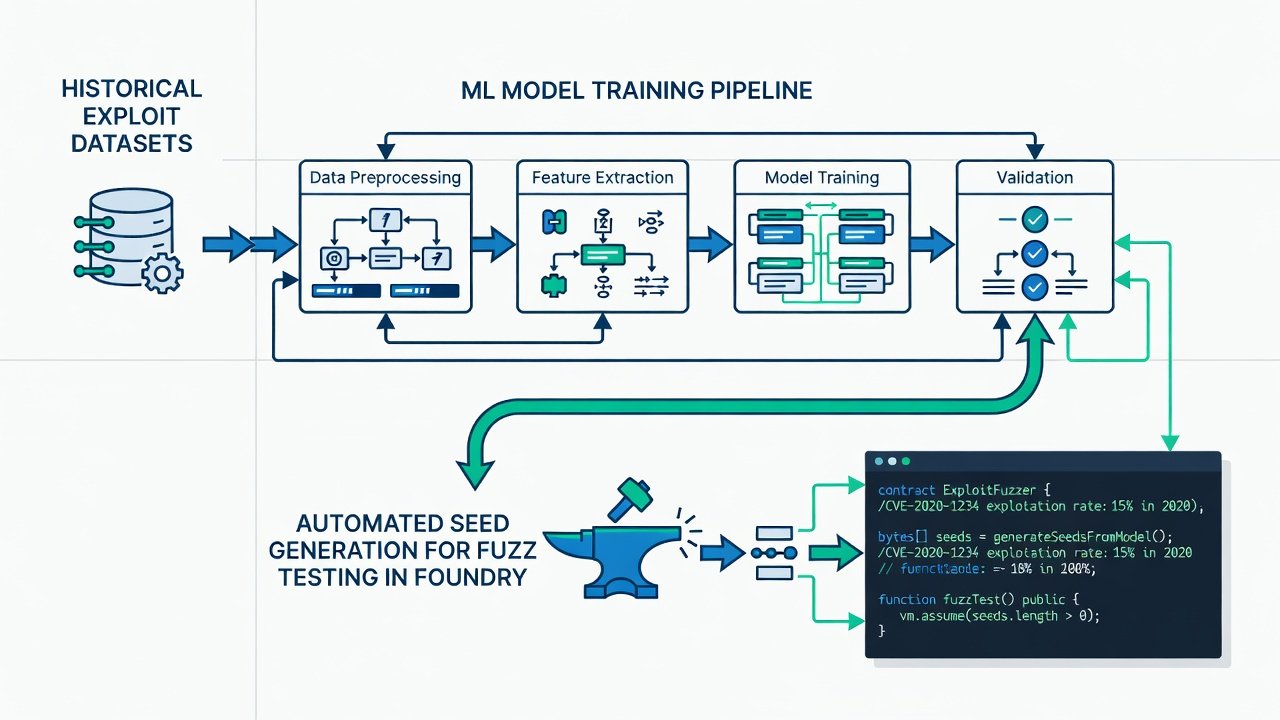
Automated Seed Generation Techniques
ML models generate initial seeds by mutating legitimate transaction data. Reinforcement learning agents further refine these seeds based on coverage feedback from Foundry runs. This automation reduces manual seed crafting time and uncovers deeper bugs in contract logic. For example, an agent might learn to craft sequences involving multiple contract interactions that simulate complex DeFi flash loan attacks, something random fuzzers rarely achieve efficiently.
Step-by-Step Setup for ML-Enhanced Fuzzing
- Install Foundry and required ML libraries such as scikit-learn or Hugging Face transformers for NLP-based code analysis.
- Prepare a dataset of historical exploits in JSON format, including details like vulnerable code snippets and exploit transaction traces.
- Train a simple neural network or decision tree ensemble to classify high-risk inputs, validating against a held-out test set for accuracy above 85 percent.
- Integrate the model output as custom fuzzing hooks in Forge scripts using Python bindings or external oracles.
- Run tests and iterate on model accuracy using coverage metrics from Foundry's built-in reporting tools.
- Implement logging to track seed effectiveness and feed results back into the training loop for continuous improvement.
Integration with CI Pipelines
Embedding ML fuzzers into GitHub Actions or GitLab CI allows automated security checks on every pull request. Scripts trigger model inference to select seeds, then execute Foundry tests and report findings. This workflow catches issues early in development cycles. Teams often configure thresholds so that only high-confidence vulnerabilities block merges, balancing security with development velocity.
Benchmark Comparisons Against Standard Fuzzers
Recent evaluations show ML-enhanced fuzzers achieving 30-50% higher coverage on complex DeFi contracts than vanilla Forge fuzzing. They also reduce time-to-bug-discovery by focusing on probable attack vectors first. Comparisons often highlight improved detection of access control flaws. In controlled tests on popular open-source contracts, ML variants found twice as many medium-severity issues within the same runtime budget.
Real Contract Case Studies
Consider a lending protocol audited in early 2026 where ML-guided fuzzing identified a subtle flash loan vulnerability missed by standard tests. The model flagged unusual collateral liquidation sequences that led to an under-collateralized state. Another case involved an NFT marketplace contract where automated seeds exposed an underflow issue during batch transfers, leading to a quick patch before deployment. A third example from a yield aggregator showed the ML approach surfacing a reentrancy vector in a reward distribution function after just 15 minutes of targeted fuzzing, whereas traditional methods required hours.
Gas Optimization Findings from ML Fuzzing
Beyond security, these tools surface inefficient code paths. By exploring extreme inputs, developers identify functions with unexpectedly high gas costs, enabling optimizations that lower transaction fees for users. In one project, ML fuzzing revealed a loop that could be unrolled, saving an estimated 20 percent in average gas usage across common operations.
Addressing Common False Positives
ML models can flag benign inputs as threats. Mitigation involves threshold tuning and post-processing filters that validate alerts against actual contract state changes. Regular human review of flagged cases improves long-term accuracy. Teams document these reviews to refine future model versions and reduce noise in reports.
Tools and Libraries Recommended for 2026
Popular choices include integrating Foundry with Python-based ML pipelines using libraries like NumPy for data handling and ONNX for model export. The official Foundry book at Foundry documentation provides hooks for external oracles. Additional options encompass custom Solidity analyzers combined with scikit-learn for classification tasks.
Common Pitfalls and How to Avoid Them
- Overfitting models to specific exploit types—counter this with diverse training data.
- Ignoring gas limits during seed generation—always simulate realistic EVM constraints.
- Neglecting model updates—schedule quarterly retraining sessions.
- Underestimating integration complexity—start with modular scripts before full CI embedding.
Practical Tips for Developers
- Start with small models and expand datasets gradually to avoid resource bottlenecks.
- Combine ML seeds with Foundry's built-in cheatcodes for hybrid testing that maximizes strengths of both approaches.
- Monitor model drift and retrain quarterly using fresh audit data from sources like Consensys security resources.
- Document all findings to build internal knowledge bases that accelerate future projects.
- Share anonymized exploit data with the community via platforms like Solidity documentation resources.
- Test on both mainnet-forked environments and local testnets to validate real-world applicability.
Conclusion
ML-enhanced fuzz testing represents a significant leap forward for securing Solidity contracts in 2026. By leveraging historical data and intelligent automation, developers achieve stronger guarantees with less manual effort. Adopting these techniques positions teams to build more resilient decentralized applications that withstand evolving threats.
FAQ on Scaling These Workflows
How much data is needed to train effective models?
Effective starting datasets contain several thousand labeled exploit examples, with ongoing augmentation from new audits to maintain relevance.
Can this approach work for non-Ethereum chains?
Yes, the principles transfer to other EVM-compatible environments with adjusted feature extraction for chain-specific opcodes.
What hardware is recommended for training?
Modern GPUs accelerate training, but CPU-based setups suffice for smaller proof-of-concept models used in individual developer workflows.
How do you handle proprietary contract code?
Use on-premise training pipelines to keep sensitive data secure while still benefiting from ML guidance during local test runs.
What metrics should teams track for success?
Key metrics include code coverage percentage, number of unique bugs found per hour, and reduction in false positive rate over successive model iterations.


No comments yet. Be the first!