 CryptoChain Blog

Introduction to Decentralized Compute Networks in 2026
Decentralized compute networks have emerged as a cornerstone of Web3 scalability, enabling developers to access distributed resources without relying on centralized cloud providers. As blockchain ecosystems expand rapidly, platforms like Akash, Render, and iExec offer compelling alternatives that prioritize cost efficiency, uptime, and censorship resistance. In 2026, the demand for scalable infrastructure continues to grow alongside the proliferation of decentralized applications, AI integrations, and data-intensive protocols. This article examines 2026 benchmarks in depth, focusing on performance metrics, tokenomics, and real-world integrations to help developers evaluate solutions for scalable Web3 innovations. By exploring practical examples and detailed comparisons, readers can make informed decisions about adopting these networks for their projects.
Overview of Leading Platforms
Akash Network operates as a decentralized marketplace for cloud computing, leveraging Kubernetes for container orchestration and allowing providers to offer unused capacity in a peer-to-peer manner. This approach creates a flexible environment suitable for a wide range of workloads. Render Network specializes in GPU-intensive tasks such as rendering, 3D modeling, and AI training workloads, connecting artists and developers directly with GPU owners worldwide. iExec provides a blockchain-based platform for confidential computing and oracles, enabling secure off-chain computations that integrate seamlessly with smart contracts. Together, these networks address the growing demand for Web3 infrastructure that scales beyond traditional data centers while maintaining transparency through on-chain governance and incentives.
2026 Performance Metrics Comparison
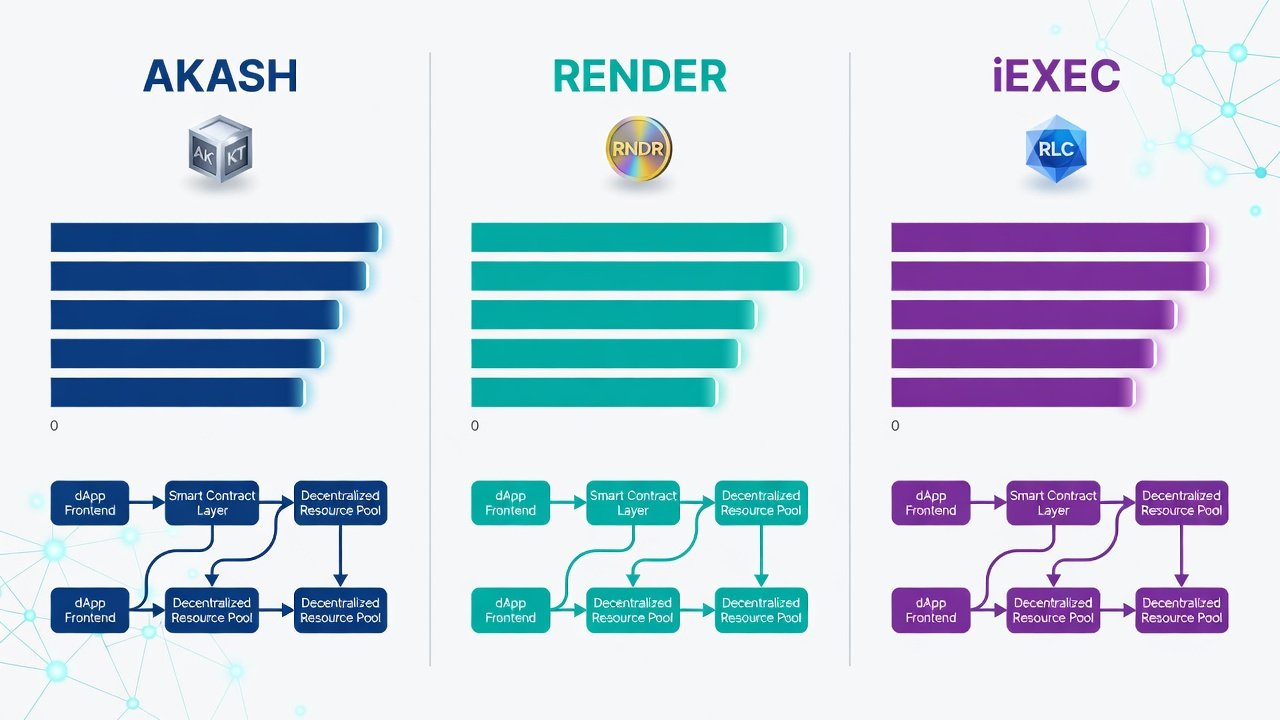
Benchmarks from late 2026 highlight key differences across the platforms. Akash demonstrates strong throughput for general-purpose workloads, achieving consistent uptime above 99.5 percent across distributed nodes with support for multi-region deployments. Render excels in parallel processing for graphics and machine learning, with latency reductions reported in high-demand periods due to its specialized GPU marketplace. iExec stands out in secure execution environments, supporting trusted execution environments that minimize data exposure during computations. Developers should consider workload type when selecting a platform, as metrics vary significantly by use case. Additional factors include network throughput under peak loads and compatibility with popular frameworks like Docker and TensorFlow.
Tokenomics and Economic Models
Each platform employs native tokens to incentivize participation and maintain network health. Akash uses AKT for payments, staking, and governance, fostering a vibrant provider ecosystem that rewards reliable resource contributions. Render's RNDR token facilitates GPU rentals with mechanisms that reward high-quality render nodes through usage-based distributions. iExec's RLC token supports resource trading, oracle services, and confidential task execution. In 2026, these models emphasize sustainable yields through staking rewards and usage fees, aligning incentives between providers and consumers. Economic sustainability also depends on token utility in governance decisions, which helps adapt the networks to evolving Web3 requirements such as increased AI workloads or cross-chain compatibility.
dApp Integrations and Real-World Case Studies
Several Web3 projects have migrated workloads successfully, providing concrete evidence of the platforms' value. A decentralized gaming studio shifted rendering tasks to Render, achieving substantial cost reductions and improved uptime during peak events by leveraging global GPU providers. An AI-driven DeFi protocol integrated iExec for confidential computations, enhancing data privacy while maintaining scalability across multiple chains. Akash has supported storage-heavy dApps migrating from centralized hosts, resulting in greater resilience against outages and better alignment with decentralized principles. Another example involves a metaverse platform that combined Akash for backend services and Render for visual assets, demonstrating how hybrid approaches can optimize performance. These cases illustrate tangible benefits in both operational savings and system reliability for growing Web3 ecosystems.
Step-by-Step Migration Guides
Migrating to decentralized compute involves careful planning to ensure smooth transitions. First, audit current workloads to identify compatible tasks such as rendering, batch processing, or secure data analysis. Second, select the platform based on metrics like latency tolerance and hardware requirements. Third, deploy smart contracts or containers using provided SDKs and documentation, starting with small test deployments. Fourth, test in a staging environment to validate performance, security, and cost implications under realistic conditions. Fifth, monitor via dashboards and optimize token usage through automated scripts. Sixth, scale gradually while maintaining fallback options. Following these steps minimizes disruption during transition and allows teams to address issues early in the process.
Security Checklists for Developers
- Verify node reputation and encryption standards before deployment to avoid compromised resources.
- Implement multi-signature wallets for token management and limit exposure through role-based access controls.
- Conduct regular audits of smart contract interactions and integrate with established security tools.
- Enable confidential computing features where available, such as on iExec, to protect sensitive data.
- Establish backup providers to handle potential node failures and ensure redundancy.
- Monitor for anomalous activity using on-chain analytics and set up alerts for unusual token movements.
- Educate team members on best practices for handling private keys and network configurations.
ROI Calculations and Cost Considerations
Return on investment varies with usage patterns and project scale. Projects report qualitative gains through reduced operational overhead and higher availability compared to traditional providers. Factors include token price stability, network fees, and workload volume. Developers should model scenarios based on current Web3 trends, factoring in staking yields and potential savings from distributed resources. For instance, teams handling variable demand benefit from pay-per-use models that avoid over-provisioning. Long-term ROI also improves when networks demonstrate resilience during market fluctuations, allowing consistent service delivery without centralized single points of failure.
Addressing Common Pitfalls
Latency issues often arise in geographically dispersed networks; mitigation includes selecting providers in optimal regions and using caching strategies. Token volatility can impact budgeting—strategies like hedging or stablecoin pairings help stabilize costs over time. Other challenges involve integration complexity, addressed through community documentation, gradual rollouts, and participation in developer forums. Network congestion during high-traffic periods may require prioritizing critical tasks. Awareness of these pitfalls enables smoother adoption and helps teams build more robust decentralized applications that perform reliably at scale.
Innovations Shaping the Decentralized Web
Advancements in 2026 include improved interoperability protocols that allow seamless resource sharing across multiple chains. Platforms are integrating zero-knowledge proofs for enhanced privacy without sacrificing performance. AI-optimized resource allocation is becoming standard, enabling dynamic matching of workloads to the most efficient nodes. Exploration of layer-2 solutions for faster settlements and reduced fees continues to evolve the ecosystem. These innovations position decentralized compute as a foundation for next-generation Web3 applications, including advanced metaverses, decentralized AI training, and real-time data processing at global scale.
Conclusion
Decentralized compute networks like Akash, Render, and iExec provide robust pathways to Web3 scalability in 2026. By understanding detailed benchmarks, following comprehensive migration steps, and applying security best practices, developers can unlock meaningful cost savings and reliability gains. Continued innovation promises even greater potential for the decentralized web, empowering a new wave of scalable and resilient applications.
FAQ
What are the main advantages of decentralized compute over traditional cloud?
Key benefits include lower costs through competitive marketplaces, censorship resistance via distributed nodes, and improved uptime through geographic redundancy, as demonstrated in multiple 2026 migrations.
How do I choose between Akash, Render, and iExec?
Evaluate based on workload specifics: Akash for general-purpose and containerized compute, Render for GPU-heavy rendering and AI tasks, and iExec for confidential or oracle-supported applications.
Are there risks with token volatility?
Yes, price fluctuations can affect operational costs, but mitigation through diversified payments, staking strategies, and monitoring tools reduces exposure effectively.
What security measures are essential?
Node verification, encryption protocols, regular audits, and redundancy planning form the core checklist for safe deployments.
Can these platforms handle enterprise-level workloads?
Yes, with proper configuration and scaling, many projects have successfully migrated complex dApps while maintaining high performance standards.

No comments yet. Be the first!