 CryptoChain Blog

Introduction to Web3 Autonomous Agents in 2026
The decentralized web continues to evolve at an unprecedented pace in 2026, driven by the rise of autonomous agents that operate independently across blockchain ecosystems. These AI-powered entities go far beyond simple scripts or centralized bots by executing sophisticated tasks such as dynamic asset management, cross-protocol interactions, and real-time decision-making without requiring ongoing human intervention. Built on decentralized infrastructure, they combine machine learning models with blockchain primitives to handle complexity that traditional Web3 tools struggle to address. For developers, investors, and enterprises seeking cutting-edge innovations, understanding autonomous agents offers practical pathways to adoption that can transform operations in DeFi, supply chains, and beyond. This article delves deeply into their mechanics, real-world applications, and implementation strategies to help readers navigate this emerging landscape effectively.
Autonomous agents represent a natural progression from earlier automation attempts in Web3. They address pain points like manual oversight in smart contract interactions and reliance on centralized oracles by embedding intelligence directly into decentralized networks. As adoption grows, these agents promise to unlock new efficiencies while raising important questions around governance and risk management.
Integration with Smart Contracts and Oracles
Seamless integration with smart contracts forms the backbone of autonomous agent functionality. Agents can read contract states, propose transactions, and execute calls autonomously when conditions are satisfied through predefined logic. Oracles play a critical role by supplying verified external data, such as price feeds, weather conditions, or shipment statuses, that smart contracts cannot access natively. For example, an agent monitoring a lending protocol might use an oracle to detect collateral value drops and automatically initiate liquidation processes to protect lenders.
Advanced integrations often involve multi-signature approvals and event-driven triggers that allow agents to operate across multiple blockchains. Developers benefit from standardized interfaces that support Ethereum Virtual Machine compatibility and emerging layer-2 networks. This setup reduces friction in decentralized applications and enables agents to respond in milliseconds to market shifts, far surpassing manual or semi-automated alternatives. The combination fosters trustless environments where data integrity and execution reliability are maintained through cryptographic proofs and consensus mechanisms.
Real-World Case Studies from DeFi and Supply Chains
In decentralized finance, autonomous agents have demonstrated tangible value through yield optimization strategies. Consider an agent deployed on a major protocol that continuously evaluates lending rates across platforms, reallocating user funds to maximize returns while dynamically adjusting for impermanent loss risks. Another DeFi example involves agents that manage options trading positions by hedging against volatility using oracle-fed market data, resulting in more stable portfolio performance during turbulent periods.
Supply chain applications showcase agents coordinating physical and digital workflows. An agent integrated with IoT sensors can track goods in transit, verify delivery milestones via oracles, and release escrow payments only upon successful confirmation. This eliminates intermediaries and reduces disputes. Additional case studies from logistics platforms highlight agents that predict delays using historical on-chain data and reroute shipments accordingly. These implementations underscore improvements in transparency and speed. Ethereum Foundation resources provide further context on decentralized finance architectures supporting such innovations.
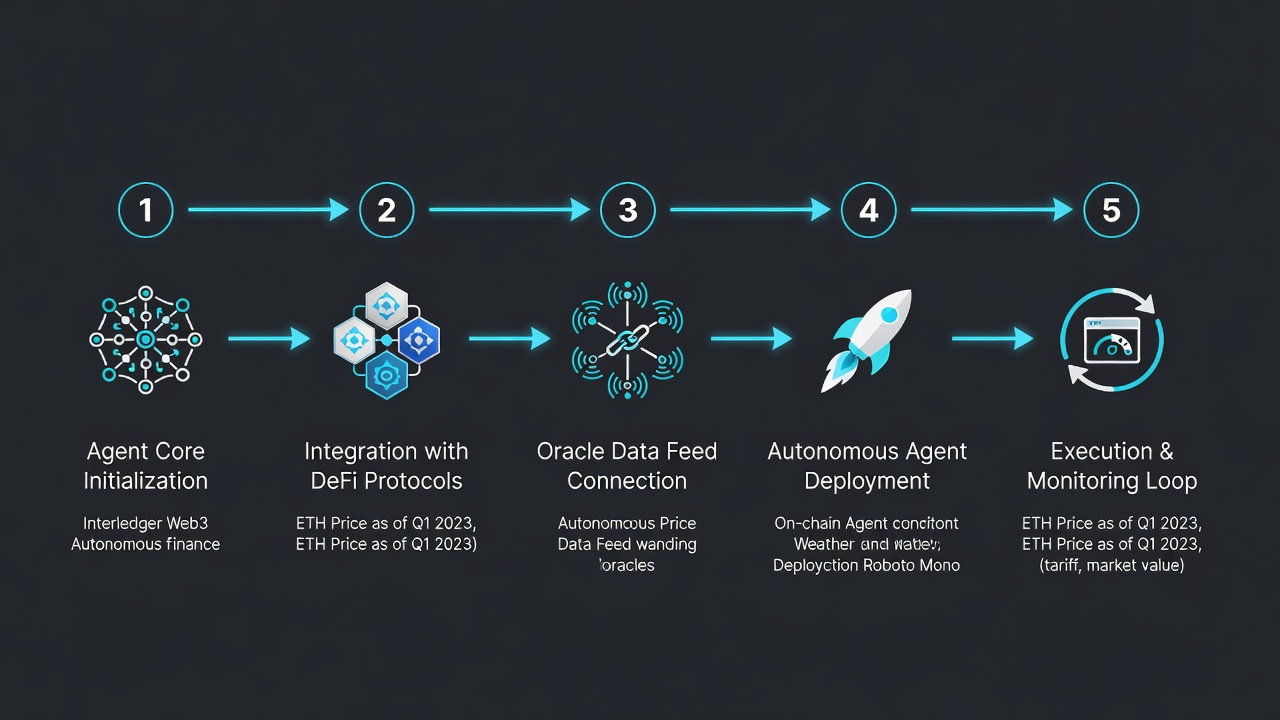
Step-by-Step Guide to Deploying a Basic Agent
Deploying an autonomous agent requires careful planning to ensure security and functionality. Begin by selecting a framework that supports both AI decision-making and blockchain connectivity, such as libraries compatible with Python or JavaScript environments. Next, outline the agent's objectives, including specific triggers, data sources, and fallback procedures.
- Establish a secure wallet and API connections for oracle access while configuring permissions to limit the agent's scope.
- Develop the core logic using conditional statements that reference smart contract events and external feeds.
- Implement testing protocols on testnets to simulate various scenarios, including edge cases like network congestion or oracle failures.
- Incorporate monitoring dashboards for real-time oversight of agent actions and performance metrics.
- Conduct a professional audit and gradually scale deployment from limited funds to full operations.
This methodical approach minimizes errors and supports iterative improvements based on observed behavior. Practical experience shows that starting small allows teams to refine agent parameters before broader rollout.
Comparisons with Traditional Automation Tools
Traditional automation tools typically depend on centralized servers and scheduled scripts that require constant maintenance and expose single points of failure. In contrast, Web3 autonomous agents leverage distributed networks for inherent resilience against censorship and downtime. They excel in environments demanding transparency, as every action is recorded immutably on-chain.
Key advantages include reduced operational costs over time and the ability to operate across trustless parties without intermediaries. However, traditional tools often offer simpler debugging and lower learning curves. Performance evaluations indicate that agents achieve superior responsiveness in volatile conditions, though they necessitate expertise in cryptography and decentralized protocols. Organizations must weigh these trade-offs based on their specific use cases and technical capabilities.
Security Best Practices and Expert Insights
Robust security practices are essential for safe agent deployment. Experts recommend implementing role-based access controls, regular smart contract audits, and encrypted communication channels with oracles. Limiting an agent's authority to read-only functions initially can prevent catastrophic exploits during early testing phases. Multi-party computation techniques further enhance protection against key compromises.
Insights from industry specialists highlight the importance of continuous monitoring and incident response plans tailored to decentralized systems. Performance metrics from production environments in 2026 demonstrate high reliability when these practices are followed, with agents maintaining consistent operation across extended periods. Chainlink documentation offers guidance on securing oracle integrations effectively.
Addressing Scalability Concerns: FAQ Section
How do autonomous agents handle high transaction volumes?
Agents leverage layer-2 solutions and optimistic rollups to process batches of transactions efficiently while minimizing base-layer congestion.
What are the main scalability bottlenecks?
Primary challenges include oracle response times and fluctuating gas fees, which can be mitigated through predictive scheduling and alternative data providers.
Are agents suitable for enterprise-level adoption?
With integrated governance modules and compliance features, agents support complex enterprise workflows across global supply chains and financial services.
How does agent autonomy impact regulatory compliance?
Built-in audit trails and configurable rules help align agent behavior with evolving regulations in different jurisdictions.
Conclusion
Web3 autonomous agents stand as a defining innovation for the decentralized web in 2026, extending automation capabilities well beyond conventional tools. Through thoughtful integration with contracts and oracles, detailed case study learnings, structured deployment processes, and rigorous security measures, stakeholders can harness their potential responsibly. Ongoing exploration and refinement will continue to drive adoption across industries. Additional references are available at Web3 Foundation for foundational decentralized technologies.

No comments yet. Be the first!