 CryptoChain Blog
Introduction to 2026 Scaling Challenges on Solana and Avalanche
Intermediate developers building decentralized applications in 2026 face intense pressure to deliver high-throughput experiences that can handle growing user bases and complex interactions. Solana and Avalanche L1 blockchains offer distinct advantages over other altcoins, but realizing their full potential requires moving beyond basic tutorials into advanced optimization strategies. This guide examines parallel transaction processing on Solana, subnet customization for AVAX, performance benchmarks against competing L1s, and practical implementation steps drawn from successful high-throughput projects that have already demonstrated results in production environments.
By focusing on actionable insights rather than theory, teams can reduce latency, lower operational friction, and choose the right chain for their 2026 roadmap while avoiding common architectural pitfalls that plague many early-stage deployments.
Parallel Transaction Processing on Solana
Solana’s Sealevel runtime enables true parallel execution of smart contracts, allowing multiple programs to run simultaneously when they do not share write access to the same accounts. In 2026, developers are leveraging Gulf Stream and Turbine improvements to push beyond 65,000 TPS under real-world conditions with careful program architecture. The key lies in minimizing account contention through deliberate state design and instruction batching.
Step-by-step tips include using PDA (Program Derived Addresses) with explicit account lists in every transaction, implementing optimistic concurrency checks before committing state changes, and batching instructions where dependencies allow. High-throughput dApps such as decentralized exchanges have demonstrated sustained performance by structuring state accounts to allow independent parallel writes across unrelated user positions. For example, one major Solana-based perpetuals protocol redesigned its margin accounts to separate per-user ledgers, resulting in dramatically higher concurrent order processing without runtime conflicts.
Developers should also monitor the scheduler’s behavior using Solana’s built-in metrics and consider adopting the latest version of the Anchor framework, which provides improved macros for declaring account dependencies. Testing with synthetic load generators helps surface hidden contention points before mainnet deployment.
Subnet Customization for Avalanche
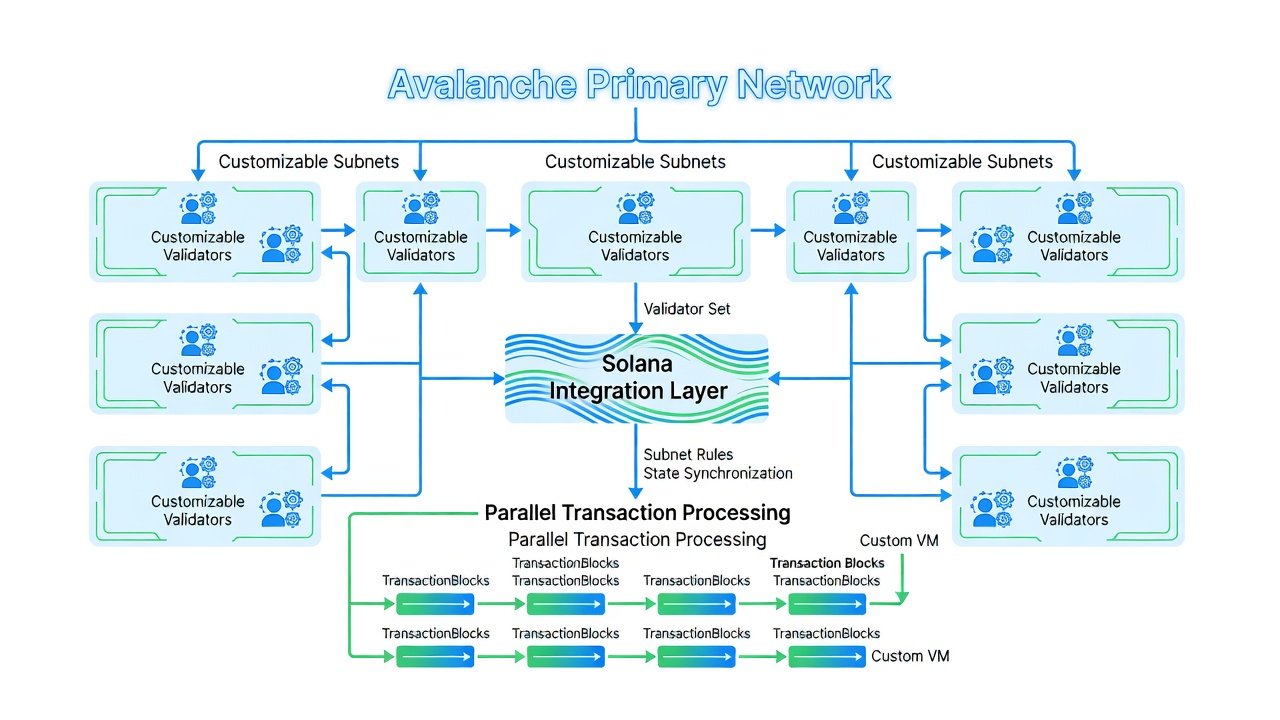
Avalanche subnets provide sovereign execution environments with customizable virtual machines, enabling teams to tune parameters that directly affect throughput and finality. In 2026, projects are deploying custom subnets that adjust block times, gas mechanics, and validator sets to match specific dApp workloads ranging from high-frequency trading to large-scale gaming economies. Unlike shared L1s, a dedicated subnet can achieve sub-second finality while maintaining full EVM compatibility when needed through the use of the Avalanche Warp Messaging protocol for cross-subnet communication.
Implementation begins with the Avalanche-CLI to launch a local subnet for development, followed by configuring dynamic fee algorithms, validator staking parameters, and custom VM extensions. Real-world examples include gaming platforms that run isolated subnets to eliminate congestion from unrelated network activity, allowing consistent frame-rate-level transaction speeds for in-game asset transfers. Teams often start with a proof-of-authority validator set during testing before transitioning to a more decentralized proof-of-stake configuration for production.
Performance Benchmarks Against Other L1 Altcoins
Comparative testing in 2026 shows Solana maintaining higher raw throughput while Avalanche subnets excel in predictable latency for complex, state-heavy transactions. Against chains such as Near or Aptos, both Solana and AVAX demonstrate superior fee stability during peak periods, with fewer instances of sudden fee spikes that can disrupt user experience. Developers should run their own load tests using tools like Solana’s bench-tps and Avalanche’s warp messaging benchmarks to validate assumptions for their specific use case.
Additional comparisons reveal that Solana’s parallel model shines in read-heavy workloads, whereas Avalanche subnets provide stronger isolation guarantees when multiple independent applications share infrastructure. These differences become critical when planning for 2026 user growth projections that may exceed current network capacities.
Real-World High-Throughput dApp Examples
Projects like Jupiter on Solana have optimized routing algorithms to handle millions of daily swaps with minimal slippage by leveraging parallel transaction paths and aggressive caching of liquidity pool states. On Avalanche, DeFi protocols have launched custom subnets that support institutional-grade settlement speeds for large-volume trades without impacting the primary network. Gaming titles have also migrated to dedicated Avalanche subnets to support thousands of simultaneous player actions, including asset minting and marketplace interactions.
These cases highlight the importance of monitoring account access patterns, validator health dashboards, and cross-chain messaging latency. Teams that invest early in observability tooling consistently outperform those that treat scaling as an afterthought.
Fee Structure Comparisons
Solana continues to offer extremely low per-transaction costs with priority fees that scale dynamically based on network demand. Avalanche subnets allow operators to set custom fee markets, often resulting in more predictable expenses for enterprise workloads that require guaranteed execution windows. Qualitative analysis favors Solana for retail-facing applications where micro-transactions dominate and Avalanche subnets for high-value, low-frequency operations where certainty around costs outweighs raw speed.
Step-by-Step Implementation Tips for 2026 Projects
Begin by profiling your dApp’s transaction graph to identify read-only versus write-heavy accounts. On Solana, refactor programs to maximize parallelizable paths and incorporate retry mechanisms with exponential backoff. On Avalanche, prototype your subnet locally, then gradually increase validator count while measuring finality times. Integrate comprehensive logging early and establish performance budgets that trigger alerts when latency exceeds defined thresholds.
Checklist for Choosing the Right Chain
- Evaluate expected transaction volume and account contention patterns through simulation.
- Test parallelization feasibility on Solana versus subnet isolation on Avalanche using representative workloads.
- Assess validator decentralization, geographic distribution, and historical uptime metrics.
- Run cost simulations under peak load conditions with realistic fee market assumptions.
- Review tooling maturity for your preferred programming language and existing team expertise.
- Plan for cross-chain messaging requirements using official bridges and test interoperability thoroughly.
- Establish monitoring and alerting infrastructure before mainnet launch.
FAQ: Common Pitfalls and Solutions
How do I avoid account locks on Solana?
Design programs so that each transaction touches disjoint sets of accounts. Use read-only flags where possible and implement retry logic with exponential backoff to handle transient contention gracefully.
What subnet parameters matter most for performance?
Block time, maximum block size, and the number of active validators directly influence throughput. Start with conservative values and tune after monitoring real usage patterns over several weeks.
Are there migration paths between the two chains?
Yes, projects increasingly use messaging protocols to move liquidity and state across Solana and Avalanche environments without full redeployment, though careful state mapping is required.
What monitoring tools should teams prioritize?
Integrate network-specific dashboards, custom metrics exporters, and third-party observability platforms to track both on-chain activity and validator performance in real time.
Conclusion
Scaling dApps on Solana and Avalanche in 2026 demands deliberate architecture choices and ongoing measurement. By mastering parallel execution, subnet customization, and rigorous benchmarking, developers can deliver applications that outperform competitors on other L1 altcoins. Use the checklist, implementation tips, and real-world examples above to guide your next project and stay ahead of network evolution as user expectations continue to rise.
Additional resources are available at Solana’s official site and Avalanche’s official site.

No comments yet. Be the first!