 CryptoChain Blog

Introduction to IoT on Layer 1 Blockchains in 2026
The intersection of Internet of Things (IoT) devices and layer 1 blockchains like Solana and Avalanche (AVAX) is transforming how sensor networks handle real-time data in 2026. Developers and altcoin investors are increasingly exploring these platforms for their high throughput, low latency, and energy-efficient consensus mechanisms that suit high-volume IoT traffic. This article provides in-depth analysis, practical integration strategies, and comparisons to help readers build scalable solutions that meet the demands of modern sensor ecosystems.
IoT deployments require blockchains that can process thousands of transactions per second from edge devices while maintaining security and minimizing costs. Solana's proof-of-history combined with proof-of-stake and Avalanche's subnets offer distinct advantages over slower networks. As IoT adoption grows across industries such as agriculture, logistics, and smart infrastructure, choosing the right layer 1 becomes essential for long-term viability. Real-world implementations show that these networks can support millions of data points daily without compromising decentralization.
Key Advantages of Solana for IoT Applications
Solana excels in environments demanding real-time data oracles and seamless device-to-chain communication. Its architecture supports parallel transaction processing, making it ideal for sensor networks that generate continuous data streams. Energy efficiency is a standout feature, as the consensus model reduces the computational overhead compared to traditional proof-of-work systems, benefiting battery-powered IoT devices. Developers appreciate Solana's single-state machine that simplifies state management for thousands of concurrent device connections.
Real-Time Data Oracles on Solana
Integrating oracles allows IoT devices to feed verified data directly onto the chain. Projects leverage Solana's speed for applications like supply chain tracking and smart city sensors. Oracles act as bridges that aggregate and validate sensor readings before they are committed on-chain, reducing the risk of faulty data influencing downstream smart contracts.
Device-to-Chain Communication Patterns
Common patterns include lightweight clients that poll for updates and push-based models using WebSockets. These patterns enable efficient handling of bursty traffic from devices like environmental monitors or industrial equipment.
Avalanche's Strengths in Scalable IoT Deployments
AVAX shines through its subnet architecture, enabling custom blockchains tailored for specific IoT use cases. This provides flexibility for device-to-chain patterns while maintaining interoperability with the primary network. Avalanche's consensus is particularly energy-efficient for sensor networks spread across wide areas, allowing teams to fine-tune validator requirements based on geographic distribution and data sensitivity.
Subnet Customization for IoT
Subnets can isolate IoT traffic from general-purpose transactions, improving predictability and reducing interference during peak loads. This design choice is especially useful for enterprise deployments requiring dedicated resources.
Transaction Throughput and Cost Comparison for High-Volume IoT Traffic
When evaluating Solana versus AVAX for IoT, throughput and operational efficiency are critical. Solana routinely handles over 65,000 transactions per second in optimized conditions, while Avalanche subnets can be configured for similar or higher localized performance. For high-volume sensor data, Solana's fee model remains consistently minimal, and Avalanche offers predictable costs within subnets. These qualitative differences help teams choose based on deployment scale rather than fluctuating expenses. In practice, Solana often demonstrates superior global throughput for public networks, whereas AVAX subnets excel in controlled environments where custom rules can further optimize performance for repetitive sensor updates.
Solana official resources provide detailed benchmarks, while Avalanche documentation outlines subnet customization options. Additional guidance on JavaScript integration patterns can be found at MDN Web Docs.
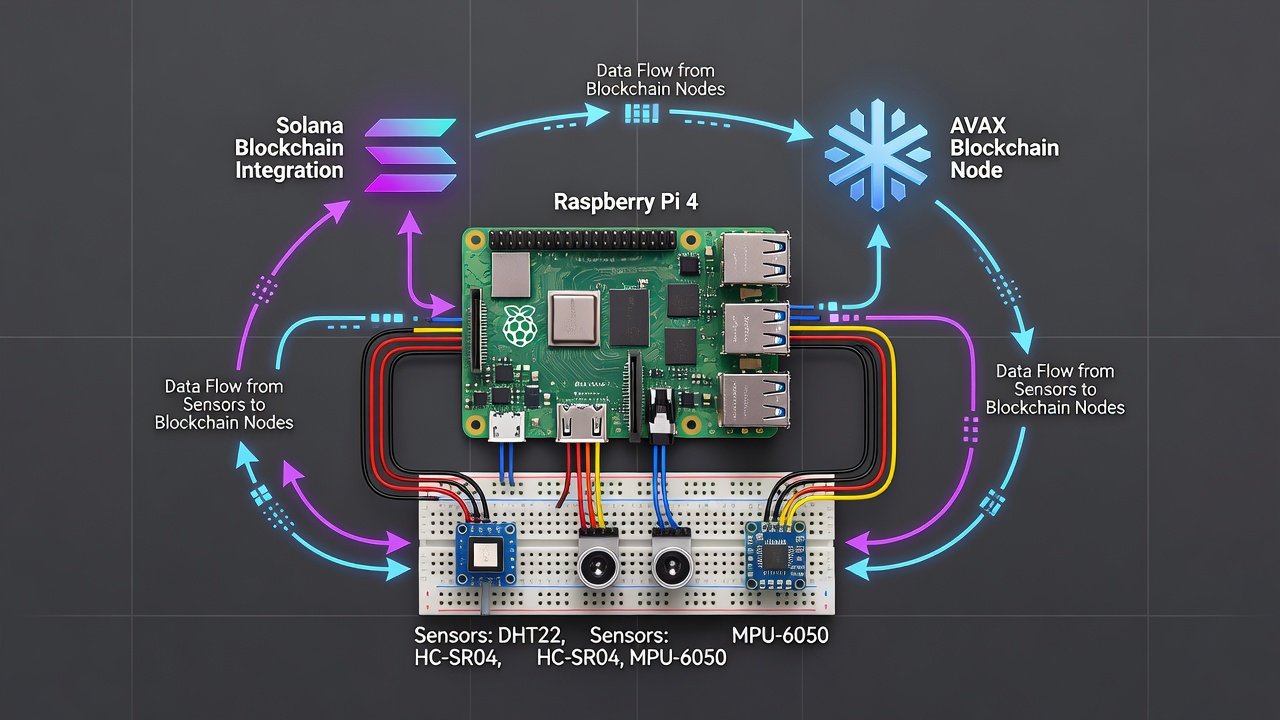
Step-by-Step: Connecting Raspberry Pi to Solana Testnet
Follow these practical steps to integrate a Raspberry Pi with Solana's devnet for IoT testing. This process assumes a standard Raspberry Pi 4 or 5 running the latest Raspberry Pi OS.
- Install the Solana CLI on your Raspberry Pi running Raspberry Pi OS by downloading the installer script and running it in the terminal, then verify installation with the version command.
- Configure a wallet using the CLI and request test SOL from the official faucet to cover transaction fees during development.
- Use the @solana/web3.js library in a Node.js script to send sensor data as transactions, including examples of creating instructions that encode temperature or humidity readings.
- Implement a simple Python script with the Solana Python SDK to read from GPIO pins and broadcast readings at regular intervals, adding error handling for network timeouts.
- Monitor transactions via Solana Explorer for confirmation times under one second and set up logging to track successful submissions versus failures.
This setup demonstrates reliable device-to-chain communication for real-world sensor networks and can be extended with encryption layers for sensitive data.
Step-by-Step: Connecting Raspberry Pi to AVAX Testnet
For Avalanche Fuji testnet integration, begin by ensuring your Pi has sufficient storage for the lightweight client.
- Set up the AvalancheGo client or use the JavaScript SDK on your Pi, configuring environment variables for the Fuji testnet endpoints.
- Create a subnet if needed for isolated IoT traffic, defining custom chain parameters that match your expected sensor data volume.
- Write a script using ethers.js adapted for AVAX to submit data from connected sensors, incorporating batching logic to group multiple readings into single transactions.
- Configure RPC endpoints for low-latency calls from the device and test connectivity with simple ping scripts.
- Test with sample temperature data and verify on the Avalanche block explorer, then implement retry mechanisms for intermittent connectivity issues common in remote deployments.
These steps highlight AVAX's flexibility for custom IoT deployments and allow for easy scaling when moving from testnet to mainnet subnets.
Case Studies from Emerging IoT Projects
Emerging initiatives in 2026 showcase both networks. One Solana-based project tracks agricultural sensors across farms, achieving thousands of daily updates with minimal energy use by leveraging parallel transaction execution. An AVAX subnet powers a logistics network of vehicle trackers, leveraging custom consensus for regional efficiency and achieving sub-second finality for location updates. A third example involves a smart building project on Solana that integrates motion and air-quality sensors, using oracles to trigger automated responses in connected HVAC systems. These examples illustrate practical scalability for developers seeking production-ready architectures.
Energy-Efficient Consensus Advantages for Sensor Networks
Both platforms prioritize energy efficiency, but their approaches differ. Solana's proof-of-history reduces redundant computations across the network, while Avalanche's repeated voting mechanism allows validators to reach agreement quickly with lower overall resource consumption. For IoT teams managing thousands of battery-operated sensors, these characteristics translate to longer device lifespans and reduced maintenance costs in the field.
Mistakes to Avoid When Building IoT on These Networks
Common pitfalls include exposing private keys in device firmware, failing to implement rate limiting on RPC calls, and neglecting to test under realistic network latency conditions. Always use hardware security modules where possible and simulate high-traffic scenarios during development to prevent bottlenecks once devices are deployed at scale.
Addressing Common Pitfalls: Latency, Security, and FAQs
FAQ
How do I reduce latency in IoT-blockchain connections? Optimize by using regional RPC nodes and batching non-critical transactions. Both Solana and AVAX support configurations that keep delays under 400 milliseconds for most sensor updates.
What security measures protect edge devices? Implement hardware wallets, encrypted key storage on the Pi, and regular firmware updates. Avoid exposing private keys directly in device firmware.
Which network is better for energy-constrained sensors? Avalanche subnets often edge out for localized low-power setups, while Solana's overall efficiency benefits large-scale deployments.
Can I migrate an existing IoT project between Solana and AVAX? Yes, using standardized data formats and oracle bridges facilitates migration with minimal code changes.
How should I handle device authentication at scale? Use NFT-based identity tokens or zero-knowledge proofs to verify devices without revealing sensitive metadata on-chain.
Conclusion
Solana and AVAX both deliver robust layer 1 foundations for IoT in 2026, offering developers concrete paths to scalable, efficient solutions. By following the integration examples and understanding their unique strengths, teams can deploy reliable sensor networks that meet investor and operational goals. Explore official developer portals to begin building today.


No comments yet. Be the first!