 CryptoChain Blog
Introduction to Utility Token Launches in 2026
Creators and developers in 2026 are increasingly turning to high-performance Layer 1 blockchains like Solana and Avalanche (AVAX) for launching utility tokens. These platforms offer fast transaction speeds, low costs, and robust ecosystems ideal for projects emphasizing real-world utility rather than speculation. This guide provides actionable steps, comparisons, and best practices to help you navigate the process successfully from initial planning through post-launch operations.
Utility tokens power decentralized applications, governance mechanisms, and access features within ecosystems. Focusing on long-term value requires careful planning around token standards, deployment procedures, liquidity management, and security protocols. Unlike hype-driven launches, successful utility token projects in 2026 prioritize sustainable tokenomics that align incentives between developers, users, and stakeholders over extended periods.
The search for actionable altcoin creation guides often highlights the need for concrete examples and decision frameworks. Solana and Avalanche stand out due to their distinct architectural advantages, making them top choices for developers seeking scalability without compromising on decentralization.
Comparing Token Standards: SPL vs. ERC-20 Equivalents on AVAX
Solana uses the SPL token standard, which supports fungible and non-fungible tokens with efficient on-chain metadata handling. This standard integrates deeply with Solana's runtime for optimized performance. Avalanche supports multiple standards, including its native ERC-20 compatible tokens via the C-Chain, enabling seamless Ethereum tool compatibility and easier migration for teams familiar with EVM environments.
Key differences include transaction throughput, where Solana often exceeds 65,000 TPS under optimal conditions, and Avalanche's subnets that allow customized chains for specific use cases. Developers should evaluate compatibility with existing wallets, DeFi protocols, and cross-chain bridges when choosing between platforms. SPL tokens benefit from Solana's parallel processing capabilities, reducing congestion during high-volume periods, while AVAX tokens leverage Avalanche's consensus mechanisms for strong finality guarantees.
- SPL advantages: Native integration with Solana's high-speed runtime, lower overhead for simple transfers, and built-in support for token extensions like confidential transfers.
- AVAX advantages: Broader EVM tooling ecosystem, flexible subnet deployment for isolated environments, and robust bridging options through Avalanche's architecture for multi-chain interoperability.
- Trade-offs: Solana offers superior speed but requires learning Rust or Anchor, whereas AVAX provides easier onboarding for Solidity developers but may involve more complex subnet configuration.
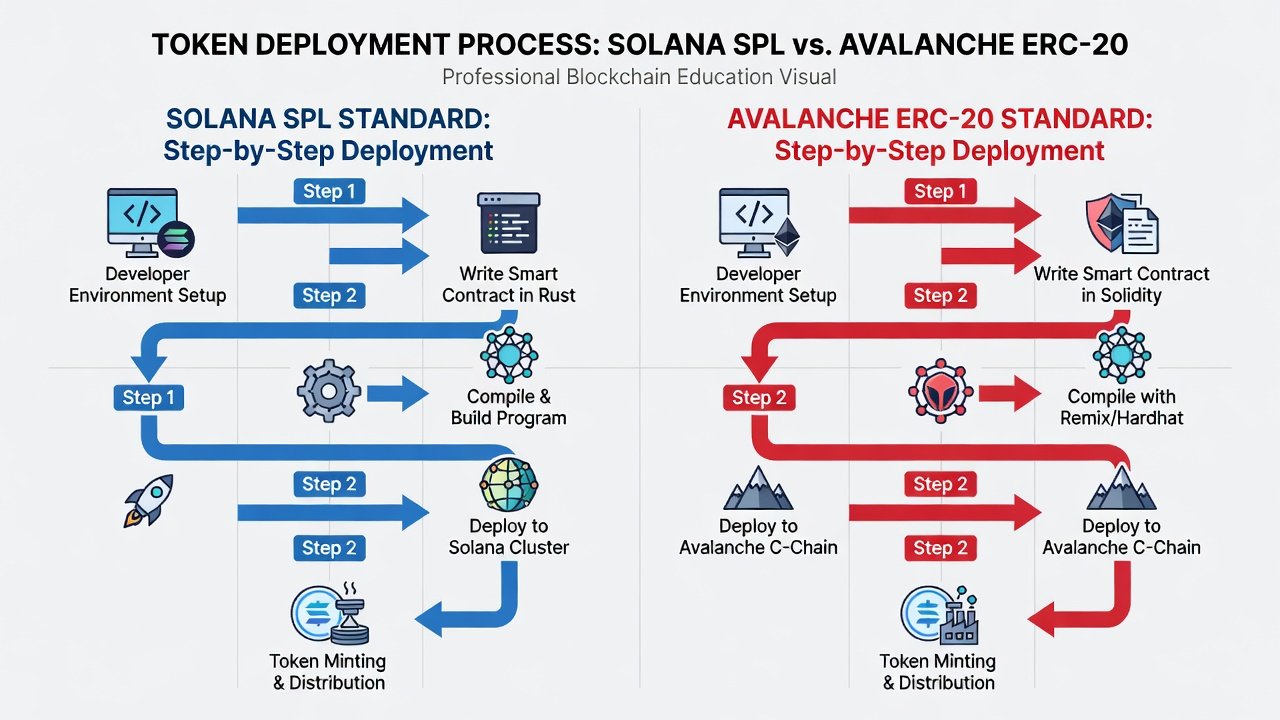
Step-by-Step Deployment on Solana
Launching an SPL token starts with setting up a development environment using the Solana CLI and Anchor framework. This approach allows for both simple token creation and advanced program logic tailored to utility features such as access gating or reward distribution.
- Install Solana tools via the official command line interface and initialize a wallet with sufficient SOL for transaction fees and rent exemptions.
- Use the spl-token CLI to create the mint account, configure decimals, and set authority parameters for minting and freezing capabilities.
- Implement custom logic for utility features like staking rewards or governance voting using Rust or the Anchor framework to abstract common patterns.
- Test thoroughly on devnet with simulated user interactions before proceeding to mainnet deployment, including stress tests for concurrent transactions.
- Verify the token on explorers and set up metadata via Metaplex for enhanced discoverability in wallets and marketplaces.
Real-world 2026 examples include projects like decentralized identity platforms that integrated SPL tokens for access control, demonstrating sustained utility through ongoing governance votes and feature unlocks. Another case involved a content platform using SPL tokens to manage creator royalties with automated distribution logic embedded in the token program.
Step-by-Step Deployment on Avalanche
On AVAX, deployment typically occurs on the C-Chain using Solidity. Leverage Hardhat or Foundry for contract compilation, testing, and deployment to ensure reliable execution across the network.
- Set up an Avalanche wallet and bridge AVAX for gas fees while configuring network endpoints for the C-Chain or a custom subnet.
- Write an ERC-20 contract with extensions for utility functions such as vesting schedules, role-based access, or integration hooks for external protocols.
- Deploy via Remix, Hardhat scripts, or a local node setup, then verify the contract source code on the Avalanche block explorer for transparency.
- Configure subnet parameters if building a custom chain for enhanced scalability, including validator sets and custom fee structures tailored to your utility model.
- Implement cross-chain messaging if your token needs to interact with other Avalanche subnets or external blockchains.
Case studies from 2026 highlight AVAX-based gaming tokens that used subnet isolation to reduce congestion during peak usage events, allowing seamless in-game transactions without impacting the primary network.
Gas Fee Optimization and Wallet Integration Examples
Gas fee optimization is critical for user adoption. On Solana, prioritize compute unit optimization in programs to minimize costs during complex operations. Batch multiple instructions where possible to reduce per-transaction overhead. For Avalanche, monitor C-Chain gas prices and use EIP-1559 compatible strategies to cap fees during volatile periods.
Wallet integration examples include using @solana/wallet-adapter for Solana projects to connect Phantom or Solflare wallets seamlessly in web applications. On AVAX, ethers.js combined with MetaMask or Core wallet provides straightforward account management and transaction signing. Test integrations across multiple devices and browsers to ensure broad accessibility.
Setting Up Liquidity and Market Presence
Post-deployment, establish liquidity pools on decentralized exchanges like Raydium for Solana or Trader Joe for Avalanche. This involves pairing your token with a base asset such as SOL or AVAX and providing initial liquidity to enable trading.
Monitor pool ratios closely to maintain stability and prevent excessive slippage. Consider adding concentrated liquidity positions for more efficient capital use. Integrate wallet connections early in your dApp frontend to facilitate easy onboarding for new users.
Security Best Practices and Avoiding Common Pitfalls
Security remains paramount throughout the token lifecycle. Conduct multiple audits with firms specializing in each chain's unique architecture. Implement multi-signature wallets for admin controls and use time-locks for critical functions to allow community review periods.
Common pitfalls include rug pulls, often mitigated by renouncing ownership where appropriate or using community-controlled multisigs. Compliance involves understanding regulations in target jurisdictions; consult legal experts early to structure token distribution and utility claims transparently. Post-launch monitoring tools such as on-chain analytics platforms help track holder distribution, transaction patterns, and potential anomalies in real time.
FAQ: Addressing Developer Questions
How do I choose between Solana and AVAX? Evaluate your project's need for raw speed and parallel execution versus EVM compatibility and subnet flexibility based on your target user base and technical stack.
What about gas optimization strategies? Solana's fee model favors batch operations and compute budgeting, while AVAX benefits from dynamic gas pricing on the C-Chain and potential use of subnets for predictable costs.
How to handle compliance and regulatory concerns? Focus on transparent tokenomics documentation, clear utility definitions, and avoid unregistered securities offerings by prioritizing functional use cases over investment promises.
What monitoring tools are recommended after launch? Utilize explorers, Dune Analytics alternatives for custom dashboards, and on-chain alerting services to stay informed about ecosystem health.
Conclusion
Launching utility tokens on Solana or AVAX in 2026 demands a balanced approach prioritizing utility, security, and ecosystem fit. By following these structured steps, incorporating real deployment examples, and learning from existing projects, developers can build sustainable initiatives that deliver lasting value. Explore official resources at Solana and Avalanche for the latest developer documentation and tools to support your next launch.
No comments yet. Be the first!