 CryptoChain Blog

Introduction to Building DApps on Solana and AVAX in 2026
In 2026, Layer 1 (L1) blockchains like Solana and Avalanche (AVAX) dominate for high-performance decentralized applications (DApps). Solana's blistering speeds and Avalanche's subnet flexibility make them ideal for altcoin projects seeking Ethereum alternatives. This guide provides a hands-on tutorial for developers to create and deploy a simple counter DApp on either chain, covering tools, architectures, code snippets, testing, scalability benefits, and pitfalls.
Whether you're building DeFi protocols, NFT marketplaces, or gaming DApps, understanding Solana's Proof-of-History (PoH) and AVAX's subnets unlocks massive scalability. We'll use Rust for Solana programs and Solidity for AVAX smart contracts. By the end, you'll have deployable code ready for mainnet.
Key Differences in Solana and AVAX L1 Architectures
Solana and AVAX differ fundamentally in design, impacting DApp development:
- Solana's Proof-of-History (PoH): Combines Proof-of-Stake (PoS) with a cryptographic clock, enabling 65,000+ TPS. No sharding; single global state with parallel transaction processing via Sealevel runtime.
- AVAX Subnets: Customizable blockchains (subnets) for sovereign L1s. Primary network uses Snowman++ consensus for 4,500+ TPS; subnets scale horizontally by isolating state.
Solana excels in raw throughput for general DApps, while AVAX shines for enterprise-grade customization. Both offer sub-second finality, outpacing Ethereum's rollups.
For official docs, check Solana Documentation and Avalanche Documentation.
Prerequisites and Development Tools
Before coding:
- Hardware: 16GB RAM, SSD; Solana needs more for local validation.
- Solana Tools: Install Rust via
curl --proto '=https' --tlsv1.2 -sSf https://sh.rustup.rs | sh, thencargo install --git https://github.com/solana-labs/solana.git solana-cli --locked. - AVAX Tools: Node.js, Yarn; Remix IDE or Hardhat for Solidity. Install Core wallet and Fuji testnet faucet.
- Wallets: Phantom for Solana, Core for AVAX.
Verify setups: solana --version and avax --version.
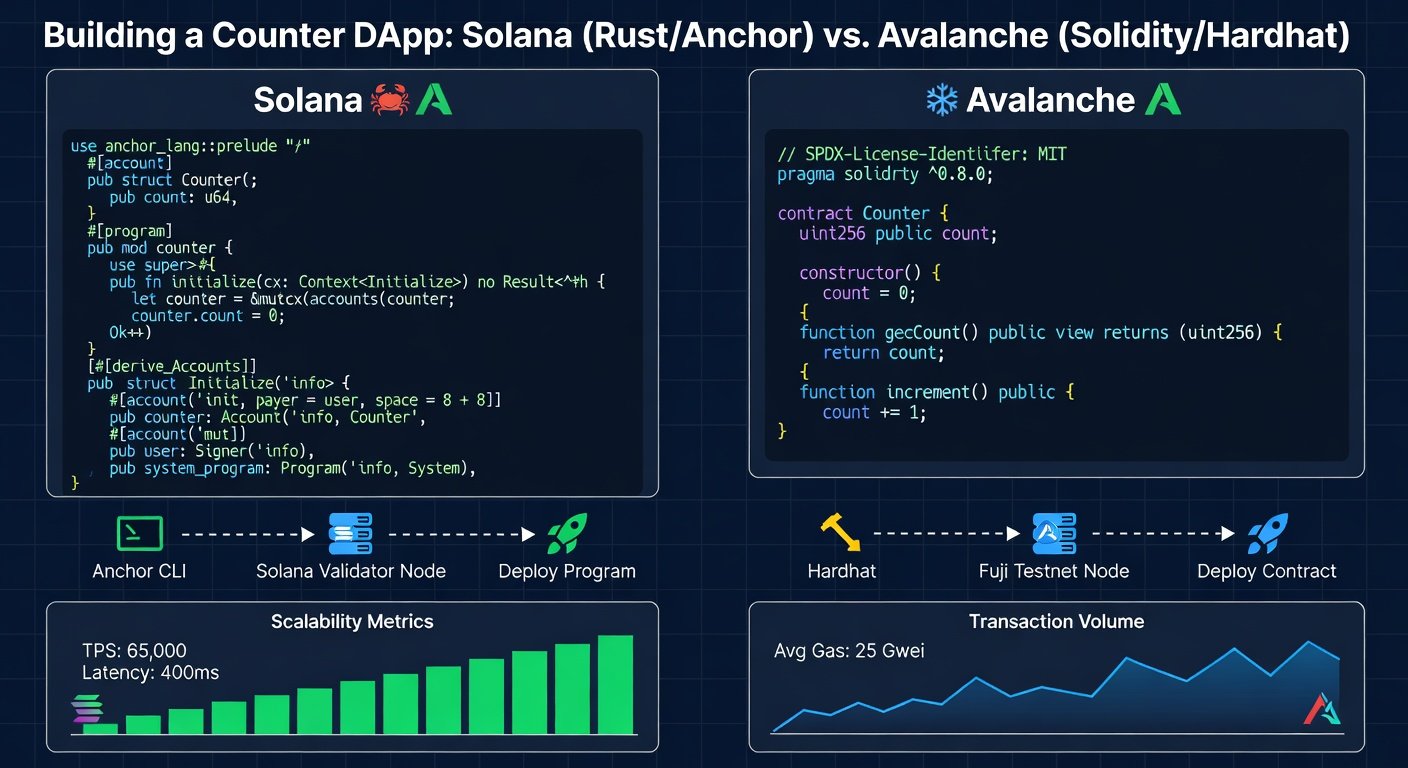
Step-by-Step: Building a Counter DApp on Solana with Rust
Create a simple on-chain counter that increments/decrements.
1. Initialize Project
cargo init --lib solana-counter && cd solana-counter
Cargo.toml:
[lib]
crate-type = ["cdylib", "lib"]

[dependencies]
solana-program = "1.18.0"
borsh = "0.10"
borsh-derive = "0.10"
2. Write the Program (src/lib.rs)
use solana_program::{
    account_info::{next_account_info, AccountInfo},
    entrypoint,
    entrypoint::ProgramResult,
    msg,
    program_error::ProgramError,
    pubkey::Pubkey,
};

#[derive(borsh::BorshSerialize, borsh::BorshDeserialize)]
pub struct Counter {
    pub count: u64,
}

entrypoint!(process_instruction);

pub fn process_instruction(
    program_id: &Pubkey,
    accounts: &[AccountInfo],
    instruction_data: &[u8],
) -> ProgramResult {
    let accounts_iter = &mut accounts.iter();
    let account = next_account_info(accounts_iter)?;

    if account.owner != program_id {
        return Err(ProgramError::IncorrectProgramId);
    }

    let mut counter = Counter::try_from_slice(&account.data.borrow())?;
    let instruction = instruction_data[0];

    match instruction {
        0 => counter.count += 1,
        1 => if counter.count > 0 { counter.count -= 1; },
        _ => return Err(ProgramError::InvalidInstructionData),
    }

    counter.serialize(&mut &mut account.data.borrow_mut()[..])?;
    Ok(())
}
3. Build and Deploy
anchor build (install Anchor first: cargo install --git https://github.com/coral-xyz/anchor anchor-cli --locked). Deploy to devnet: solana program deploy target/deploy/solana_counter.so.
4. Client-Side Interaction (JS/TS)
Use @solana/web3.js to call increment/decrement.
Step-by-Step: Building a Counter DApp on AVAX with Solidity
AVAX uses EVM-compatible Solidity.
1. Setup Hardhat Project
npx hardhat init
// hardhat.config.js:
require('@nomicfoundation/hardhat-toolbox');

module.exports = {
  solidity: '0.8.24',
  networks: {
    fuji: {
      url: 'https://api.avax-test.network/ext/bc/C/rpc',
      accounts: ['YOUR_PRIVATE_KEY'],
    },
  },
};
2. Smart Contract (contracts/Counter.sol)
// SPDX-License-Identifier: MIT
pragma solidity ^0.8.24;

contract Counter {
    uint256 public count;

    function increment() public {
        count++;
    }

    function decrement() public {
        require(count > 0, "Count cannot be negative");
        count--;
    }
}
3. Compile, Test, Deploy
npx hardhat compile. Test with Chai/Mocha. Deploy: npx hardhat run scripts/deploy.js --network fuji.
Link to Solidity docs: Solidity Documentation.
Deploying to Mainnet and Testing Tips
Solana: Use solana airdrop 2 for devnet SOL; test with local validator (solana-test-validator). Monitor via Solana Explorer.
AVAX: Fuji testnet faucet; deploy to C-Chain. Use Snowtrace for verification.
Testing best practices:
- Unit tests: Anchor for Solana, Hardhat for AVAX.
- Integration: Simulate high load with solana-program-test or Foundry.
- Security: Audit with Slither (AVAX) or custom Rust lints.
Scalability Benefits for Altcoin Projects
Solana handles 2,000+ TPS real-world (e.g., Serum DEX); AVAX subnets enable infinite scaling via custom VMs. For altcoins, this means low fees (<$0.01/tx) and global adoption. Compare to ETH: Solana/AVAX reduce gas wars, perfect for memecoins or RWAs.
Common Pitfalls to Avoid
- Solana: Account size mismatches—use borsh for serialization. Avoid cross-program invocations without CPI guards.
- AVAX: Reentrancy in Solidity—use checks-effects-interactions. Subnet misconfigs lead to isolation issues.
- General: Neglect RPC rate limits; use premium providers like Helius (Solana) or AVAX nodes.
- Overlook upgrades: Solana BPF limits; AVAX proxy patterns needed.
Conclusion: Choose Solana or AVAX for Your 2026 DApp
Solana suits speed demons; AVAX for customizable ecosystems. Start with testnets, iterate with real users, and scale your altcoin project confidently. Dive into Rust or Solidity today— the future of Web3 is high-performance L1s.

No comments yet. Be the first!