 CryptoChain Blog
Introduction to Token Launches on Solana and AVAX in 2026
Creators seeking to issue altcoins on high-performance Layer-1 blockchains require concrete, actionable steps rather than abstract theory. Solana and Avalanche (AVAX) continue to rank among the leading choices for fast finality and low transaction costs in 2026. This comprehensive guide delivers a complete workflow covering wallet preparation, token standard comparisons, smart contract deployment, liquidity pool creation, security protocols, cost considerations, and lessons drawn from successful meme and utility token launches throughout the year. Whether you are building a community-driven meme coin or a utility token for decentralized applications, the following sections provide the depth needed to execute a launch successfully.
SPL versus ERC-20 and ARC-20 Token Standards Explained
The SPL standard on Solana is purpose-built for the network’s parallel processing architecture, enabling high throughput and native composability with other programs. In contrast, Avalanche’s C-Chain supports tokens compatible with the ERC-20 interface through its ARC-20 implementation, allowing developers familiar with Ethereum tooling to transition smoothly. SPL tokens excel in environments where speed and minimal fees matter most, while ARC-20 tokens benefit from mature EVM tooling and easier cross-chain bridging. Understanding these distinctions helps creators choose the chain that aligns with their project’s technical requirements and target user base.
Side-by-Side Platform Comparison
| Aspect | SPL on Solana | ARC-20 on AVAX |
|---|---|---|
| Programming Language | Rust with Anchor framework | Solidity with Hardhat or Foundry |
| Transaction Finality | Sub-second | 1–2 seconds |
| Primary Tooling | Solana CLI and Anchor | Foundry and Remix IDE |
| Native DEX Options | Raydium, Orca | Trader Joe, Pangolin |
Preparing Your Development Wallets
Begin by setting up dedicated wallets for each chain. Phantom provides an intuitive interface for Solana, while the official Core wallet or MetaMask configured for Avalanche C-Chain handles AVAX transactions. Generate fresh keypairs, store seed phrases offline in multiple secure locations, and fund each wallet with small amounts of the native token for gas. Enable transaction simulation and hardware wallet support where available to reduce human error during deployment. Many 2026 creators maintain separate wallets for development, testing, and treasury management to isolate risks.
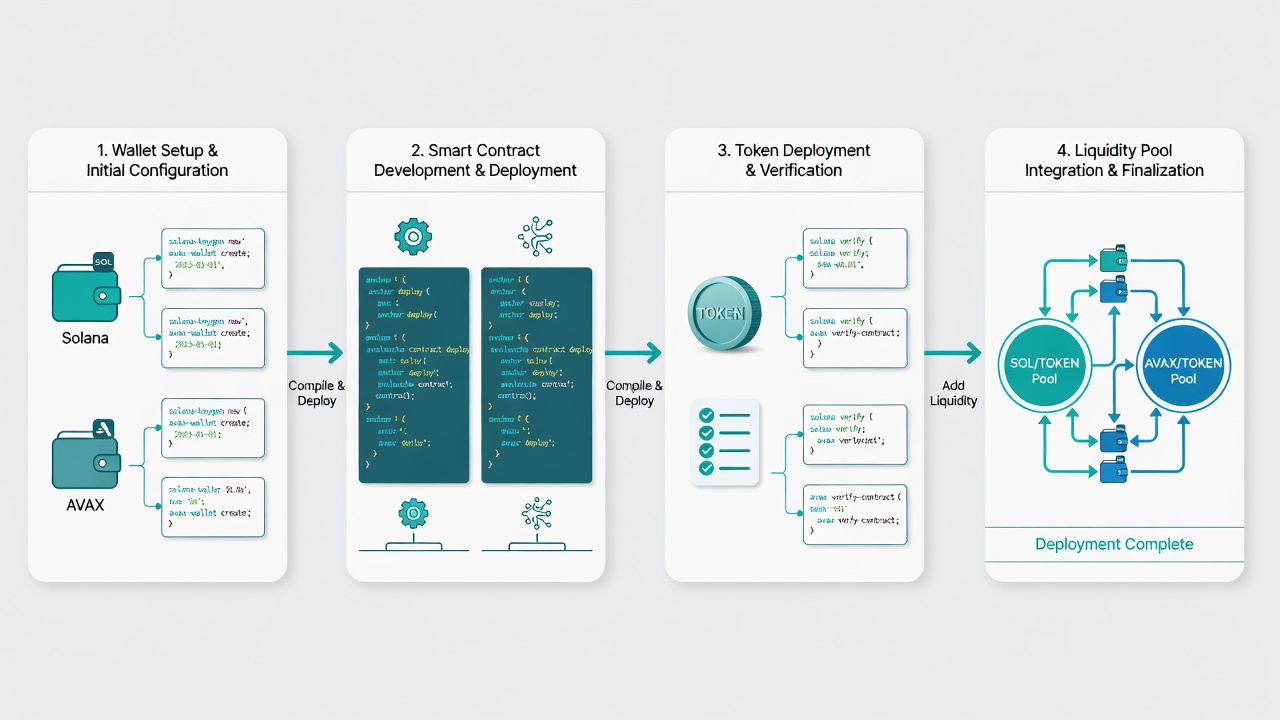
Step-by-Step Token Deployment on Solana
Follow this numbered workflow to create and mint an SPL token:
- Install the Solana CLI tools and configure your environment for the mainnet-beta cluster.
- Create a new keypair dedicated to the token mint and fund it sufficiently.
- Initialize an Anchor project and define your token metadata including name, symbol, and decimals.
- Implement the token program using the SPL token library, setting initial supply and authority parameters.
- Build and deploy the program to the cluster, then verify the mint address on a public explorer.
- Revoke mint authority immediately after the initial distribution to prevent future inflation.
// Sample Rust snippet for minting tokens
use spl_token::instruction;
let mint_to_ix = instruction::mint_to(&token_program_id, &mint_pubkey, &destination, &authority, &[], amount)?;
Thorough testing on devnet is essential before mainnet execution. Document every address and transaction signature for transparency with your community.
Step-by-Step Token Deployment on Avalanche
Avalanche deployment follows a similar but EVM-oriented process. Switch your wallet to the C-Chain, install Foundry for rapid compilation, and write a standard ERC-20 contract with any custom features such as burn mechanisms or access controls. Compile, deploy via the avalanche CLI or a web IDE, and confirm the contract address. Set up token metadata for explorers and indexers, then verify the source code for public auditability. Many teams also deploy on Avalanche subnets when specialized performance characteristics are required.
Creating and Securing Liquidity Pools
Once the token contract is live, the next critical phase is establishing liquidity. On Solana, Raydium serves as the primary automated market maker for SPL pairs. On Avalanche, Trader Joe provides concentrated liquidity options that can reduce impermanent loss. Deposit equal values of your new token and the native asset, then consider locking a meaningful portion of the liquidity provider tokens through audited vesting contracts. This step builds lasting trust with early holders and reduces rug-pull risks that plagued earlier cycles.
Understanding Cost Structures Without Specific Figures
Deployment expenses vary with network conditions but remain qualitatively lower on both Solana and Avalanche compared with Ethereum mainnet. Budget for wallet funding, program or contract deployment, metadata storage, and initial liquidity seeding. Solana’s architecture typically demands fewer resources for equivalent token supplies, while Avalanche offers predictable fee markets through its subnet design. Always monitor real-time gas estimators before executing large transactions.
Comprehensive Security Checklist for 2026 Launches
- Engage at least two independent audit firms with proven experience on the chosen chain.
- Immediately revoke all privileged authorities after initial minting or distribution.
- Implement multisignature controls for treasury and upgrade functions.
- Use time-locked contracts for any future changes to token parameters.
- Integrate real-time on-chain monitoring and alerting for large transfers or unusual activity.
- Publish full source code and audit reports on public repositories.
- Conduct internal penetration testing and simulate common attack vectors on testnets.
Common Pitfalls and How Successful Projects Avoided Them
Many early 2026 launches encountered issues from incomplete authority revocation, shallow liquidity that enabled manipulation, or insufficient community communication. Study projects that succeeded by maintaining transparent on-chain reporting, releasing gradual liquidity over weeks, and clearly documenting token utility from the outset. Avoiding over-promising and focusing on verifiable milestones has proven more effective than hype-driven approaches.
Real-World 2026 Launch Examples
Utility-focused tokens on Solana have integrated directly with lending protocols and decentralized exchanges, leveraging SPL’s composability. On Avalanche, several gaming projects deployed tokens on custom subnets to achieve specialized throughput while maintaining C-Chain compatibility for broader liquidity. These cases demonstrate that choosing the right chain and executing the deployment workflow methodically leads to sustainable adoption.
Post-Launch Management and Community Building
After deployment, shift focus to ongoing operations. Set up governance forums, distribute tokens according to a published schedule, and maintain active developer communication channels. Regular updates on token metrics and roadmap progress help retain holder confidence. Consider integrating with analytics platforms to track holder distribution and trading volume over time.
Frequently Asked Questions
What regulatory considerations should new altcoin projects address?
Projects should consult qualified legal counsel regarding securities classification in relevant jurisdictions. Clear documentation of utility and avoidance of investment-like marketing language reduces regulatory exposure. Resources from established blockchain foundations can provide starting points for compliance research.
How do scalability concerns impact new token launches?
Both networks continue to release upgrades that increase throughput. Monitor official announcements from Solana and Avalanche to anticipate capacity improvements. Choosing parallel programs or subnets can further mitigate congestion during high-demand periods.
Which chain is better for meme coins versus utility tokens?
Solana’s speed and low fees favor high-volume meme coin activity, while Avalanche’s EVM compatibility and subnet flexibility suit utility tokens requiring complex logic or specialized performance. Evaluate your project’s technical needs before deciding.
Conclusion
Launching tokens on Solana or Avalanche in 2026 rewards creators who follow structured, security-first workflows and understand each chain’s strengths. By applying the detailed steps, comparison data, and lessons outlined above, you can move confidently from concept to a live, secure deployment that serves your community effectively.

No comments yet. Be the first!