 CryptoChain Blog

Introduction to Quantum Threats in Layer-1 Blockchains
Quantum computing poses a growing risk to blockchain security, particularly for Layer-1 networks like Solana and Avalanche (AVAX). As quantum processors advance, they could break widely used elliptic curve cryptography that underpins transaction signing and wallet security. This article examines how these leading altcoins are preparing for the post-quantum era through research initiatives, upgrades, and practical developer guidance planned for 2026 and beyond. Both networks rely on established standards today but recognize the need for migration to quantum-resistant algorithms. Understanding these changes helps investors and builders assess long-term viability. Quantum threats are no longer theoretical; governments and corporations are investing heavily in quantum hardware, making proactive blockchain defenses essential for maintaining trust in decentralized systems.
Quantum Computing Basics Relevant to Blockchain
Quantum computers leverage superposition and entanglement to solve certain mathematical problems exponentially faster than classical machines. Shor's algorithm specifically threatens public-key cryptography by efficiently factoring large numbers and solving discrete logarithms. In blockchain contexts, this directly impacts signature schemes used for authorizing transactions. Grover's algorithm offers a quadratic speedup for brute-force searches, affecting hash functions to a lesser degree. These capabilities mean that once large-scale, error-corrected quantum computers exist, current digital signatures could be forged, compromising entire networks.
Current Cryptographic Standards in Solana
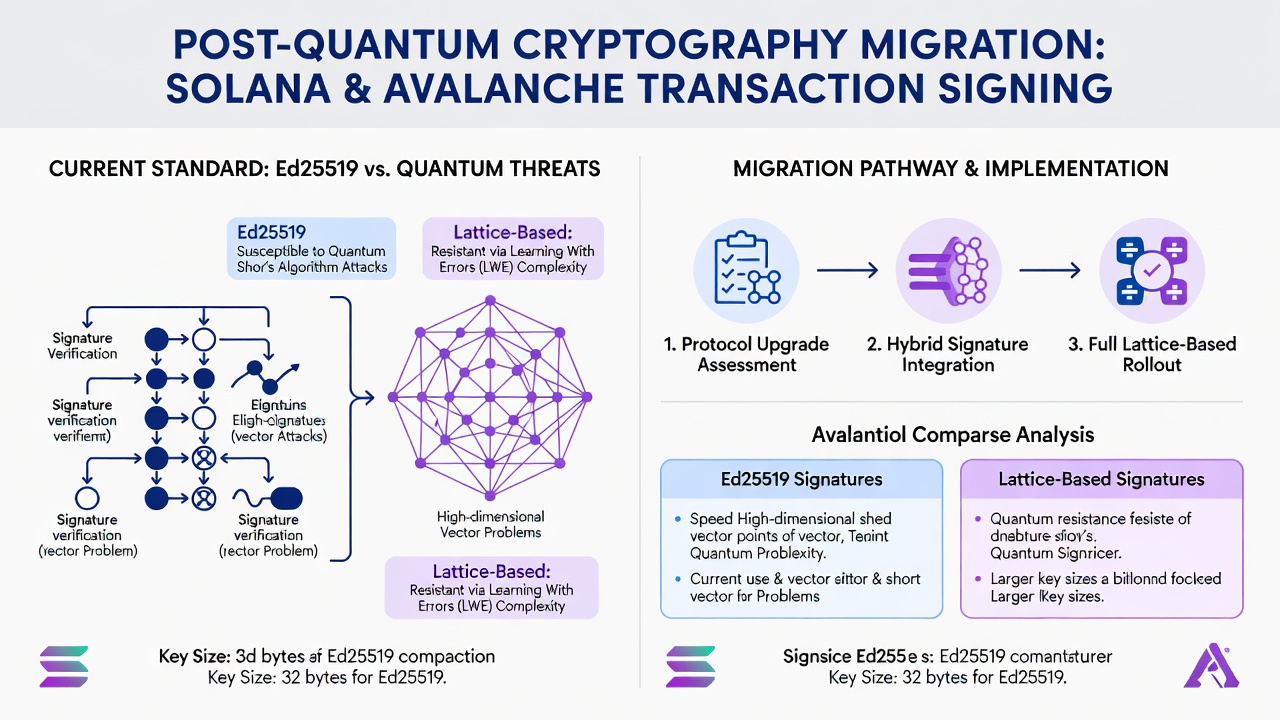
Solana uses Ed25519 signatures for transaction validation and account security. This elliptic curve approach delivers high throughput but remains vulnerable to Shor's algorithm on sufficiently powerful quantum computers. Consensus relies on Proof-of-History combined with Tower BFT, where cryptographic commitments secure validator votes. The network's speed advantage stems partly from streamlined signature verification, yet this efficiency could become a liability without upgrades. Solana's architecture processes thousands of transactions per second, but each signature must eventually transition to post-quantum alternatives that maintain comparable performance.
Current Cryptographic Standards in Avalanche
Avalanche employs ECDSA with the secp256k1 curve, consistent with Bitcoin and Ethereum. Its primary consensus mechanism, Snowball, and variants like Avalanche consensus depend on repeated sampling and digital signatures for finality. Subnets inherit the same cryptographic foundation, making network-wide migration a coordinated effort. These standards perform well today but face the same quantum exposure as other major chains. Avalanche's subnet model adds complexity because each custom chain must eventually adopt compatible quantum-resistant primitives.
Potential Vulnerabilities in Transaction Signing and Consensus
Transaction signing represents the most immediate risk. Quantum computers could derive private keys from public keys once exposed on-chain, enabling theft from dormant wallets. Active addresses with visible public keys are especially exposed. Consensus mechanisms face subtler threats. While Proof-of-Stake and BFT protocols emphasize liveness and safety, forged signatures could disrupt validator sets or enable double-spends in extreme scenarios. Both Solana and AVAX must address these vectors before large-scale quantum hardware emerges. Additional risks include replay attacks on legacy transactions and compromised multi-signature schemes that rely on classical curves.
Timeline for Quantum Threats and Industry Readiness
Current estimates suggest cryptographically relevant quantum computers may arrive between 2030 and 2040, though breakthroughs could accelerate this. NIST has already standardized several post-quantum algorithms, providing a roadmap for blockchain teams. Solana and Avalanche developers are aligning internal timelines with these milestones to ensure upgrades precede real-world threats.
Announced Upgrades and Research Initiatives for 2026
Solana developers have begun exploring lattice-based and hash-based signature schemes through community proposals. Research collaborations focus on integrating post-quantum algorithms without sacrificing the network's sub-second block times. Avalanche's team participates in broader industry efforts, evaluating hybrid schemes that combine classical and quantum-resistant primitives. Key 2026 milestones include testnet deployments of quantum-safe signature modules and community governance votes on activation timelines. Solana and Avalanche both monitor NIST standardization progress closely. Additional work involves benchmarking algorithms such as CRYSTALS-Dilithium and Falcon for latency and size on high-throughput validators.
Practical Steps Developers Can Take to Future-Proof dApps
- Audit smart contracts for hardcoded public-key assumptions and replace with abstracted signature verification libraries that support multiple algorithms.
- Implement hybrid signature schemes that support both current and post-quantum algorithms during the transition period to avoid breaking changes.
- Use wallet providers that plan quantum-resistant key derivation functions and encourage users to rotate keys regularly to minimize exposure windows.
- Monitor subnet or program upgrade paths to adopt network-level cryptographic changes seamlessly without requiring full redeployments.
- Participate in testnets and governance forums to provide feedback on performance impacts of new algorithms and help shape optimal parameters.
- Adopt modular cryptography frameworks in dApp codebases so signature schemes can be swapped via configuration updates rather than full rewrites.
- Educate users about quantum-safe address generation practices and provide migration tooling within applications.
Real-World Examples from Blockchain Research Collaborations
The NIST Post-Quantum Cryptography project supplies reference implementations that Solana and Avalanche researchers are evaluating. Joint workshops with academic institutions have produced early prototypes demonstrating lattice-based signatures on high-throughput chains. These collaborations highlight measurable trade-offs in signature size and verification latency, guiding realistic 2026 rollout plans. Additional partnerships with organizations such as the Quantum Economic Development Consortium are testing interoperability between classical and quantum-safe chains in simulated environments.
Investor and Developer Implications for Long-Term Security
Investors should prioritize networks demonstrating concrete migration roadmaps. Developers who begin integration now will avoid rushed, error-prone upgrades later. Both Solana and AVAX offer strong fundamentals, yet their quantum preparedness will increasingly influence adoption and valuation in the coming decade.
Short FAQ on Long-Term Security Concerns
Will my current SOL or AVAX holdings become unsafe?
Not immediately. Quantum threats require fault-tolerant machines that remain years away. Proactive network upgrades will protect assets well before widespread risk materializes.
How soon should developers begin migration work?
Start evaluating libraries and hybrid approaches in 2025 to align with 2026 testnets. Early adoption reduces technical debt and positions dApps for smoother upgrades.
Are there performance costs to quantum resistance?
Yes, larger signatures and slower verification are expected trade-offs. Both networks prioritize optimizations that preserve speed advantages while adding protection.
What role does governance play in these upgrades?
Community proposals and on-chain votes will determine final algorithm selections and activation dates, ensuring broad stakeholder alignment.
Can existing wallets be upgraded without losing funds?
Most wallets will support key migration tools that allow users to move assets to quantum-resistant addresses through standard transaction flows.
Conclusion
Solana and Avalanche are actively addressing quantum computing risks through targeted research, hybrid cryptography exploration, and developer tooling. By following the outlined steps and staying engaged with official upgrade channels, participants can help secure these networks for the post-quantum future.

No comments yet. Be the first!