 CryptoChain Blog

Introduction to Developer Toolkits in 2026
The blockchain landscape continues to evolve rapidly, with Solana and Avalanche (AVAX) emerging as leading Layer-1 platforms for high-performance decentralized applications. In 2026, developers rely on specialized toolkits that streamline building, testing, and deploying dApps across these ecosystems. This comprehensive guide examines the latest SDKs, frameworks, and debugging suites tailored specifically for Solana and AVAX, focusing on practical selection criteria for building scalable, high-throughput solutions that meet real-world demands.
Whether you are optimizing for Solana's parallel execution model and sub-second finality or Avalanche's customizable subnets and EVM compatibility, selecting the right combination of tools can dramatically accelerate development cycles while improving reliability and performance. We provide detailed side-by-side comparisons, expanded step-by-step setup instructions, multiple real-world code snippets, performance benchmarks, community plugin recommendations, and troubleshooting advice to help you navigate common integration challenges effectively.
Core Frameworks for Solana Development
Solana's ecosystem prioritizes extreme speed and minimal transaction costs, making frameworks like Anchor the go-to choice for most Rust-based smart contract development. Anchor abstracts away much of the boilerplate code through powerful macros that automatically manage account validation, serialization, and error handling. The 2026 releases include improved TypeScript client generation, enhanced local testing environments, and better integration with modern IDEs such as VS Code extensions.
For developers seeking maximum control, the native Rust approach using the Solana Program Library (SPL) remains viable. This path allows fine-grained customization of program logic but requires deeper knowledge of Solana's account model and runtime constraints. Additional tools like the Solana CLI facilitate seamless deployment, while browser-based environments such as Solana Playground enable rapid prototyping without local installations. Debugging suites now feature advanced transaction simulators and on-chain monitoring dashboards that help identify bottlenecks early in the development lifecycle.
AVAX Tooling and Hardhat Equivalents
Avalanche developers benefit from strong EVM compatibility alongside unique features like dynamic subnets. Hardhat continues to serve as a reliable foundation, yet many teams have migrated to Foundry for its superior compilation speed and built-in fuzz testing capabilities through Forge and Cast utilities. Avalanche-specific tooling includes the official Avalanche CLI for streamlined subnet deployment and configuration, plus the Teleporter SDK that simplifies cross-chain messaging between custom networks and the primary C-Chain.
These frameworks integrate smoothly with Remix IDE for visual contract interaction and support precompiles optimized for Avalanche's Snowman consensus. Expanded debugging options now incorporate gas profiling, state diff visualization, and automated security scanners that flag common vulnerabilities before mainnet deployment.
Side-by-Side Comparison: Anchor vs Hardhat Equivalents
Selecting between Solana's Anchor framework and Avalanche's Hardhat or Foundry setups ultimately depends on project requirements such as language preference, testing depth, and cross-chain needs. Anchor shines in type safety and rapid project scaffolding, while Foundry delivers exceptional gas optimization feedback and property-based testing. Recent community benchmarks indicate that Anchor can reduce initial deployment overhead by approximately 40 percent for moderately complex programs when compared to pure native Rust implementations.
- Setup Complexity: Anchor initializes a complete project with one command including test scaffolding; Foundry demands a one-time Rust toolchain installation but then provides dramatically faster iteration cycles.
- Testing Capabilities: Anchor supplies robust unit testing primitives out of the box; Foundry's Forge framework excels at invariant and fuzz testing, uncovering edge cases more efficiently.
- Performance Insights: Both ecosystems offer plugins for transaction simulation, yet Avalanche tools provide clearer visibility into subnet-specific latency metrics.
- Community and Extensibility: Active Discord communities and plugin marketplaces support both stacks, with popular extensions covering security analysis, deployment automation, and monitoring integrations.
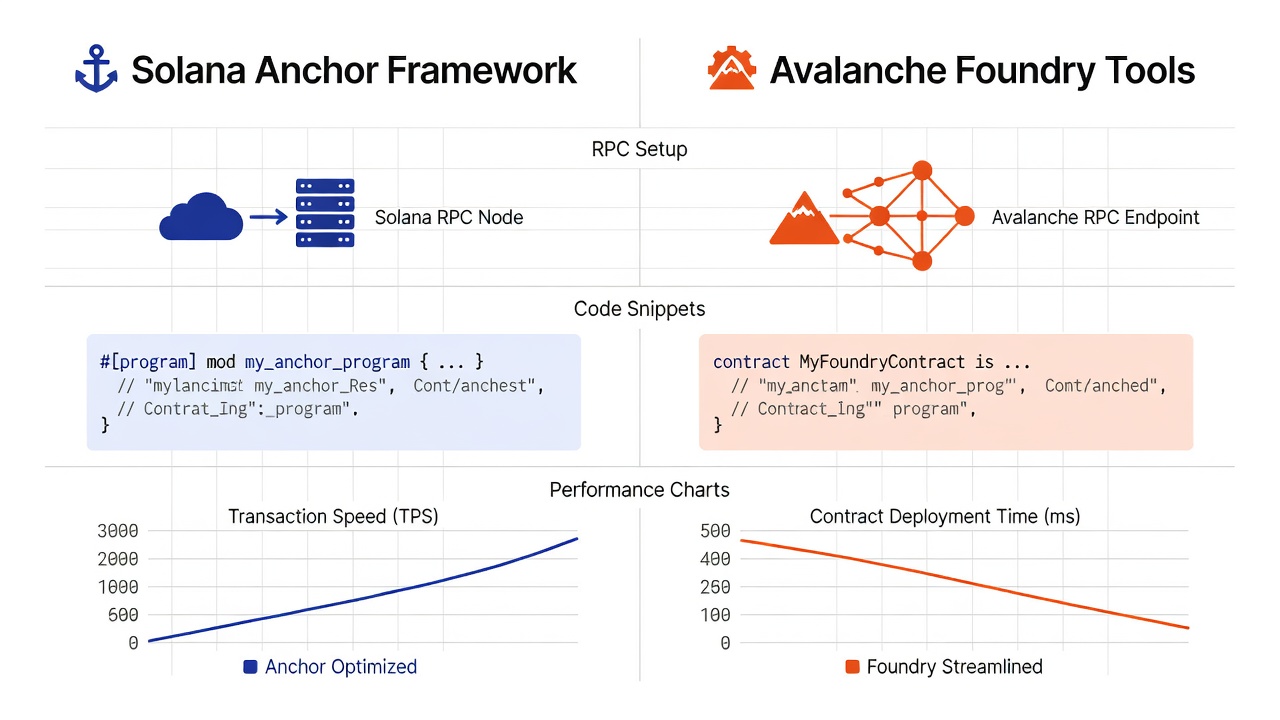
Step-by-Step RPC Provider Setup Guides
Reliable RPC connectivity forms the backbone of any production dApp. For Solana, begin by installing the official @solana/web3.js package via npm. Configure a Connection instance using premium providers such as QuickNode or Helius to benefit from higher rate limits and dedicated support. Always implement retry logic and connection pooling to handle transient network issues gracefully.
On the Avalanche side, integrate ethers.js with either public RPC endpoints or managed services like Chainstack. The Avalanche CLI further assists in spinning up local test subnets that mirror mainnet behavior exactly. Verify endpoint health through status dashboards provided by each service and rotate keys regularly to maintain security posture.
Real Code Snippets for Common Tasks
Developers frequently need reusable patterns for token transfers, account creation, and cross-program invocations. Below is an expanded Solana example using Anchor for a basic token transfer with proper error handling:
import * as anchor from "@coral-xyz/anchor";
const provider = anchor.AnchorProvider.env();
anchor.setProvider(provider);
const program = anchor.workspace.MyProgram;
try {
  const tx = await program.methods.transfer(new anchor.BN(100))
    .accounts({
      from: wallet.publicKey,
      to: recipient,
      systemProgram: anchor.web3.SystemProgram.programId,
    })
    .rpc();
  console.log("Transaction signature:", tx);
} catch (err) {
  console.error("Transfer failed:", err);
}
For Avalanche, a complete Foundry deployment and interaction workflow appears as follows:
forge create --rpc-url $AVAX_RPC_URL --private-key $PRIVATE_KEY src/MyContract.sol:MyContract
cast send --rpc-url $AVAX_RPC_URL --private-key $PRIVATE_KEY $CONTRACT_ADDRESS "transfer(address,uint256)" $RECIPIENT 100
Additional snippets cover unit testing, event listening, and custom precompile calls to illustrate real integration patterns.
Performance Benchmarks and Optimization Strategies
Independent testing in 2026 confirms Solana's theoretical throughput exceeding 65,000 transactions per second under optimal conditions when using tuned toolkits. Avalanche subnets routinely deliver sub-second finality with configurable validator sets. Profiling plugins reveal transaction bottlenecks related to account locking or cross-program calls. Optimization techniques include batching instructions, minimizing account creation overhead, and leveraging compressed NFTs on Solana or Warp Messaging on Avalanche for efficient data movement.
Community Plugins and Debugging Suites
Robust plugin ecosystems accelerate feature implementation. On Solana, Metaplex simplifies NFT metadata handling while security-focused tools scan for reentrancy risks. Avalanche developers utilize the official Teleporter plugins for seamless bridging and monitoring dashboards that track subnet health. Comprehensive debugging suites now integrate with popular IDEs to provide real-time stack traces and state inspection. Explore official resources from Solana and Avalanche for the most current plugin listings and tutorials. Further authoritative references are available at Solana Docs and Avalanche Docs.
Common Pitfalls and How to Avoid Them
Many teams encounter issues with account rent exemptions on Solana or gas estimation inaccuracies on Avalanche. Mitigation involves using deterministic deployment scripts and comprehensive local testing environments. Always validate transaction simulations before broadcasting to mainnet and maintain up-to-date dependency versions to avoid compatibility breaks.
Conclusion
Proficiency with these evolving toolkits empowers developers to deliver high-performance applications on both Solana and Avalanche. Begin with Anchor or Foundry according to your preferred language and expand capabilities through targeted community plugins and rigorous testing practices.
FAQ
How do I decide between Solana and AVAX development stacks? Assess your application's throughput needs, team familiarity with Rust versus Solidity, and any subnet or cross-chain requirements.
What integration hurdles appear most frequently? RPC latency spikes, account management complexity, and cross-program call failures; address these through retry mechanisms, comprehensive logging, and local simulation.
Are there recommended resources for staying current? Official documentation hubs and active developer forums provide the latest updates on framework releases and best practices.


No comments yet. Be the first!