 CryptoChain Blog
Introduction to Layer 1 Consensus Evolution
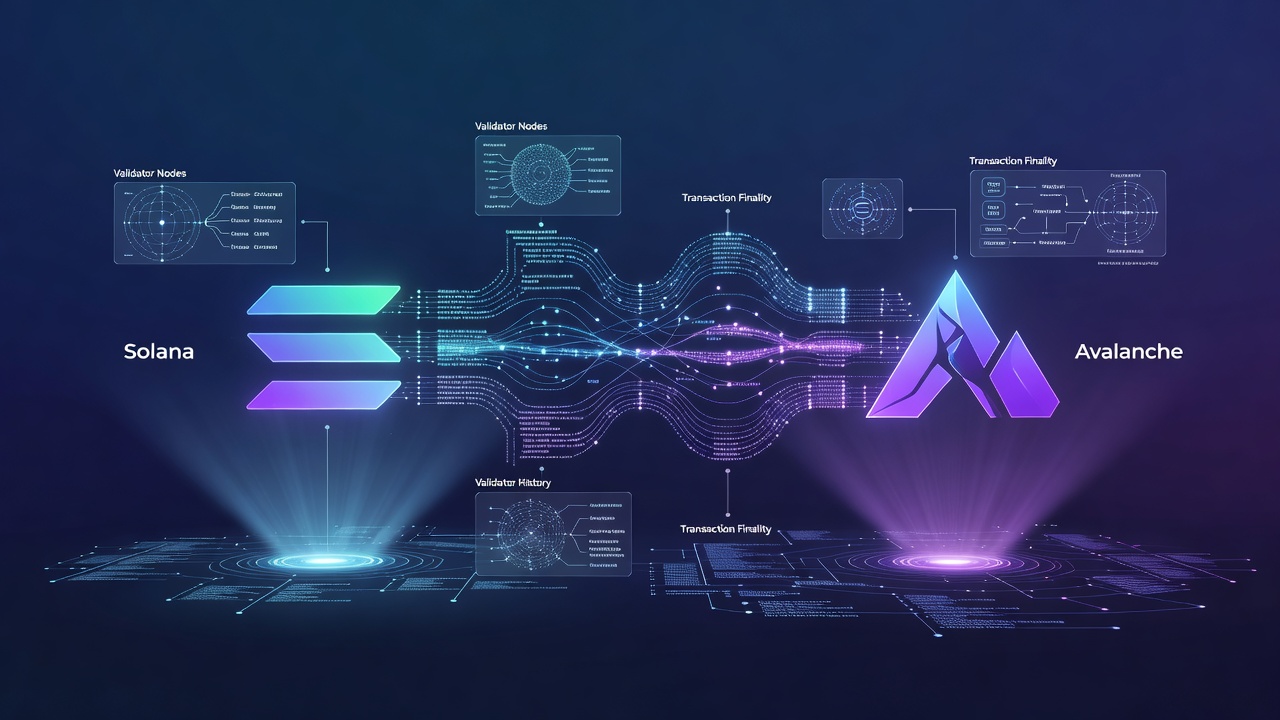
Developers and investors exploring Solana and Avalanche (AVAX) in 2026 seek more than surface-level speed claims. Both networks operate as high-performance Layer 1 blockchains, yet their consensus designs differ fundamentally in architecture and trade-offs. Solana combines Proof-of-History (PoH) with Tower BFT, while Avalanche relies on the Snow family of protocols. Understanding these mechanisms reveals why each chain behaves differently under load and how planned upgrades may shape their futures. This deep dive covers the technical foundations, performance metrics, real-world stress tests, and forward-looking considerations for teams building decentralized applications or allocating capital across altcoin ecosystems.
Solana Consensus: Proof-of-History and Tower BFT
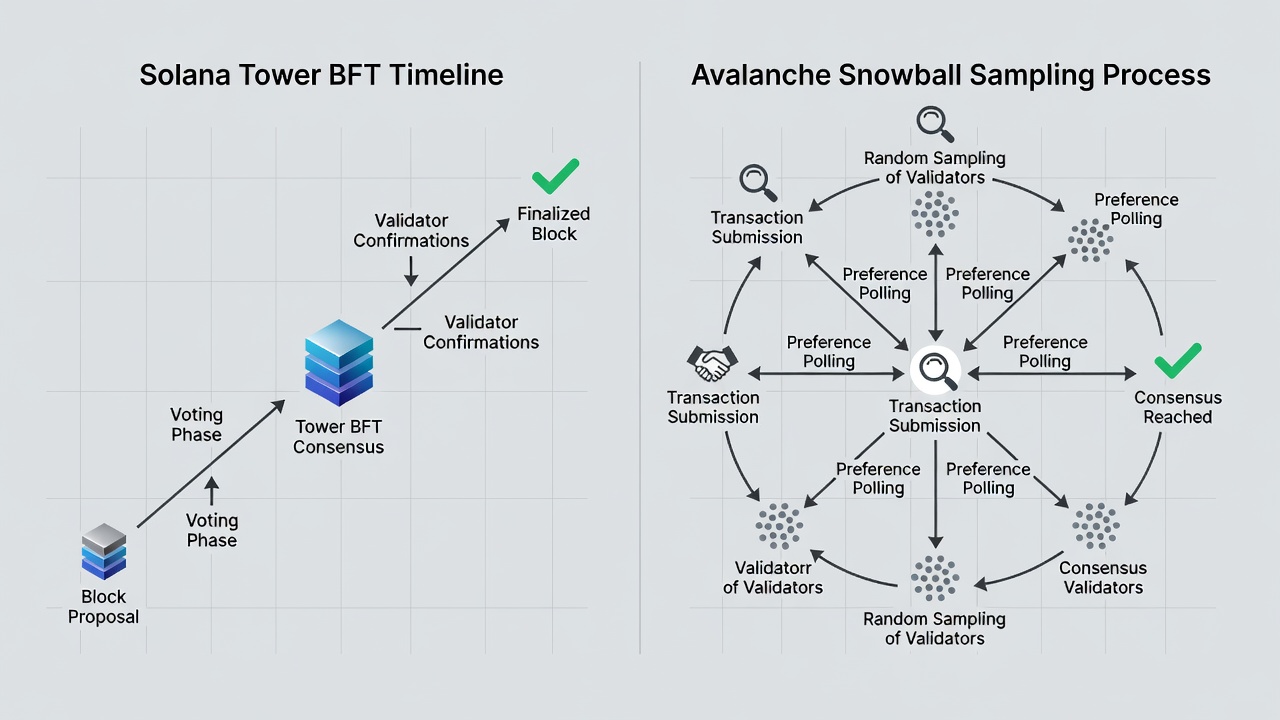
Solana’s core innovation, Proof-of-History, creates a verifiable timeline of events without requiring validators to communicate timestamps. A cryptographic hash chain records the passage of time, allowing leaders to produce blocks at predictable intervals. Tower BFT then overlays Byzantine Fault Tolerance on this timeline, enabling rapid voting and slashing for misbehavior. The combination supports theoretical throughput exceeding 65,000 transactions per second while maintaining sub-second finality in optimal conditions. In practice, validators rotate as leaders based on a stake-weighted schedule, and each leader embeds a PoH sequence that subsequent validators can verify instantly.
Validators in the Solana network must maintain high hardware specifications, including fast SSDs and reliable network connections. This hardware emphasis contributes to the network’s performance but also raises centralization concerns among smaller operators. Under heavy load, such as during popular NFT mints or DeFi events, Solana has experienced periods of congestion that temporarily degrade user experience. For example, during the 2024 meme coin frenzy, transaction queues grew dramatically, forcing some applications to implement priority fees or off-chain batching strategies. Developers building on Solana often integrate tools like the Solana Web3.js library to monitor slot progress and handle retry logic gracefully when network conditions fluctuate.
Avalanche Consensus: Snowball and Snowflake Protocols
Avalanche uses a probabilistic consensus model based on repeated random sampling. The Snowball protocol allows nodes to query a small subset of peers repeatedly until a threshold of confidence is reached. Snowflake extends this with metastable mechanisms that help the network converge quickly even when partitions occur. The result is linear scalability: adding more validators increases throughput without proportional latency growth. Unlike traditional BFT systems that require all-to-all communication, Avalanche’s gossip-based sampling reduces message complexity dramatically.
Subnets in Avalanche allow customized virtual machines to run alongside the primary network. This design supports specialized chains for gaming, DeFi, or institutional use cases while inheriting security from the primary network’s validators. Finality typically arrives within one to two seconds, though the exact time varies with network participation rates. Teams evaluating Avalanche often explore subnet deployment tutorials on official documentation to isolate high-frequency trading logic from the broader C-Chain activity.
Performance Implications: Throughput and Finality
Solana prioritizes raw speed through its time-based ordering, achieving high throughput when the network is healthy. However, recovery from outages or forks can require coordinated restarts. Avalanche’s sampling approach provides stronger partition tolerance and faster recovery, though maximum throughput per subnet remains lower than Solana’s peak theoretical capacity. Real-world examples illustrate these differences clearly. During the 2024 Solana congestion events, transaction fees spiked and some dApps paused operations for hours. In contrast, Avalanche subnets have handled isolated high-load scenarios without affecting the primary chain, demonstrating resilience through architectural separation.
Practical implications for developers include choosing Solana when building latency-sensitive applications such as on-chain order books, while preferring Avalanche for projects requiring modular governance or regulatory compliance features on dedicated subnets. Investors monitoring validator metrics should track both networks’ Nakamoto coefficients to assess true decentralization levels over time.
Side-by-Side Comparison
| Aspect | Solana | Avalanche |
|---|---|---|
| Core Mechanism | PoH + Tower BFT | Snowball / Snowflake |
| Finality Time | Sub-second to 400ms | 1-2 seconds |
| Throughput Focus | Global high TPS | Subnet-parallel scaling |
| Hardware Requirements | High (GPU/SSD) | Moderate |
| Partition Tolerance | Lower | Higher |
| 2026 Upgrade Path | Firedancer client, Alpenglow | Durango upgrade, Warp messaging |
Security Trade-offs and Real-World Network Behavior
Both protocols face distinct risks. Solana’s reliance on leader schedules and hardware creates potential single points of failure, though client diversification via Firedancer aims to mitigate this. Avalanche’s repeated sampling introduces theoretical vulnerabilities to sophisticated network attacks, yet empirical performance since mainnet launch has remained stable. Under sustained load, Solana validators may experience memory pressure during large state updates, while Avalanche nodes benefit from lightweight sampling that scales more gracefully with validator count.
Common mistakes developers make include underestimating the importance of priority fee estimation on Solana or failing to configure proper subnet bonding requirements on Avalanche. A practical checklist for teams includes stress-testing smart contracts on testnets, monitoring validator uptime dashboards, and reviewing recent governance proposals for protocol parameter changes.
2026 Upgrade Paths and Long-Term Considerations
Planned 2026 upgrades include Solana’s Alpenglow proposal for improved vote compression and Avalanche’s continued subnet enhancements for cross-chain messaging. Developers evaluating these networks should monitor testnet results and governance proposals on official channels. Additional considerations involve hardware roadmap alignment, such as Solana’s push toward more efficient GPU acceleration, and Avalanche’s focus on expanding supported virtual machine runtimes.
Frequently Asked Questions
How do the consensus models affect transaction costs?
Solana’s fee market remains dynamic during congestion, while Avalanche subnets can implement custom fee structures that isolate costs from the primary network. Teams should simulate fee scenarios using public RPC endpoints before mainnet deployment.
Which network offers better security for high-value DeFi?
Security depends on validator distribution and economic incentives. Both chains have undergone multiple audits; investors should review recent validator decentralization metrics before committing capital.
What upgrade changes are expected beyond 2026?
Long-term roadmaps emphasize client diversity for Solana and expanded subnet interoperability for Avalanche, though exact timelines remain subject to community approval.
How should developers choose between the two for new projects?
Start by mapping application requirements to throughput needs, finality guarantees, and operational complexity. Prototyping on both testnets provides concrete data for decision making.
Conclusion
Choosing between Solana and Avalanche requires matching protocol characteristics to specific use cases. Solana suits applications demanding maximum throughput, while Avalanche excels in modular, resilient deployments. Continued monitoring of 2026 upgrades will clarify how each network evolves its consensus strengths.
Further reading is available at solana.com and avax.network.


No comments yet. Be the first!