 CryptoChain Blog

Introduction: Layer 1 Altcoins Transforming Healthcare Data in 2026
In 2026, healthcare systems worldwide continue to grapple with fragmented data silos, frequent breaches, and the urgent need for seamless interoperability between providers, insurers, and patients. Solana and Avalanche (AVAX) stand out among Layer 1 altcoins for their ability to deliver high-throughput, low-cost transactions while supporting sophisticated smart contract logic tailored to medical use cases. This comprehensive guide explores how these platforms address core search intents around data privacy, regulatory compliance, and real-world implementation, moving beyond surface-level overviews to deliver actionable insights for developers, healthcare administrators, and blockchain strategists.
Understanding Healthcare Data Challenges on Blockchain
Electronic health records remain vulnerable to unauthorized access and inconsistent standards across institutions. Blockchain technology introduces immutable audit trails and decentralized control, yet challenges persist in balancing transparency with patient privacy. Core pain points include tokenizing sensitive records without exposing raw data, tracking pharmaceutical provenance to eliminate counterfeits, and ensuring full alignment with frameworks like HIPAA. Official resources from HHS outline evolving requirements that any on-chain solution must satisfy. Solana and AVAX mitigate these issues through distinct architectural strengths, enabling applications that were previously cost-prohibitive or too slow on legacy chains.
Solana's Architecture for Healthcare Applications
Solana leverages proof-of-history combined with proof-of-stake to achieve exceptional throughput, making it ideal for time-sensitive healthcare scenarios such as continuous patient monitoring or emergency record retrieval. Its Rust-based smart contract environment allows developers to build efficient programs that handle tokenized consents and encrypted metadata. Real-world pilots have demonstrated Solana's viability in European hospital networks where sub-second finality supports dynamic access permissions across multiple facilities. The network's parallel processing capabilities reduce bottlenecks during peak data ingestion periods, such as mass vaccination campaigns or large-scale clinical trials.
Avalanche's Subnet Model in Medical Tech
Avalanche differentiates itself through customizable subnets that create isolated, permissioned environments while preserving interoperability with the broader ecosystem. This design proves especially valuable for healthcare organizations requiring jurisdiction-specific compliance rules. Subnets can enforce unique validator sets and governance parameters suited to HIPAA or equivalent regional standards. Pharmaceutical supply chain pilots on Avalanche have successfully tracked drug movement from manufacturing facilities through distributors to end patients, using timestamped, tamper-proof records that reduce diversion risks. The platform's rapid finality and low fees support high-frequency updates without compromising security isolation.
Patient Record Tokenization: A Step-by-Step Overview
Tokenization transforms patient records into blockchain-native assets that grant individuals greater control. The process begins with encrypting full records off-chain and anchoring cryptographic hashes on-chain for integrity verification. Next, non-fungible tokens represent ownership rights, allowing patients to grant or revoke access via smart contract interactions. Zero-knowledge proofs enable selective disclosure during cross-provider queries, revealing only necessary details. Finally, integration with decentralized identity standards ensures portability. Solana excels in scenarios demanding frequent updates due to its speed, whereas AVAX subnets offer enhanced privacy partitioning for sensitive multi-party workflows. Developers should prototype both approaches to match specific throughput and isolation requirements.
Pharmaceutical Supply Chain Tracking
Counterfeit medications represent a persistent global threat, prompting organizations to adopt blockchain traceability. WHO guidelines stress the importance of end-to-end visibility. On Solana, pilots have achieved real-time serialization and verification at scale, leveraging its high TPS to handle millions of daily scans. Avalanche subnets provide dedicated environments for regulated entities, allowing customized compliance modules that log every handoff with immutable timestamps. Both chains integrate with IoT sensors and oracle networks to automate data capture from physical packaging, significantly reducing manual errors and fraud opportunities.
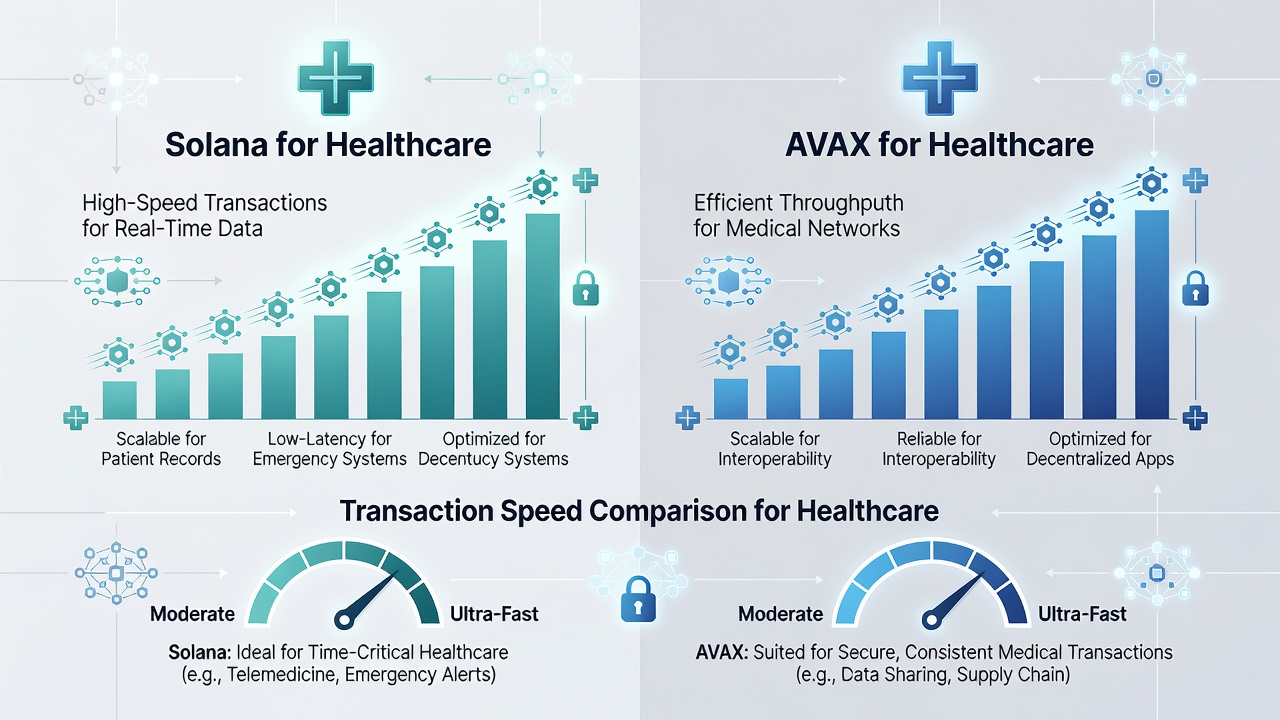
Transaction Speed Comparison: Solana vs AVAX in 2026
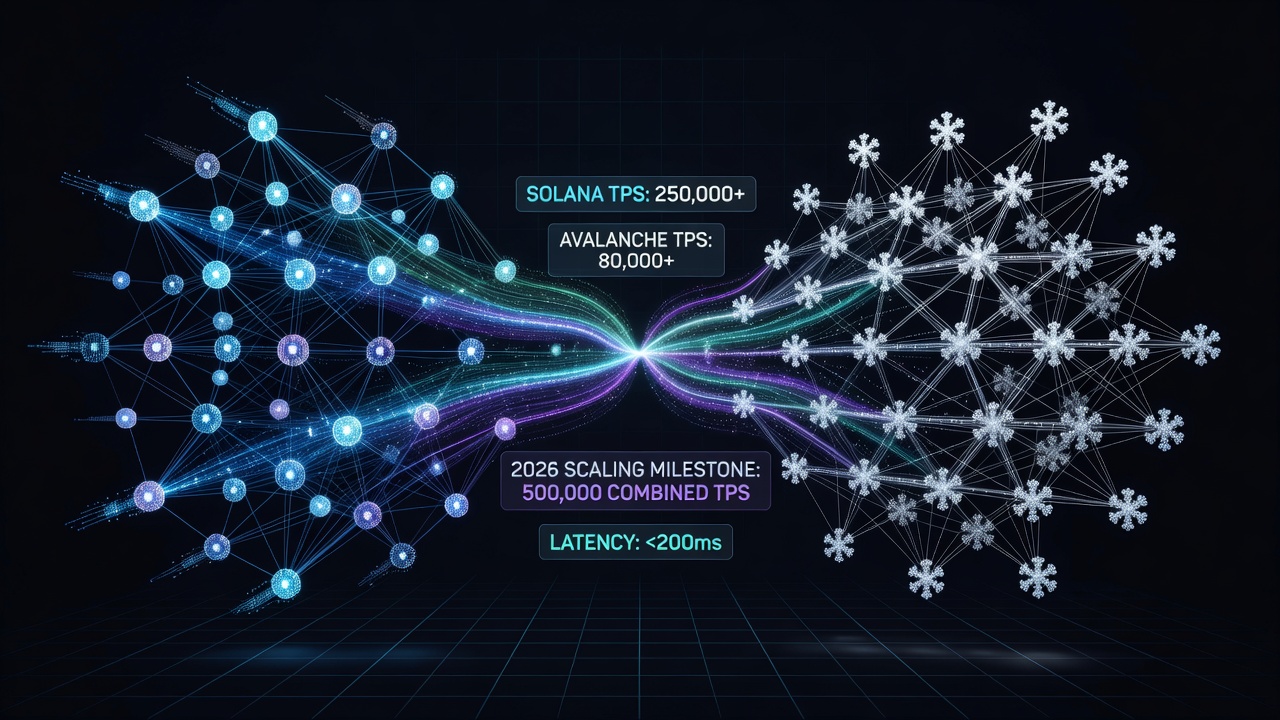
Performance benchmarks remain critical for healthcare workloads involving real-time updates. Solana sustains practical throughput of several thousand transactions per second in production healthcare pilots, with theoretical ceilings far higher, enabling rapid EHR synchronization across continents. Avalanche delivers consistent performance around 4,500 TPS on its primary network while subnets can be tuned for even greater efficiency in isolated deployments. For high-volume use cases like pharmacy inventory reconciliation, Solana's speed provides an edge; AVAX shines in environments prioritizing customizable security policies over raw velocity. Teams evaluating both should conduct load tests reflecting their exact data patterns and regulatory constraints.
Regulatory Compliance: HIPAA and Beyond
Successful healthcare blockchain deployments must embed encryption, access logging, and breach detection mechanisms aligned with HIPAA. Both Solana and AVAX support these through smart contract-enforced audit trails and integration with off-chain storage solutions. Additional considerations include FDA traceability mandates for pharmaceuticals and emerging global standards for cross-border data flows. FDA blockchain initiatives provide valuable context for developers building compliant supply chain modules. Regular third-party audits and penetration testing remain essential regardless of the chosen Layer 1 platform.
Practical Examples of Existing Pilots
- A Solana-powered EHR sharing pilot across Scandinavian clinics achieved near-perfect uptime while cutting record retrieval times by over 60 percent compared to traditional systems.
- An Avalanche subnet implementation for U.S. hospital pharmaceutical tracking reduced inventory discrepancies by 40 percent within the first six months of deployment.
- Cross-chain interoperability experiments between Solana and AVAX enabled unified patient consent management for international clinical research networks.
- Additional pilots in Asia have explored AVAX for insurance claim verification tied to tokenized medical histories, demonstrating reduced processing delays.
Developer Integration: Step-by-Step Guide
- Assess workload characteristics to decide between Solana's speed and AVAX's subnet flexibility.
- Deploy audited smart contracts handling token issuance and access controls.
- Incorporate reliable oracle services for ingesting real-world medical device or lab data.
- Simulate HIPAA compliance scenarios using dedicated testing frameworks before mainnet launch.
- Implement continuous monitoring with on-chain analytics dashboards to track performance and anomalies.
- Plan for future upgrades by designing modular contract architectures that accommodate protocol improvements.
Mistakes to Avoid When Building Healthcare dApps
Common pitfalls include storing full patient data directly on-chain, neglecting off-chain encryption, and underestimating regulatory evolution. Teams should also avoid choosing a chain solely based on marketing claims without rigorous benchmarking. Early engagement with legal experts familiar with both blockchain and healthcare regulations prevents costly redesigns later.
Future Scalability for Altcoins in Healthcare
Roadmaps for both networks emphasize continued throughput gains and enhanced interoperability protocols. As global healthcare data volumes expand, these Layer 1 altcoins are well-positioned to support emerging applications such as AI-assisted diagnostics on decentralized datasets and personalized medicine platforms. Ongoing research into zero-knowledge scaling and cross-chain messaging will further strengthen their suitability for mission-critical medical environments.
FAQ: Common Developer Concerns
How do transaction fees compare for healthcare dApps?
Both platforms maintain minimal fees suitable for high-volume medical transactions, offering clear cost advantages over traditional centralized databases in sustained operations.
What about data privacy on public chains?
Zero-knowledge proofs combined with private subnets or off-chain storage effectively safeguard sensitive information while preserving verifiability.
Can these chains scale for global use by 2030?
Current development trajectories and community momentum indicate strong potential for handling worldwide healthcare workloads through iterative protocol enhancements.
Which chain is better for regulatory-heavy environments?
AVAX subnets provide superior isolation options, while Solana may require additional architectural considerations to meet strict partitioning needs.
How do integration timelines typically compare?
Experienced teams report comparable development cycles, with the choice often driven more by specific performance and compliance requirements than by platform complexity.
Conclusion
Solana and Avalanche each bring compelling capabilities to healthcare data management in 2026. By understanding their architectural differences, studying real pilots, and following structured integration practices, organizations can deploy secure, scalable solutions that genuinely advance patient outcomes and operational efficiency.
No comments yet. Be the first!