 CryptoChain Blog

Introduction to AI-Driven BTC Forecasting in 2026
Bitcoin price forecasting has evolved significantly with the integration of artificial intelligence and machine learning. In 2026, traders and analysts rely on sophisticated models that go beyond traditional technical analysis by incorporating on-chain metrics, sentiment data, and real-time market feeds. This guide provides a deep dive into building and applying these AI tools for actionable BTC insights. The cryptocurrency market remains highly volatile, influenced by macroeconomic factors, regulatory developments, and network-specific events. AI models can process millions of data points across multiple timeframes, revealing correlations that human analysts might overlook. By 2026, advancements in compute power and data availability have made these techniques more accessible than ever, enabling both institutional and retail participants to develop custom forecasting systems.
Traditional methods such as moving averages or simple regression often fall short in volatile markets because they assume linear relationships. AI models excel at identifying complex, non-linear patterns in vast datasets, offering predictive power that manual approaches cannot match. This shift is particularly relevant for Bitcoin, where on-chain activity like hash rate fluctuations and wallet distributions provide unique signals not found in traditional equities.
Key Data Sources and On-Chain Metrics for 2026 Models
Effective forecasting begins with high-quality data. Primary sources include blockchain explorers that track transaction volumes, active addresses, and exchange reserves. Additional layers come from derivatives markets, funding rates on perpetual futures, and macroeconomic indicators such as interest rate decisions. On-chain metrics like realized price, MVRV ratio, and spent output profit ratio have proven especially predictive when fed into machine learning pipelines. Analysts often combine these with off-chain signals such as Google Trends data and futures open interest to create multidimensional feature sets.
Practical implementation requires APIs from providers that deliver both historical and streaming data. Feature engineering plays a crucial role: transforming raw blockchain data into normalized inputs like 30-day moving averages of transaction counts or ratios of long-term holder activity. This preprocessing step dramatically improves model convergence and reduces noise.
Selecting the Right Algorithms for Bitcoin Analysis
Choosing algorithms is critical for effective forecasting. Neural networks, particularly LSTM and GRU variants, handle sequential time-series data from BTC prices exceptionally well because they maintain memory of previous states across extended sequences. Random forests provide robust feature importance rankings when analyzing on-chain indicators like transaction volume and wallet activity, making them interpretable for risk management teams. Gradient boosting frameworks such as XGBoost or LightGBM often deliver strong baseline performance with faster training times than deep learning alternatives.
Transformer architectures have gained traction in 2026 for their ability to capture long-range dependencies across market regimes. Hybrid approaches that ensemble neural networks with tree-based models frequently outperform single-algorithm systems. When selecting an algorithm, consider factors including training speed, interpretability requirements, and whether real-time inference on modest hardware is necessary. For example, a random forest model might run efficiently on a laptop, whereas a large transformer may require GPU resources.
Integrating Bitcoin News Feeds and Sentiment Analysis
Market sentiment plays a major role in BTC movements. Integrating news APIs and social media feeds into models allows real-time adjustment of predictions. Natural language processing pipelines can score headlines, Reddit threads, and tweets for bullish or bearish signals, enhancing model accuracy during news-driven events. Advanced setups use fine-tuned language models to detect nuanced language such as regulatory warnings or institutional adoption announcements.
Bitcoin.org offers foundational resources on network fundamentals that complement sentiment data. Combining textual embeddings with numerical features creates richer input vectors. Traders should implement lag analysis to determine how quickly sentiment translates into price action, often finding optimal windows between four and twenty-four hours depending on the source.
Step-by-Step Model Training Examples
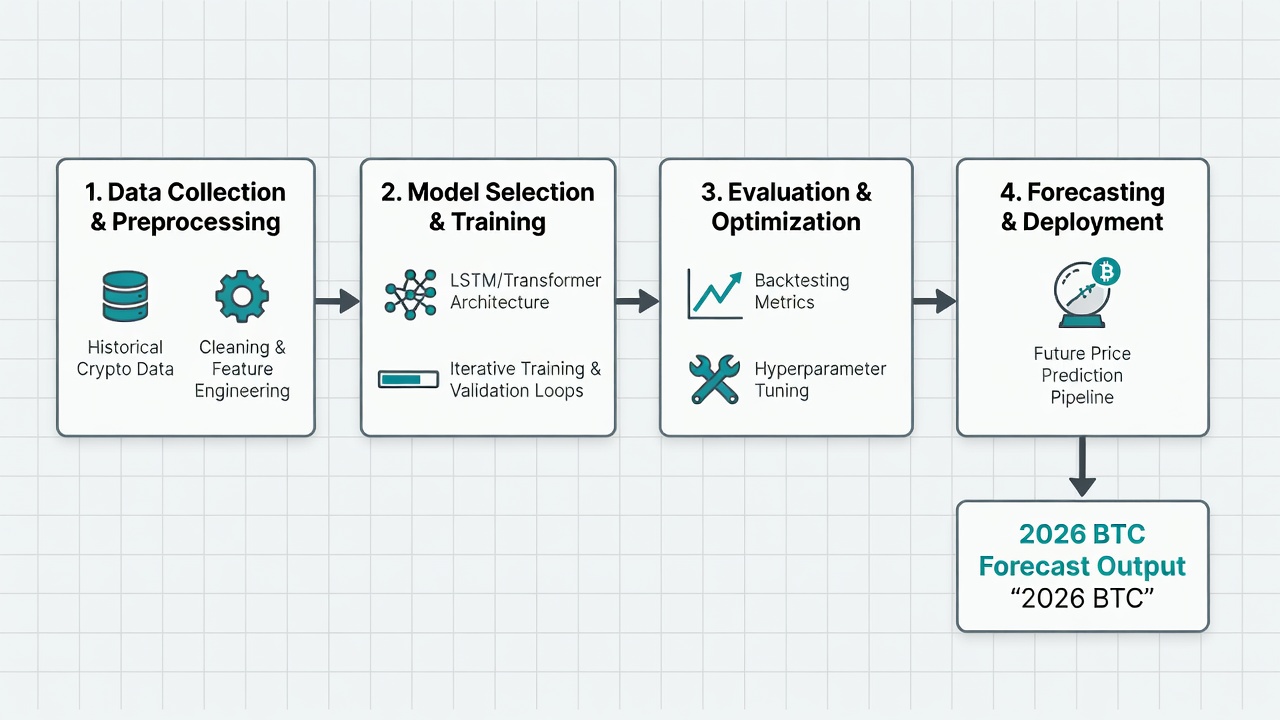
Training an AI model starts with data collection from reliable sources such as blockchain explorers and exchange APIs. Clean and normalize on-chain metrics alongside historical prices. Split data into training, validation, and test sets using walk-forward validation to simulate real trading conditions and ensure no future leakage occurs. Feature scaling via standardization or min-max normalization follows, along with handling missing values through interpolation or forward-filling techniques.
For a neural network example, use frameworks like TensorFlow or PyTorch to define an LSTM architecture with multiple layers, dropout for regularization, and attention mechanisms. Train on features including hash rate, active addresses, exchange inflows, and funding rates. Hyperparameter tuning via grid search, random search, or Bayesian optimization refines performance; typical experiments test learning rates between 0.0001 and 0.01 and sequence lengths from 30 to 180 days. After initial training, backtest the model on out-of-sample periods covering both bull and bear markets to evaluate robustness.
Practical tip: Begin with smaller datasets spanning two market cycles to validate the entire pipeline before scaling to full historical records. Monitor training curves for signs of overfitting and apply early stopping when validation loss plateaus. Once trained, deploy models using containerized services that ingest live data streams and output probability distributions rather than single-point forecasts.
Performance Comparisons with Manual Analysis
AI models consistently outperform manual chart reading in backtests, especially during high-volatility periods. Manual analysis excels in qualitative judgment and contextual understanding of geopolitical events but struggles with scale and speed when processing dozens of indicators simultaneously. Hybrid workflows where AI generates probabilistic signals that are then reviewed by experienced traders deliver optimal outcomes for many professional desks.
Key metrics for comparison include mean absolute percentage error, directional accuracy, maximum drawdown of simulated portfolios, and the Sharpe ratio of resulting trades. Studies from 2025-2026 show AI-augmented strategies achieving 15-25 percent higher risk-adjusted returns than pure discretionary approaches when transaction costs are factored in. However, during black-swan events, human oversight remains essential to override model outputs that fail to account for unprecedented circumstances.
Common Pitfalls and How to Avoid Them
Even well-designed systems encounter challenges. Overfitting to historical data without proper regularization leads to poor live performance. Ignoring regime shifts in market conditions, such as post-halving dynamics, can render models obsolete quickly. Neglecting data quality from on-chain sources introduces bias, while underestimating computational requirements for real-time inference causes latency issues. Additional pitfalls include lookahead bias during feature creation and failure to account for changing exchange liquidity landscapes.
- Always use purged cross-validation techniques to prevent information leakage.
- Implement automated monitoring for data drift in both on-chain and sentiment inputs.
- Document every preprocessing decision to maintain reproducibility across retraining cycles.
- Stress-test models against extreme scenarios including exchange outages or sudden regulatory announcements.
Frequently Asked Questions
What data sources work best for 2026 BTC models?
Combine on-chain analytics platforms with established market data providers and verified news aggregators. Reliable starting points include public blockchain nodes and aggregated exchange feeds.
How often should models be retrained?
Retraining quarterly or after major network events such as halvings maintains relevance without excessive computational overhead. Continuous learning approaches with incremental updates are gaining popularity for high-frequency applications.
Can beginners implement these techniques?
Start with open-source libraries and public tutorials on platforms like Kaggle before progressing to custom architectures. Many cloud providers now offer managed machine learning environments that lower the barrier to entry.
Conclusion
Advanced AI modeling for BTC continues to mature in 2026, offering traders powerful new capabilities when applied thoughtfully. By focusing on robust data pipelines, appropriate algorithm selection, and rigorous validation, practitioners can build systems that deliver consistent edges. The most successful implementations treat AI as a decision-support tool rather than a crystal ball, combining quantitative outputs with qualitative market awareness. As the ecosystem evolves, ongoing education and adaptation will separate sustainable strategies from fleeting experiments.
No comments yet. Be the first!