 CryptoChain Blog
Introduction to Taproot Adoption in 2026
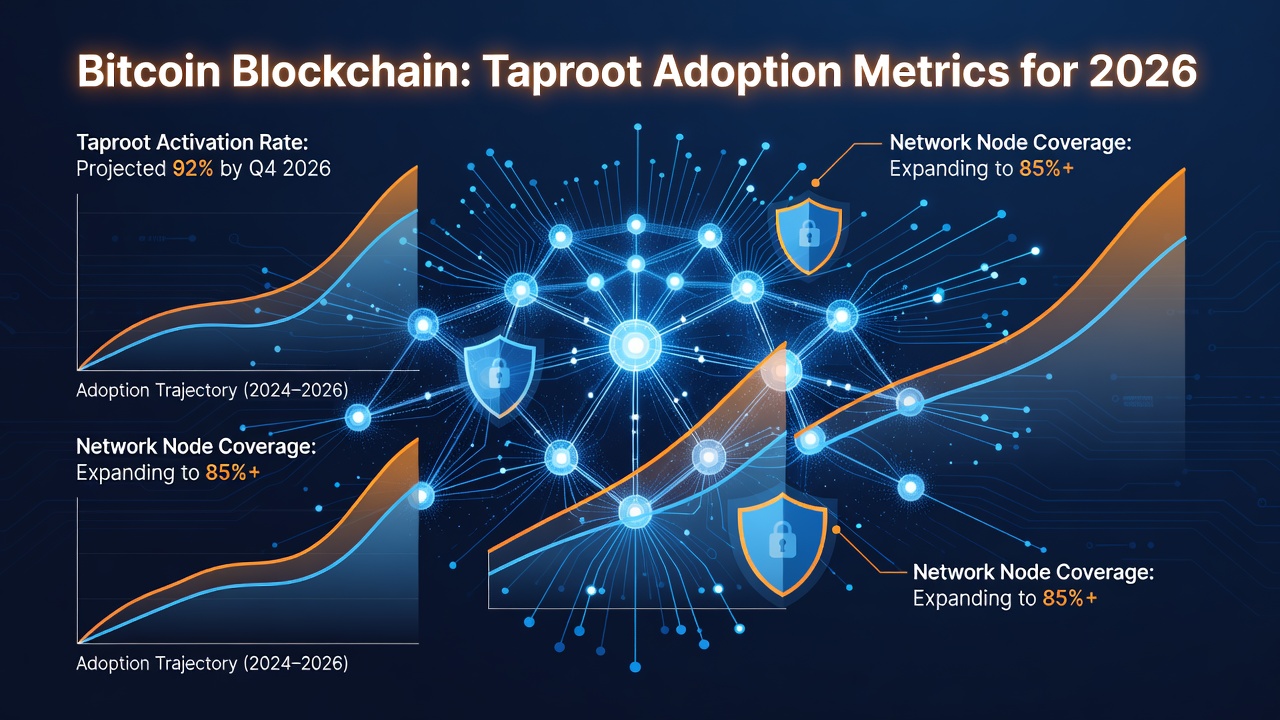
Taproot, activated in November 2021, continues to reshape Bitcoin's capabilities as the network matures into 2026. Analysts focused on practical metrics now examine how this upgrade influences transaction efficiency, privacy, and ecosystem adoption. This analysis provides actionable insights drawn from real-world usage patterns rather than speculative trends. Bitcoin's Taproot soft fork introduced Schnorr signatures and Merkelized Abstract Syntax Trees (MAST), enabling more complex smart contracts while maintaining the network's security model. By mid-2026, adoption has accelerated among major wallets and exchanges, offering measurable improvements in fee structures and data privacy.
The upgrade addressed long-standing limitations in Bitcoin scripting, allowing developers to build more sophisticated applications without bloating the blockchain. Analysts seeking Bitcoin insights for 2026 benefit from understanding these changes because they directly affect transaction costs, user anonymity, and the feasibility of advanced use cases such as multi-party contracts. Adoption metrics show gradual but consistent growth, with Taproot outputs appearing more frequently in blocks as infrastructure catches up.
Historical Context and Activation Impact
Before diving into current metrics, it helps to recall the activation process. Taproot was deployed via a soft fork coordinated by the Bitcoin Core development team and community signaling. This ensured backward compatibility, meaning older nodes could still validate new transactions. In the years since activation, the ecosystem has seen incremental improvements rather than overnight transformation.
By 2026, the effects are clearer in daily operations. Script efficiency gains allow developers to encode complex conditions more compactly, which reduces the data footprint on the blockchain. Privacy enhancements hide the details of multi-signature setups, making them look identical to single-signature payments on-chain. These changes matter for analysts because they influence how Bitcoin scales and competes with other networks focused on programmability.
Script Efficiency Gains from Taproot
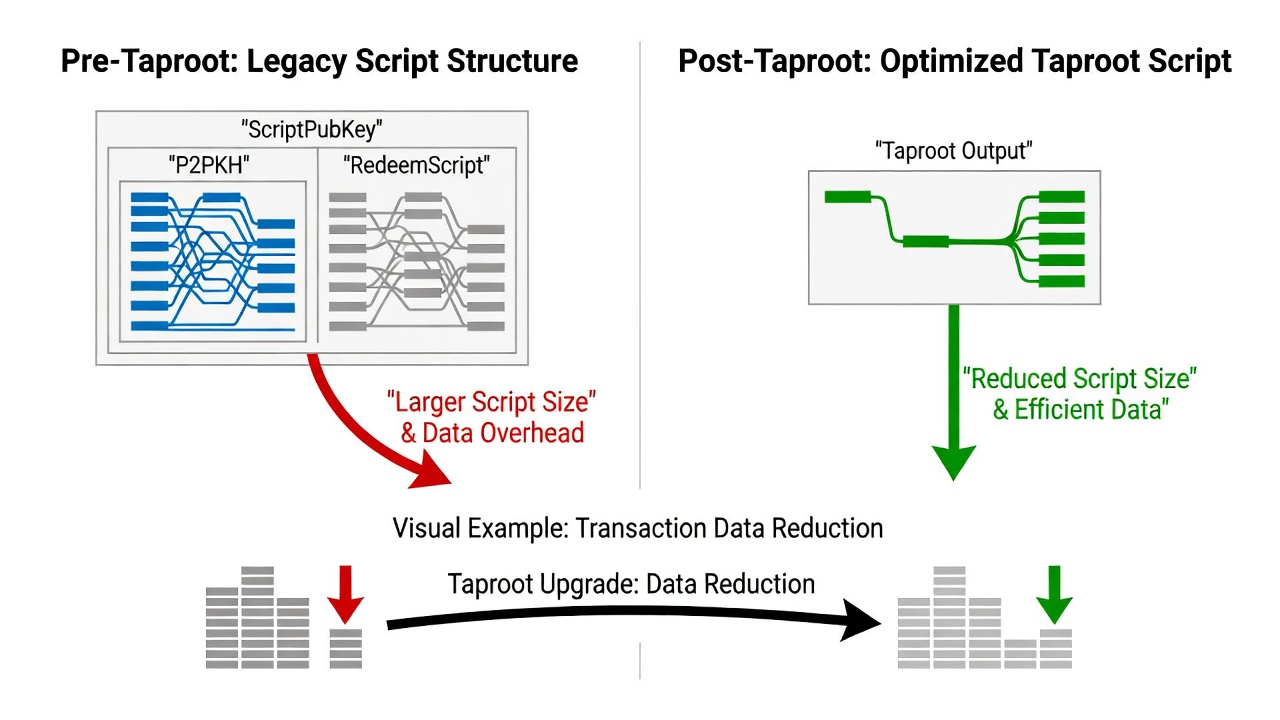
One of the most tangible benefits of Taproot lies in script efficiency. Pre-Taproot transactions involving multi-signature setups required larger script sizes, increasing on-chain data. Post-activation, complex scripts are represented more compactly through MAST, reducing the overall transaction weight. This efficiency translates to lower fees during network congestion. Analysts tracking adoption can compare transaction sizes in public explorers, noting how Taproot-enabled addresses handle batch payments with reduced byte counts. For example, a 2-of-3 multisig transaction that once occupied over 300 bytes now fits within 200 bytes in optimized Taproot formats, freeing space for additional data or simply lowering costs.
Further efficiency comes from batching and aggregation techniques that leverage Schnorr signatures. Instead of publishing multiple individual signatures, a single aggregated signature validates the entire set. This approach not only saves bytes but also improves verification speed for nodes. Practical examples include corporate treasury operations where multiple approvals are required; Taproot allows these to execute with minimal on-chain presence. Analysts should monitor how these savings accumulate across thousands of daily transactions to quantify the network-wide impact.
Privacy Enhancements in Practice
Taproot improves privacy by making complex transactions indistinguishable from simple ones on the blockchain. Schnorr signatures aggregate multiple signatures into one, obscuring the number of participants involved. Major exchanges such as those integrated with Bitcoin.org resources have begun defaulting to Taproot addresses for withdrawals. This shift reduces the visibility of user activity patterns, benefiting both retail and institutional participants seeking enhanced confidentiality without additional tools.
Privacy gains also extend to Lightning Network channels and other layer-two solutions that rely on Taproot for funding transactions. By hiding the underlying script conditions, users avoid leaking information about their wallet setups or spending policies. In 2026, this matters for analysts studying on-chain surveillance trends, as it complicates heuristic-based clustering methods used by some analytics firms. The result is a more resilient privacy baseline for the entire Bitcoin ecosystem.
Real-World Transaction Examples from Wallets and Exchanges
Leading wallets including Electrum and Sparrow have implemented Taproot support, allowing users to send funds to bc1p addresses. Exchanges like Binance and Coinbase have enabled Taproot deposits, with adoption rates climbing steadily through 2026. A practical example involves a corporate treasury using Taproot for multi-party approvals. The transaction appears as a single signature on-chain, preserving operational privacy while executing sophisticated spending conditions.
Another case study comes from decentralized finance experiments built on Bitcoin. Developers are using Taproot to create more efficient escrow mechanisms and conditional payments. These examples demonstrate how the upgrade moves beyond theory into production use. Analysts can review recent blocks to see the proportion of Taproot outputs originating from known exchange hot wallets versus individual users, providing clues about institutional versus retail adoption.
Step-by-Step Guidance: Tracking Taproot-Enabled Addresses
Analysts can monitor Taproot adoption using public blockchain explorers. Follow these steps for accurate insights:
- Visit a reliable explorer and search for recent blocks.
- Filter transactions by address prefix, focusing on bc1p for Taproot outputs.
- Compare daily volumes of Taproot versus legacy address types.
- Track fee rates associated with Taproot transactions over time.
- Export data for custom analysis of usage patterns.
- Cross-reference with wallet release notes to correlate software updates with adoption spikes.
- Observe seasonal variations, such as increased usage during market volatility periods.
This method reveals adoption curves without relying on proprietary on-chain tools. Additional tips include setting up alerts for blocks containing high percentages of Taproot outputs and combining data from multiple explorers for verification. Beginners should start with simple address-type filters before progressing to script analysis.
Pre- and Post-Adoption Fee Comparisons
Fee structures have evolved qualitatively since Taproot activation. Transactions leveraging efficiency gains typically incur lower costs during peak periods compared to equivalent pre-Taproot activity. Analysts should review mempool dynamics to observe how Taproot outputs contribute to overall network throughput improvements. By examining historical data, one can see how complex transactions that previously competed for block space now settle more affordably, freeing capacity for other users.
Tools and Resources for Deeper Analysis
Beyond basic explorers, analysts benefit from resources maintained by the Bitcoin development community. Documentation available at Bitcoincore.org provides technical details on Taproot implementation that help interpret raw blockchain data. Combining these references with custom scripts allows for automated monitoring of adoption metrics over extended periods.
FAQ: Addressing Common Misconceptions
Does Taproot compromise Bitcoin security?
No. Taproot maintains the same security guarantees through its soft-fork design, allowing optional use without forcing changes on all users.
Is Taproot only for advanced users?
While complex scripts benefit most, everyday users gain from smaller transaction sizes and better privacy even in simple payments.
How does adoption affect scalability?
By reducing data per transaction, Taproot indirectly supports higher throughput, complementing other scaling solutions like the Lightning Network.
What are the main barriers to wider Taproot use?
Legacy wallet software and exchange infrastructure still lag in some regions, though updates continue to close these gaps throughout 2026.
Conclusion
Taproot's ongoing adoption in 2026 delivers concrete benefits in efficiency and privacy for Bitcoin users. Analysts equipped with tracking methods and comparative data can better assess its ecosystem impact. Continued monitoring of wallet and exchange implementations will provide further insights as usage expands. The upgrade represents a foundational improvement that positions Bitcoin for more sophisticated applications while preserving its core principles of decentralization and security.

No comments yet. Be the first!