 CryptoChain Blog

Introduction to Proof-of-Stake in 2026
As blockchain technology matures, Proof-of-Stake (PoS) has emerged as the dominant consensus mechanism for scalable, sustainable networks. In 2026, developers and investors are closely monitoring how leading protocols balance throughput, security, and environmental impact. This analysis examines Ethereum, Cardano, and emerging PoS entrants with real-world adoption data, providing actionable insights for navigating the latest blockchain news. The evolution of PoS reflects broader industry shifts toward energy-efficient alternatives that support growing decentralized applications across finance, supply chains, and digital identity.
Core Principles of Modern PoS Systems
PoS protocols select validators based on staked assets rather than computational power. This shift dramatically reduces energy consumption compared to Proof-of-Work. Key enhancements in 2026 include advanced slashing mechanisms, liquid staking derivatives, and zero-knowledge integrations that bolster both security and privacy without sacrificing speed. Validators participate by locking tokens as collateral, earning rewards proportional to their stake while facing penalties for misconduct. These mechanics promote network stability and long-term alignment among participants.
Ethereum's PoS Journey and 2026 Performance
Ethereum completed its transition to PoS years ago and continues refining its architecture. The network now emphasizes danksharding and improved validator economics. Real-world adoption spans DeFi protocols, enterprise solutions, and layer-2 scaling solutions that process thousands of transactions per second. Ethereum.org remains the primary resource for technical specifications and upgrade roadmaps. Major upgrades in 2026 have focused on reducing validator hardware requirements, enabling broader participation from individual stakers and smaller pools. Examples include widespread use in decentralized lending platforms and NFT marketplaces that rely on Ethereum's security guarantees for high-value transactions.
Cardano's Research-Driven PoS Model
Cardano distinguishes itself through peer-reviewed research and a focus on sustainability in emerging markets. Its Ouroboros protocol has evolved with enhanced delegation features and governance tools. Adoption examples include supply-chain tracking projects in Africa and identity solutions in Asia, demonstrating practical utility beyond speculation. Cardano.org provides detailed documentation on its governance model, which allows token holders to vote on protocol changes. This approach has led to steady growth in enterprise partnerships, particularly in regions prioritizing regulatory compliance and environmental responsibility.
Newer PoS Entrants Gaining Traction
Protocols such as Sui and Aptos have introduced innovative parallel execution engines that deliver high throughput while maintaining PoS security guarantees. These newer networks attract developers seeking sub-second finality and low fees for gaming and DeFi applications. Benchmarks from mid-2026 show they often outperform legacy chains in raw transactions per second during stress tests. Sui.io highlights use cases in real-time trading and social applications. Additional entrants like newer layer-1 chains emphasize modular designs that allow easy integration with existing ecosystems, accelerating developer onboarding and mainnet deployments.
Side-by-Side Benchmarks and Metrics
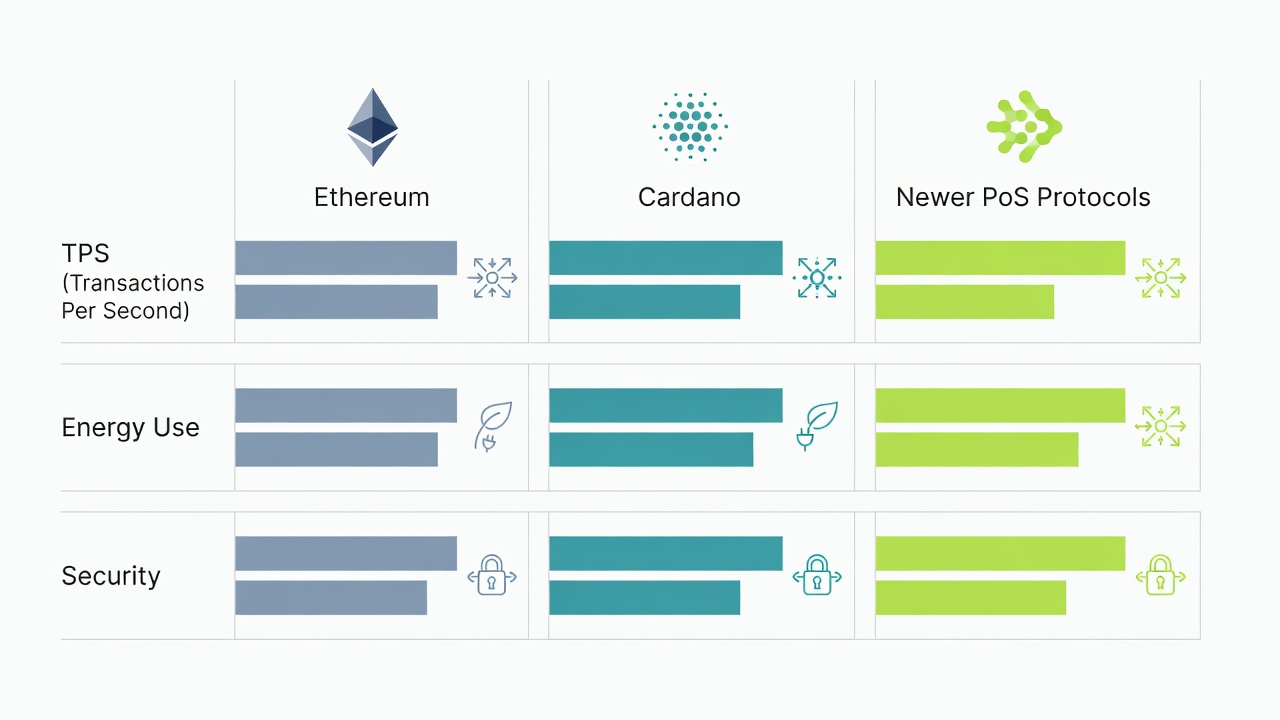
Performance comparisons in 2026 highlight clear differences. Ethereum achieves approximately 15-20 TPS on layer-1 with layer-2 solutions exceeding 100,000 TPS aggregate. Cardano maintains steady 250 TPS with strong emphasis on deterministic finality. Newer chains frequently report peaks above 10,000 TPS. Energy efficiency remains a standout PoS advantage across all examined protocols. Additional metrics include time-to-finality, where newer protocols often achieve sub-second confirmations, and validator decentralization scores that measure the distribution of stake among independent operators. These benchmarks help stakeholders assess suitability for specific use cases such as high-frequency trading versus long-term asset tokenization.
Energy Efficiency and Security Enhancements
All major PoS networks consume a fraction of the energy required by Proof-of-Work systems. Security improvements include multi-signature validator sets, formal verification of smart contracts, and real-time monitoring tools that detect anomalies faster than ever before. These upgrades address historical concerns around long-range attacks and centralization risks. In practice, networks have implemented adaptive difficulty adjustments that respond dynamically to changes in total stake, maintaining consistent block production even during periods of market volatility.
Decision Framework for Developers and Investors
Choosing a PoS protocol requires evaluating several factors:
- Throughput needs: High-frequency applications favor newer entrants with parallel processing.
- Security priorities: Established networks like Ethereum offer battle-tested validator communities.
- Energy and compliance: Cardano excels in regions with strict sustainability regulations.
- Staking rewards and risks: Assess lock-up periods, slashing conditions, and liquidity options before committing capital.
- Developer tooling: Evaluate availability of SDKs, documentation quality, and community support for rapid prototyping.
- Interoperability features: Consider cross-chain bridges and standard compatibility for seamless asset transfers.
Developers should prototype on testnets, while investors diversify across at least two protocols to mitigate single-point failures. Practical steps include reviewing on-chain governance proposals quarterly and monitoring validator performance dashboards for uptime statistics.
Staking Best Practices and Real-World Examples
Successful staking strategies in 2026 emphasize diversification and ongoing education. For instance, institutional investors often split stakes across multiple validators to reduce concentration risk. Retail participants benefit from educational resources provided by protocol foundations that outline reward calculations and tax implications. Real-world examples demonstrate how gaming studios have migrated to high-throughput PoS chains to handle in-game economies without congestion, while supply-chain companies leverage Cardano's model for transparent, auditable records.
Common Mistakes to Avoid
Many newcomers overlook the importance of validator reputation, leading to unexpected slashing events. Others ignore liquidity risks associated with certain staking derivatives during market downturns. Always verify smart contract audits and maintain awareness of protocol upgrade timelines to prevent compatibility issues with existing applications.
FAQ: Common Staking Concerns in 2026
What are typical staking reward ranges?
Rewards vary by protocol and validator performance but generally range from 3% to 8% annually, depending on network conditions and participation rates.
How do slashing risks work?
Validators face penalties for downtime or malicious behavior. Users should select reputable staking pools with insurance mechanisms and transparent reporting.
Are liquid staking options safe?
Liquid staking derivatives provide flexibility but introduce smart-contract risk. Always review audit reports and protocol maturity before using them.
What factors influence validator selection?
Key considerations include commission rates, historical uptime, geographic distribution, and community feedback from independent forums and dashboards.
How does governance participation affect staking?
Active governance involvement can influence future reward structures and protocol direction, offering stakers indirect impact on long-term network value.
Conclusion
The 2026 PoS landscape rewards those who understand nuanced trade-offs between speed, security, and sustainability. By applying the benchmarks and decision framework outlined above, readers can make informed choices amid evolving blockchain news. Continuous monitoring of protocol upgrades will remain essential throughout the year, empowering both developers and investors to capitalize on emerging opportunities.

No comments yet. Be the first!