 CryptoChain Blog

Introduction: Anticipating 2026 Regulatory Evolution in Asia
The cryptocurrency landscape in 2026 continues to be shaped by dynamic policy developments across Asia. Regulators in Singapore, Japan, and South Korea are refining compliance frameworks that influence global markets. These shifts emphasize investor protection, innovation balance, and cross-border cooperation. Businesses and traders must stay ahead to navigate risks and seize opportunities in an environment where blockchain technology underpins an increasing share of financial activity.
Forward-looking analysis reveals how new rules on stablecoins, data flows, and taxation could redefine market access. Expert forecasts suggest these changes will accelerate institutional adoption while raising the bar for operational standards. Market participants who anticipate these movements can position themselves advantageously as enforcement timelines approach and licensing regimes mature throughout the year.
Singapore's Updated Compliance Framework
Singapore's Monetary Authority continues to position the city-state as a crypto hub through enhanced licensing requirements. The focus lies on robust anti-money laundering protocols and stablecoin issuance standards that align with international norms. Companies operating exchanges must demonstrate clear governance structures to maintain licenses, including detailed risk assessments and regular third-party audits.
Cross-border data rules now require explicit consent mechanisms for user information shared across jurisdictions. This impacts platforms handling multi-regional clients, prompting investments in secure data infrastructure and encryption technologies. Firms that fail to adapt may face restrictions on serving clients from neighboring markets, limiting growth potential in the broader Asia-Pacific region.
Japan's Approach to Stablecoin Licensing and Taxation
Japan's Financial Services Agency has introduced streamlined licensing for stablecoin issuers, emphasizing transparency in reserve management. Tax implications for traders include clearer reporting on digital asset gains, encouraging compliance through simplified digital filing processes that integrate directly with existing banking systems.
Real-world examples from major exchanges like those adapting to these rules show reduced operational friction when proactive audits are conducted. Forecasts indicate further harmonization with global standards by late 2026, potentially opening doors for Japanese platforms to expand internationally. Traders benefit from predictable tax treatment that reduces uncertainty around year-end reporting obligations.
South Korea's Regulatory Innovations
South Korea's Financial Services Commission prioritizes consumer safeguards with updated enforcement timelines for virtual asset service providers. Policies address market manipulation risks through enhanced surveillance tools and mandatory reporting of large transactions. Local entity requirements are stricter than in neighboring countries, forcing foreign operators to establish physical presence or partner with domestic firms.
Comparisons with Singapore and Japan highlight South Korea's emphasis on rapid enforcement, with penalties for non-compliance that can include temporary license suspensions. Businesses entering this market must prepare detailed compliance roadmaps well in advance of key deadlines.
Cross-Border Data Rules and Their Global Ripple Effects
Unified data transfer agreements between these nations aim to facilitate seamless operations while protecting privacy. Global markets feel the impact as exchanges recalibrate their architectures to comply with varying consent standards. This creates both challenges and opportunities for technology providers specializing in compliant data solutions.
Exchanges that invest early in interoperable systems gain competitive edges, allowing smoother user experiences across borders. The ripple effects extend to decentralized finance protocols that must now incorporate jurisdiction-specific data handling modules to avoid regulatory conflicts.
Practical Step-by-Step Compliance Checklist for Businesses
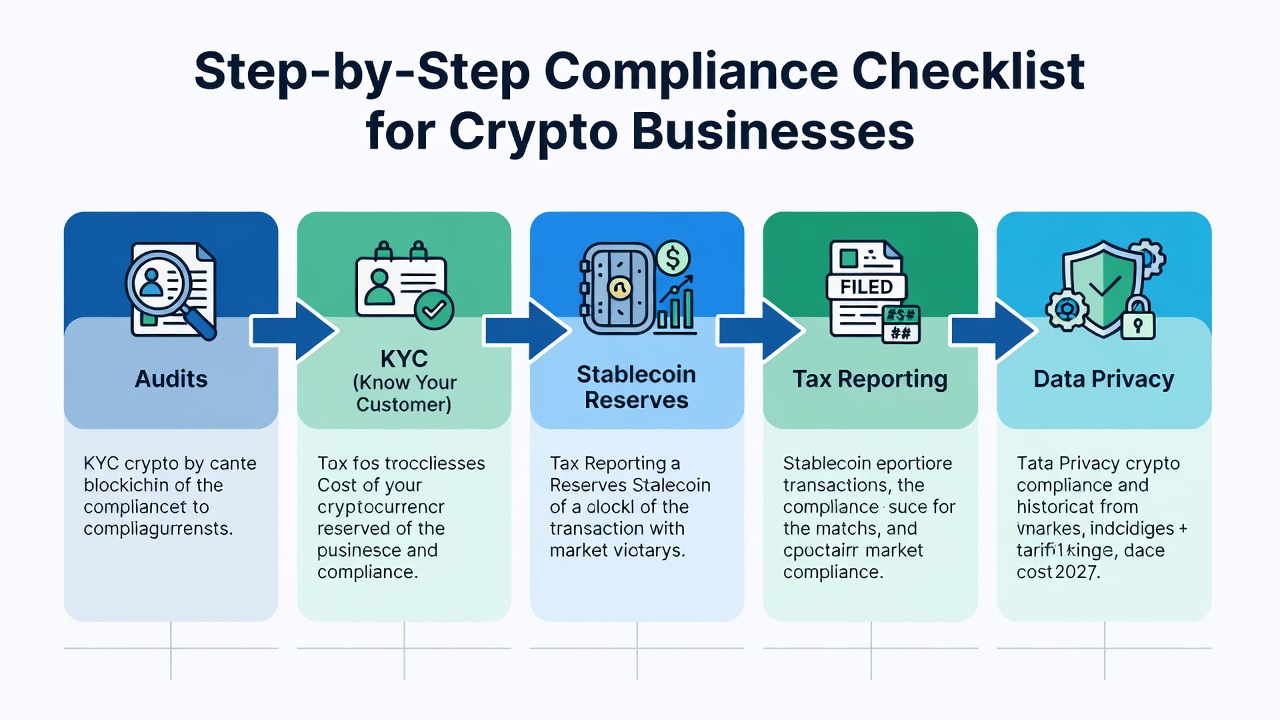
Developing a robust compliance program requires methodical execution. The following checklist provides actionable steps tailored to the 2026 regulatory environment:
- Conduct a full audit of current licensing status against 2026 requirements in each target country, documenting gaps and remediation timelines with input from local legal counsel.
- Implement enhanced KYC and AML systems with real-time monitoring capabilities, integrating AI-driven transaction screening to flag suspicious activity before it escalates.
- Establish stablecoin reserve transparency protocols aligned with new licensing updates, including monthly attestations by independent auditors and public disclosure of reserve composition.
- Review and update tax reporting workflows to cover cross-border transactions, ensuring automated reporting tools capture all taxable events across multiple jurisdictions.
- Train staff on data privacy rules and obtain necessary consents for information sharing, with annual refresher courses and clear escalation procedures for potential breaches.
- Engage legal experts for scenario planning around enforcement timelines, modeling best-case and worst-case outcomes for delayed compliance.
- Monitor regulatory announcements from official bodies for ongoing adjustments, subscribing to official newsletters and participating in industry working groups.
Case Studies from Major Exchanges
Leading platforms have demonstrated success by integrating compliance early. One exchange expanded its Asia presence after aligning with Singapore's data frameworks, resulting in increased user trust and higher trading volumes from institutional clients. Another navigated Japan's tax updates by developing user-friendly reporting tools that reduced customer support queries by a significant margin.
A third operator in South Korea partnered with local banks to meet entity requirements, enabling faster market entry despite stricter rules. These examples illustrate that proactive adaptation often translates into sustainable competitive advantages rather than mere survival tactics.
Investment Risks and Opportunities: Trend Forecasts
Opportunities arise in licensed stablecoin ecosystems and compliant DeFi protocols that can scale across regulated jurisdictions. Risks include potential market volatility during transition periods when enforcement actions become public. Expert quotes underscore the value of diversified strategies focused on regulated jurisdictions, with particular attention to stablecoin issuers that demonstrate full reserve backing.
Trend forecasts point toward increased institutional inflows into Asia-compliant products as clarity improves. Businesses that treat regulation as a strategic advantage rather than a hurdle are best positioned to capture emerging market share in 2026 and beyond.
FAQ on Enforcement Timelines and Common Queries
When do the new stablecoin licensing rules take full effect?
Implementation phases are scheduled throughout 2026, with key milestones in Q2 and Q4 depending on the jurisdiction. Early preparation is essential for issuers planning to launch new products.
How do tax implications differ for traders across these countries?
Each nation offers distinct reporting thresholds, but all emphasize accurate gain calculations on digital assets. Singapore focuses on corporate structures while Japan and South Korea prioritize individual trader disclosures.
What resources can businesses consult for the latest updates?
Official regulator sites provide primary guidance: Monetary Authority of Singapore, Financial Services Agency of Japan, and Financial Services Commission of Korea.
Are there penalties for missing enforcement deadlines?
Yes, regulators can impose fines, license revocations, or operational restrictions. The severity depends on the nature of the violation and prior compliance history.
Conclusion: Preparing for Market Movements
Asia's 2026 regulatory shifts present a blueprint for global crypto governance. By adopting proactive compliance measures, stakeholders can mitigate risks and capitalize on emerging opportunities in this evolving sector. Continuous monitoring and agile adaptation will remain critical success factors as these frameworks mature.


No comments yet. Be the first!