 CryptoChain Blog

Introduction to Decentralized Compute Networks in 2026
The crypto landscape in 2026 continues to evolve rapidly, with decentralized compute networks emerging as a critical infrastructure layer that bridges blockchain technology and high-performance computing demands. These blockchain-based systems distribute computational tasks across global node operators, enabling secure, censorship-resistant processing for AI workloads and large-scale data analytics. Unlike traditional centralized clouds, they leverage token incentives to coordinate resources, reducing single points of failure while enhancing transparency through immutable ledgers. In 2026, the surge in AI model complexity and data-intensive applications has accelerated adoption, as developers seek alternatives that avoid vendor lock-in and offer verifiable execution.
This article delves into leading projects, real performance data, ecosystem integrations, and practical participation methods. Technical readers will find actionable steps, comparisons, and regulatory context to inform infrastructure decisions. We also examine how these networks integrate with existing crypto ecosystems and highlight common pitfalls to avoid when deploying workloads.
Leading Projects Powering Decentralized Compute
Several established protocols dominate the space in 2026. Akash Network focuses on containerized workloads with a marketplace model that allows providers to bid on compute resources using Kubernetes orchestration. Render Network specializes in GPU rendering and now extends to AI training by distributing rendering and inference tasks across a peer-to-peer network of GPU owners. io.net aggregates idle GPUs for distributed machine learning tasks, emphasizing scalability for large language model fine-tuning. These projects integrate with major blockchains like Ethereum and Solana for settlement and governance, using smart contracts to automate payments and dispute resolution.
Developers benefit from open-source tooling that abstracts complexity, allowing deployment via familiar interfaces while smart contracts handle payments and verification. Additional projects such as Golem and Nosana contribute by targeting specific niches like general-purpose CPU tasks and Solana-centric GPU compute, respectively. Each network maintains its own tokenomics to incentivize uptime and honest reporting of resource availability.
Performance Benchmarks Versus Centralized Clouds
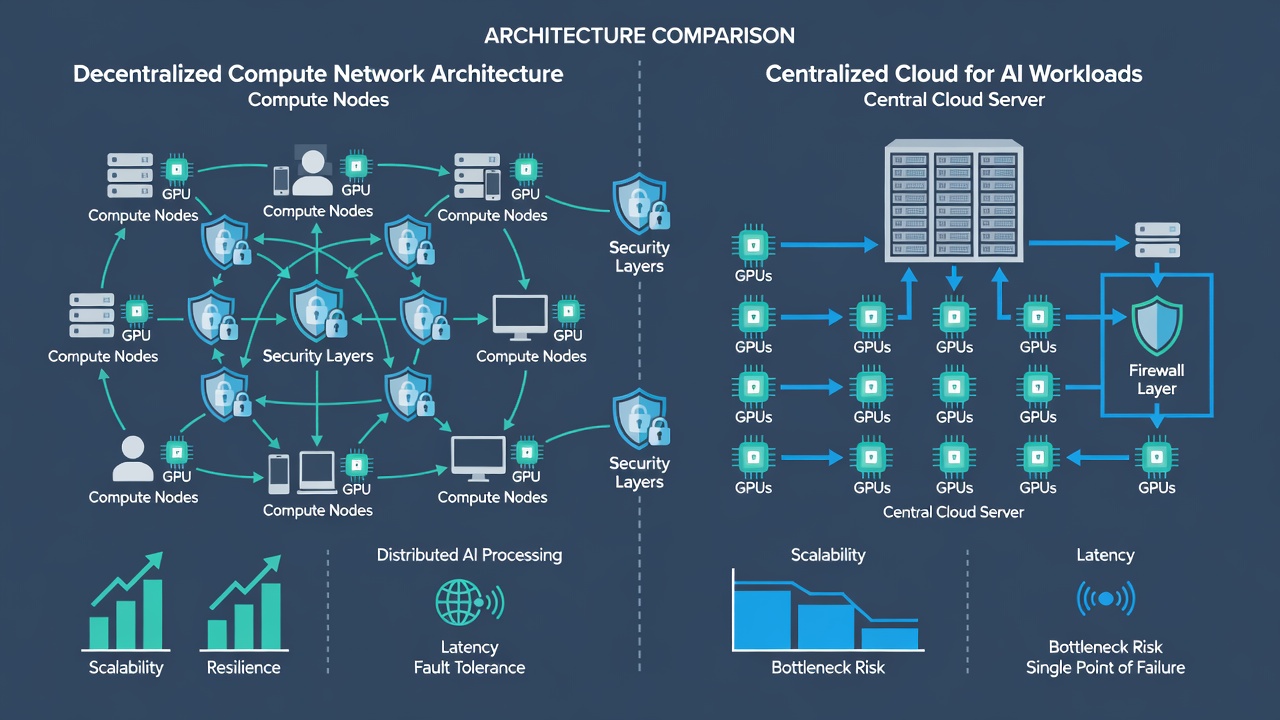
Benchmarks from mid-2026 show decentralized networks achieving competitive latency for inference tasks, often within 15-20% of centralized providers for distributed workloads. Throughput for parallel AI training jobs can match or exceed traditional setups when node density is high. Cost efficiency arises from peer-to-peer resource sharing, though variability depends on network congestion and task complexity. Security advantages include cryptographic proofs of execution, mitigating risks associated with data center breaches and offering end-to-end audit trails.
Comparisons highlight trade-offs: centralized options offer predictable SLAs and mature tooling, while decentralized alternatives provide greater resilience and auditability through on-chain records. Independent testing has demonstrated that decentralized setups excel in scenarios requiring geographic redundancy or resistance to regional outages. For developers evaluating options, factors like task duration, data sensitivity, and required hardware specialization play key roles in decision-making.
Real-World Adoption and Case Studies
Independent developers in the DeFi sector use these networks for off-chain oracle computations, achieving reliable uptime during peak trading periods. AI startups leverage them for model fine-tuning without upfront hardware investments, enabling rapid iteration on generative models. One notable case involves a climate data analytics firm processing satellite imagery across thousands of nodes, reducing central dependency while maintaining data integrity via zero-knowledge proofs.
Another example comes from a healthcare research consortium that utilized decentralized compute to analyze anonymized genomic datasets, distributing workloads to comply with privacy regulations while accelerating insights. In the gaming industry, studios have adopted these networks for real-time physics simulations and procedural content generation, integrating results directly into on-chain assets. Integration examples include bridging compute tokens with Ethereum-based DeFi protocols for yield-generating staking of unused resources, creating additional revenue streams for node operators.
Cost, Security, and Regulatory Considerations
Security models rely on economic staking and slashing mechanisms to deter malicious behavior, combined with trusted execution environments and verifiable computation protocols. Regulatory landscapes vary globally, with frameworks in the EU emphasizing data sovereignty and the US focusing on securities classification for compute tokens. Projects increasingly incorporate compliance features like permissioned subnets to navigate these environments without sacrificing decentralization benefits.
Technical users should review Ethereum documentation for smart contract best practices and consult SEC resources on evolving digital asset rules. Additional guidance is available through standards bodies such as NIST for cybersecurity frameworks applicable to distributed systems.
Integration with Existing Crypto Ecosystems
Decentralized compute networks seamlessly connect with broader crypto infrastructure through cross-chain bridges and oracle services. For instance, Solana-based projects benefit from high-speed transaction finality when settling compute jobs, while Ethereum Layer-2 solutions provide cost-effective governance voting. Token holders can participate in liquidity pools that pair compute tokens with major assets, enhancing capital efficiency. This interoperability allows developers to combine compute resources with DeFi lending protocols, NFT marketplaces, and decentralized identity systems for end-to-end application stacks.
Practical Steps for Participation
- Research node requirements on project documentation and ensure hardware meets GPU or CPU thresholds, including adequate cooling and stable internet connectivity.
- Acquire native tokens via reputable exchanges and stake them to join the network, monitoring lock-up periods and reward distribution schedules.
- Deploy workloads using provided SDKs, starting with testnets to validate configurations and estimate resource consumption.
- Monitor performance through dashboards and adjust bids for optimal resource allocation, incorporating redundancy for mission-critical tasks.
- Participate in governance forums to influence protocol upgrades and contribute to community-driven improvements.
- Implement logging and alerting systems to track job completion rates and respond quickly to any anomalies.
Mistakes to Avoid
Common errors include underestimating hardware demands, which leads to failed bids or poor performance scores. Another frequent issue is neglecting security audits of custom smart contracts used for job orchestration. Developers should also avoid concentrating workloads on a single network without diversification, as this introduces unnecessary risk during congestion events. Finally, ignoring regulatory updates in target jurisdictions can result in compliance challenges when scaling operations.
Frequently Asked Questions
How do I set up a node on a decentralized compute network?
Begin by reviewing the specific project's official guides, install required software, and connect via wallet integration for staking and rewards tracking. Test configurations on a small scale before committing significant resources.
What are common setup challenges?
Network latency and hardware compatibility issues often arise; starting on testnets and verifying firewall settings resolves most initial problems. Bandwidth limitations can also impact performance for data-heavy tasks.
Can these networks handle sensitive AI data?
Many incorporate encryption layers and verifiable computation, but users must evaluate threat models and select projects with audited security protocols. Hybrid approaches combining on-chain verification with off-chain privacy techniques are increasingly common.
How does token volatility affect participation?
Volatility influences staking rewards and operational costs, so participants often employ hedging strategies or stablecoin-denominated payment options where available.
What hardware is typically required?
Requirements vary by project but generally include modern GPUs with sufficient VRAM for AI tasks, reliable power supplies, and high-speed internet connections exceeding 100 Mbps upload speeds.
Conclusion
Decentralized compute networks represent a maturing component of the 2026 crypto ecosystem, offering robust alternatives for AI and data workloads. By understanding benchmarks, adoption patterns, integration possibilities, and participation steps, technical practitioners can leverage these systems effectively while navigating security and regulatory factors. Continued innovation promises even tighter integration with existing blockchains, positioning these networks as foundational infrastructure for the next wave of decentralized applications.


No comments yet. Be the first!