 CryptoChain Blog

Introduction: The Quantum Shadow Over Blockchain Security
As we move deeper into 2026, the intersection of quantum computing and cryptocurrency security demands urgent attention from investors, developers, and institutions worldwide. Quantum computers, leveraging principles like superposition and entanglement, threaten to undermine the cryptographic foundations of major blockchains. This article provides forward-looking market insights into these risks, examining vulnerabilities in current encryption standards, projected timelines for quantum threats, real-world blockchain examples, comparisons of major coins' resilience, and proactive defense strategies such as post-quantum cryptography. The goal is to equip readers with a clear understanding of how these technologies collide and what steps can be taken today to mitigate future disruptions.
Current encryption standards such as RSA and elliptic curve cryptography (ECC) underpin Bitcoin, Ethereum, and most altcoins. Quantum algorithms like Shor's could theoretically break these in polynomial time, exposing private keys and enabling unauthorized transactions. While large-scale quantum computers capable of this feat remain years away, proactive preparation is essential to avoid a scramble once capabilities mature. The crypto market has already begun pricing in long-term technological risks, making education on quantum resilience a priority for portfolio managers and individual holders alike.
Understanding Vulnerabilities in Current Encryption Standards
Blockchain security relies heavily on public-key cryptography for transaction signing and address generation. Quantum threats target the discrete logarithm problem and integer factorization, which ECC and RSA solve inefficiently on classical machines but which Shor's algorithm solves efficiently on quantum hardware. Grover's algorithm further reduces the security of hash functions like SHA-256 by providing quadratic speedups for brute-force searches. These mathematical breakthroughs mean that once sufficiently powerful quantum machines exist, an attacker could derive private keys from public addresses in hours rather than billions of years.
These vulnerabilities create asymmetric risks: while symmetric encryption can be strengthened by doubling key sizes, asymmetric schemes require entirely new paradigms. Developers must evaluate migration paths now to avoid future disruptions. For instance, many legacy wallets still rely on secp256k1 curves that offer no built-in quantum resistance, leaving exposed addresses vulnerable if quantum capabilities advance faster than anticipated. Understanding these technical details helps investors appreciate why certain projects are accelerating research into alternative signature schemes.
Projected Timelines for Quantum Threats
Expert consensus suggests cryptographically relevant quantum computers may emerge between 2030 and 2040, though breakthroughs could accelerate this window. As of mid-2026, prototypes with hundreds of logical qubits exist, but error-corrected systems capable of running Shor's algorithm on 2048-bit keys are not yet operational. Monitoring progress from labs like those at IBM and Google remains critical for timely responses. Industry roadmaps indicate steady improvements in qubit stability and error correction, meaning the window for preparation is narrowing even if the exact arrival date stays uncertain.
Scenarios range from gradual capability growth allowing orderly upgrades to sudden leaps triggered by a major research milestone. In either case, blockchains that have already begun integrating quantum-resistant primitives will hold a significant advantage. Investors tracking these timelines should follow quarterly hardware announcements and government funding reports that often signal acceleration in the field.
Real-World Blockchain Examples and Resilience Comparisons
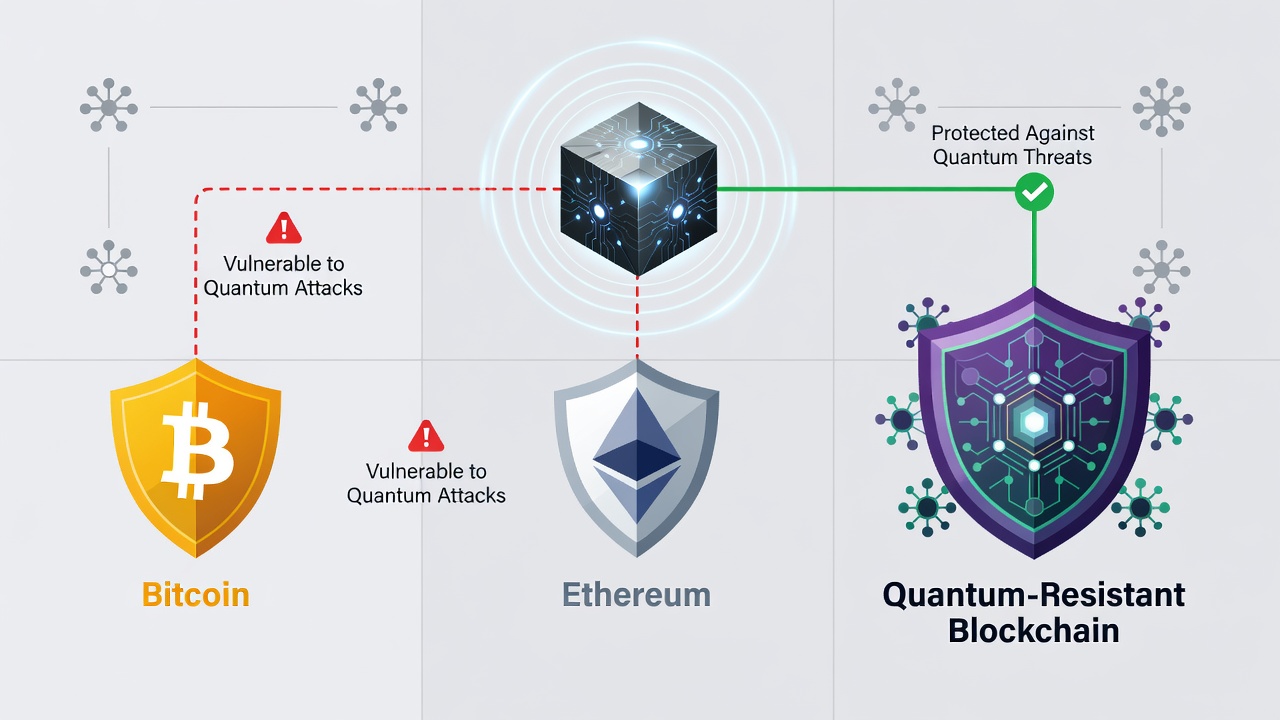
Bitcoin's use of ECDSA makes its signature scheme particularly exposed once quantum supremacy is achieved. Ethereum's transition to proof-of-stake improved some aspects but retained similar elliptic curve dependencies. In contrast, projects like QRL (Quantum Resistant Ledger) have already implemented hash-based signatures such as XMSS. Other networks, including certain enterprise-focused chains, are experimenting with lattice-based cryptography that offers stronger resistance to both classical and quantum attacks.
Comparisons reveal stark differences: Bitcoin and Ethereum currently score low on quantum readiness, while newer chains experimenting with lattice-based or hash-based cryptography demonstrate higher resilience. Investors should review whitepapers for explicit post-quantum commitments. For example, several layer-1 protocols launched in 2025 have incorporated hybrid signature schemes that combine classical and post-quantum methods, providing a bridge during the transition period. These real-world implementations serve as case studies for how the broader ecosystem might evolve without sacrificing security or performance.
Proactive Defense Strategies: Post-Quantum Cryptography
Post-quantum cryptography (PQC) offers viable alternatives. NIST has standardized algorithms including CRYSTALS-Kyber for key encapsulation and CRYSTALS-Dilithium for digital signatures. Blockchains can integrate these via hard forks or layered protocols without sacrificing decentralization. Additional strategies include hybrid schemes combining classical and quantum-resistant methods during transition periods, quantum key distribution (QKD) for high-value networks, and regular security audits focused on cryptographic agility.
Implementation challenges include larger signature sizes that could affect transaction throughput and the need for extensive testing to ensure compatibility across wallets and exchanges. Practical examples show that some projects have already completed testnet migrations using Dilithium-based signatures, demonstrating that performance overhead can be managed through optimized code. Organizations should also consider multi-signature setups that layer different cryptographic families for added redundancy.
- Adopt NIST-approved PQC standards early through community governance proposals
- Implement wallet upgrades supporting multiple signature schemes with backward compatibility
- Monitor quantum hardware roadmaps from major research institutions and adjust timelines accordingly
- Diversify holdings across quantum-aware projects while maintaining core positions in established networks
- Participate in or fund open-source PQC libraries tailored for blockchain environments
Risk Assessment Framework for Investors
A practical framework involves scoring assets on exposure level (high/medium/low), migration feasibility, and community momentum toward PQC. High-exposure assets like legacy Bitcoin holdings warrant hedging through diversified portfolios or insured custody solutions. Medium-risk assets may require monitoring and selective upgrades, while low-risk holdings can serve as stable anchors during industry transitions. Applying this framework consistently helps investors avoid both complacency and overreaction.
Steps for Investors to Future-Proof Portfolios
- Conduct a crypto audit to identify vulnerable addresses and migrate funds to quantum-resistant wallets where available.
- Stay informed via authoritative sources such as NIST updates on PQC standardization.
- Allocate a portion of holdings to projects explicitly building quantum resistance and review their development progress quarterly.
- Engage with IBM Quantum educational resources to track hardware milestones and understand technical feasibility.
- Consult with custody providers about their quantum-readiness roadmaps and insurance options covering cryptographic breakthroughs.
- Test small transfers using emerging PQC wallets to gain practical experience before larger migrations.
FAQ: Common Concerns About Adoption Impacts
Will quantum computers make all cryptocurrencies worthless overnight?
No. The transition will be gradual, allowing time for upgrades. Early movers will maintain security while laggards face higher risks, but the market as a whole is expected to adapt through coordinated hard forks and protocol improvements.
How soon should retail investors act?
Begin portfolio reviews in 2026, prioritizing education and diversification rather than panic selling. Focus first on understanding which assets carry the highest exposure.
Are there regulatory implications?
Regulators are beginning to discuss quantum readiness; expect guidance aligned with financial stability mandates in coming years. Institutional players may face compliance requirements earlier than retail participants.
What role will exchanges play in the transition?
Major exchanges are likely to enforce wallet upgrades and delist non-compliant assets if risks materialize, making proactive migration important for liquidity access.
Conclusion
Quantum computing poses a manageable yet significant long-term risk to blockchain ecosystems. By understanding vulnerabilities, timelines, and defense mechanisms today, market participants can position themselves for resilient growth. Continued collaboration between cryptographers, developers, and investors will determine how smoothly the industry navigates this technological shift, ensuring that blockchain remains a secure foundation for digital assets well into the next decade.


No comments yet. Be the first!