 CryptoChain Blog

Introduction to Crypto Taxation in 2026
As digital assets continue to mature, investors face increasingly sophisticated tax frameworks in 2026. This guide delivers practical, actionable strategies to minimize liabilities while ensuring full compliance with evolving regulations. Whether you hold Bitcoin, Ethereum, or participate in DeFi protocols, understanding these rules is essential for portfolio efficiency. Cryptocurrency taxation has shifted from basic reporting to nuanced strategies involving timing, asset classification, and cross-border considerations. Investors who proactively adapt can reduce their overall tax burden without crossing into non-compliance territory.
Key 2026 Regulatory Updates for Digital Assets
Tax authorities worldwide have refined their approaches to cryptocurrency. Capital gains remain a primary focus, with short-term and long-term rates varying by holding period. Investors must report all disposals, including trades, staking rewards, and NFT sales. IRS guidelines provide foundational references for U.S. taxpayers, while international bodies like the OECD continue harmonizing cross-border reporting standards. New rules emphasize real-time data sharing between exchanges and governments, making automated tracking more important than ever. Additional updates include clearer definitions for DeFi activities and expanded requirements for reporting foreign crypto holdings.
Capital Gains Reporting Best Practices
Accurate reporting starts with detailed transaction logs. Calculate gains or losses by subtracting cost basis from sale proceeds. Use FIFO, LIFO, or specific identification methods depending on jurisdiction. Always maintain records of acquisition dates, wallet addresses, and exchange statements for at least seven years. For example, an investor who purchased tokens in multiple batches can choose the specific identification method to optimize which lots are sold first, potentially lowering taxable gains. Failure to track properly often leads to overpayment or audits. Consider integrating blockchain analytics tools that automatically categorize events such as transfers, swaps, and rewards.
Tax Loss Harvesting Methods
Loss harvesting allows investors to offset gains by strategically selling underperforming assets. In 2026, timing is critical—execute sales before year-end while avoiding wash-sale rules that may apply to crypto in certain markets. Re-invest proceeds in similar but not substantially identical assets to maintain market exposure. A step-by-step approach includes reviewing portfolio performance quarterly, identifying assets with unrealized losses, executing sales in a tax-efficient window, and documenting every step for audit readiness. This technique works especially well for diversified portfolios containing multiple altcoins.
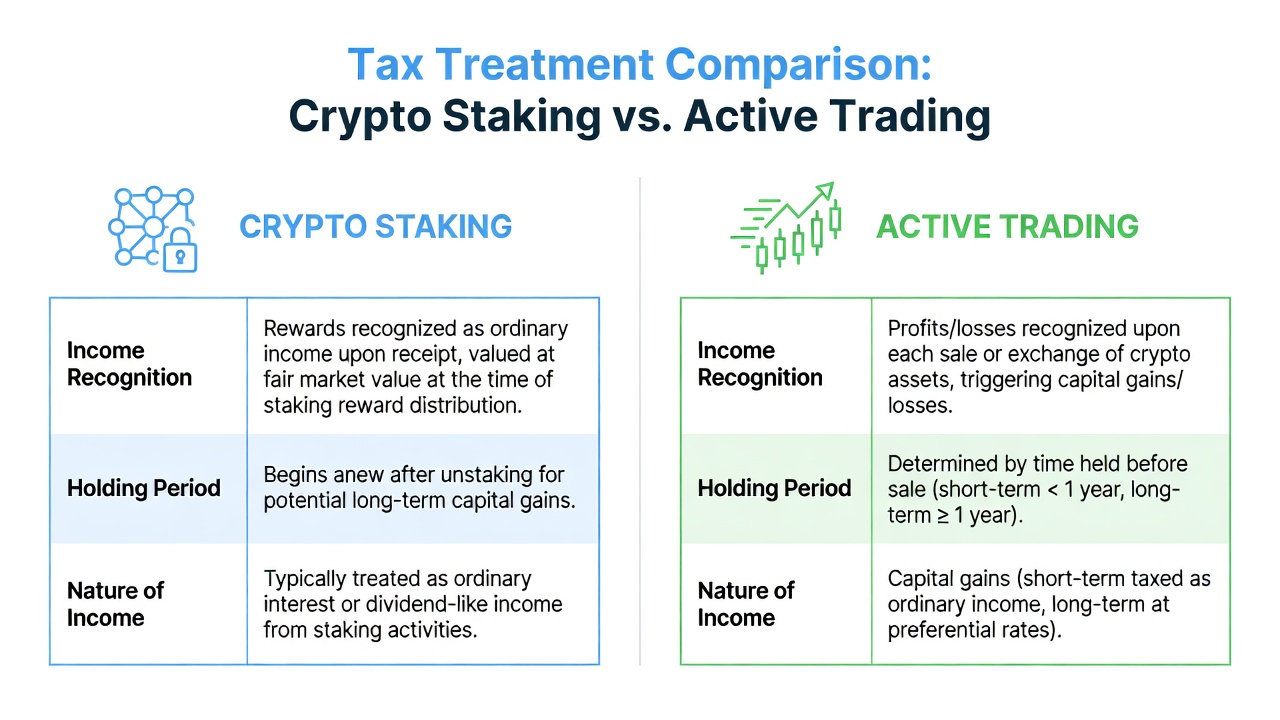
Staking Versus Trading: Tax Treatment Comparison
Staking rewards are typically taxed as ordinary income upon receipt, based on fair market value. Trading, by contrast, triggers capital gains events on each disposal. Here is a quick comparison:
- Staking: Income tax on rewards; potential capital gains on later sale of staked tokens; lower transaction frequency reduces reporting volume.
- Trading: Capital gains or losses on every buy-sell pair; higher transaction volume increases reporting complexity; short-term rates often apply to active traders.
- Key Difference: Staking creates recurring income events, while active trading amplifies short-term gain exposure.
- Hybrid Approach: Many investors combine both by staking long-term holdings and actively trading smaller allocations to balance income and growth.
- Record-Keeping Impact: Stakers need reward valuation snapshots, whereas traders require full trade histories.
Jurisdiction-Specific Rules Across Major Markets
U.S. investors follow IRS rules treating crypto as property. EU members apply VAT and capital gains directives with country-level variations. Singapore and Portugal continue offering favorable regimes for long-term holders. Always consult local statutes and consider residency planning for optimization. In the United States, the focus remains on Form 8949 and Schedule D filings. European investors must navigate both EU-wide directives and national implementations, such as Germany's one-year holding exemption. Asian markets like Japan require detailed annual reporting of crypto income, while emerging jurisdictions in Latin America are rapidly introducing new compliance frameworks.
Step-by-Step Guide to Tracking Transactions
- Export CSV files from every exchange and wallet used during the tax year.
- Aggregate data in tax software that supports API imports from major platforms.
- Reconcile on-chain activity using block explorers to verify off-exchange movements.
- Classify each event as income, trade, or transfer with supporting documentation.
- Generate Form 8949 equivalents and review for accuracy before filing.
- Archive all source materials in a secure, backed-up digital folder system.
Real-World Examples of Compliant Portfolio Adjustments
Consider an investor who harvested losses from altcoin positions in Q4 2025 to offset gains from Ethereum appreciation. By reallocating into diversified index funds and staking stablecoins, the portfolio achieved tax-efficient growth while remaining fully compliant. Another case involved a DeFi user who reported liquidity provision fees as miscellaneous income, avoiding underreporting penalties through meticulous on-chain logging. A third example shows a trader who used specific identification to sell high-basis assets first, reducing short-term capital gains exposure across multiple exchanges.
Common Pitfalls and Case Studies
Many investors overlook international transfers, mistakenly treating them as non-taxable events. A 2025 case study revealed a trader fined for failing to report DeFi yield as income. Another common error is ignoring cost basis adjustments after hard forks or airdrops. Proactive audits and professional reviews help mitigate these risks. One investor avoided penalties by maintaining separate wallets for different strategies and reconciling every month, while another faced additional scrutiny due to inconsistent exchange exports that did not match on-chain records.
Tools and Software for Crypto Tax Compliance
Selecting the right tools can dramatically simplify compliance. Popular platforms offer direct exchange integrations, automated cost-basis calculations, and export features compatible with major tax software. When choosing a solution, prioritize those with strong audit trails and support for DeFi protocols. Always verify that the software updates its rules engine to reflect 2026 regulatory changes before relying on generated reports.
Frequently Asked Questions
How are international crypto transfers taxed?
Transfers between your own wallets are generally non-taxable, but any subsequent sale triggers capital gains. Report foreign accounts under applicable FBAR or CRS rules. Maintain detailed logs of wallet addresses and timestamps for every movement.
What about DeFi income reporting?
Yield farming, lending rewards, and governance token distributions count as taxable income. Track token values at receipt date and maintain detailed protocol interaction logs. Some jurisdictions require separate schedules for decentralized finance activities.
Do hard forks create taxable events?
Receiving new tokens from a hard fork is usually treated as ordinary income at the time the tokens become available to you. Document the fair market value on the date you gain control of the new assets.
Conclusion
Effective 2026 crypto tax strategies combine meticulous record-keeping, strategic loss harvesting, and jurisdiction awareness. By following the step-by-step processes outlined above and avoiding common pitfalls, investors can optimize returns while staying fully compliant. Regular portfolio reviews, professional consultations, and the use of reliable tracking tools provide the foundation for long-term success in this evolving landscape. Consult qualified tax professionals for personalized advice tailored to your specific holdings and residency.


No comments yet. Be the first!