 CryptoChain Blog

Introduction to DeFi Composability in 2026
DeFi continues to evolve through modular building blocks often called money legos. In 2026, advanced composability allows users to chain protocols like Aave, Uniswap, and Yearn-style vaults for optimized yields. This approach treats each protocol as a reusable component that can be combined for superior returns while managing risks carefully. The concept builds on the foundational principles of permissionless smart contracts on Ethereum and compatible layer-2 networks, enabling seamless interactions that were once complex and costly to execute.
Composability works because smart contracts are permissionless and interoperable on Ethereum and layer-2 networks. Users can supply assets to Aave for lending, use the resulting collateral on Uniswap for liquidity provision, and then deposit LP tokens into automated vaults. The result is layered yield generation that exceeds single-protocol strategies. For deeper context on the underlying blockchain infrastructure, refer to resources from the Ethereum Foundation. This modular design has matured significantly, allowing sophisticated strategies that capture multiple revenue streams simultaneously without requiring users to manage each step manually.
Modular Smart Contract Flows Across Key Protocols
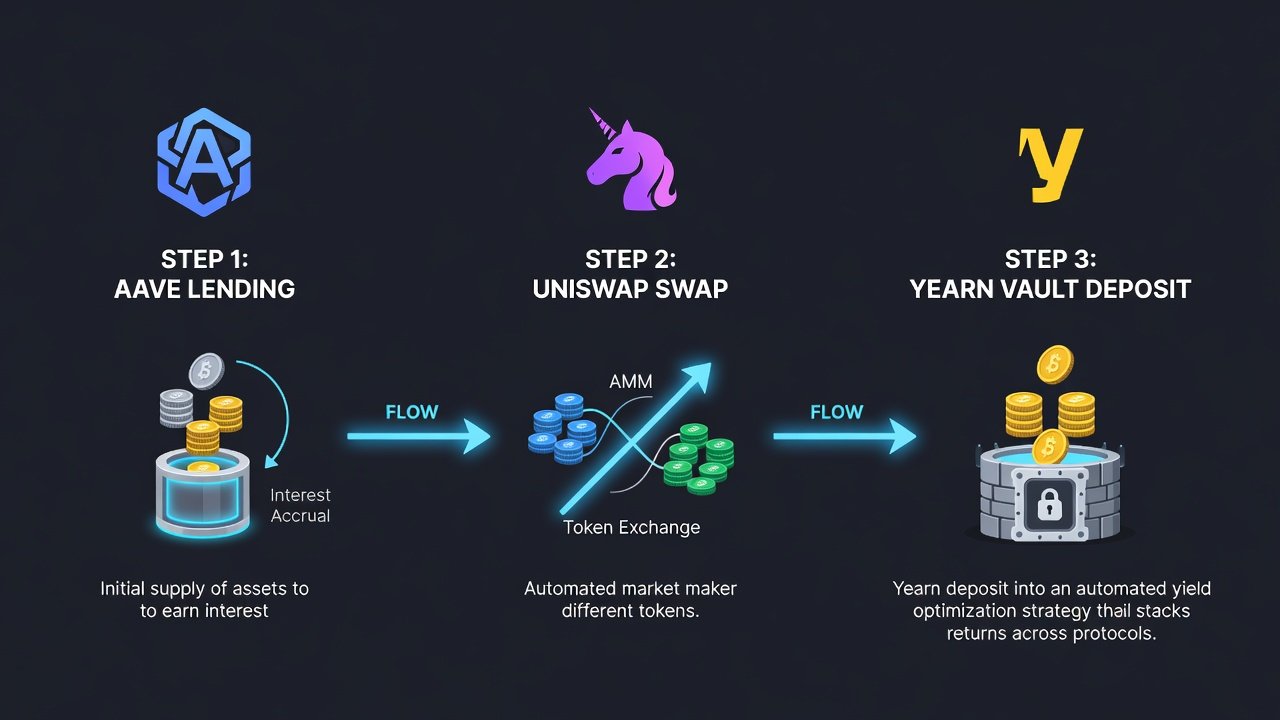
Understanding the technical flow is essential for anyone looking to implement these strategies effectively. Start by depositing collateral into Aave to borrow stablecoins at a low rate. Swap those stables on Uniswap for volatile assets offering higher fees. Finally, route the position into a Yearn-style vault that automates compounding and rebalancing. Each step relies on standardized interfaces such as ERC-20 approvals and permit functions that minimize user friction.
These flows rely on atomic transactions where approvals and executions happen in one bundle. Developers use tools like multicall contracts to reduce steps and gas costs. Real examples include looping strategies where borrowed assets are redeposited to amplify leverage while monitoring liquidation thresholds. When integrating with the Aave protocol, users must pay close attention to interest rate models and reserve factors that can fluctuate based on utilization. Similarly, connecting to Uniswap requires understanding concentrated liquidity positions and impermanent loss calculations to avoid unexpected drawdowns.
Practical Implementation Steps
To execute a basic modular flow, first connect a wallet to a supported network and approve the necessary token allowances. Next, interact with Aave's lending pool contract to supply collateral and borrow. Use a router contract to execute the Uniswap swap atomically. Finally, deposit the output tokens into the chosen vault contract. Testing these sequences on a testnet like Sepolia before mainnet deployment is highly recommended to identify any edge cases in the contract interactions.
Real-World Examples of Yield Stacking Stacks
One high-performing stack involves USDC supplied to Aave, borrowed ETH swapped on Uniswap into wstETH, then deposited into a Yearn vault for auto-compounding staking rewards. This creates triple yield from lending interest, trading fees, and staking returns. In practice, this stack has been adapted by many users on Arbitrum to minimize transaction fees while maintaining exposure to Ethereum ecosystem yields.
Another stack uses stablecoin liquidity pools on Uniswap V3 concentrated ranges, hedged with Aave borrowing for delta neutrality, and automated by a vault that rebalances positions daily. These combinations have shown resilience during market volatility when properly calibrated. A third example layers Yearn vaults directly on top of Aave borrows, where the vault itself handles the Uniswap routing internally, reducing the number of user-initiated transactions and associated risks.
Comparing High-Performing Yield Stacks
When evaluating different combinations, consider factors such as expected APY, drawdown risk, and operational complexity. Stack A: Aave lending + Uniswap V3 LP + Yearn vault – strong in bull markets with high fee capture and typically delivers consistent performance across varying market conditions.
Stack B: Recursive borrowing on Aave combined with Curve pools wrapped in vaults – excels in stablecoin environments with lower volatility and offers more predictable returns during sideways markets.
Stack C: Uniswap concentrated liquidity hedged via Aave derivatives and automated by custom keepers – offers flexibility but requires active monitoring and carries higher gas overhead on Ethereum mainnet.
Comparisons reveal that Stack A typically delivers the most consistent results across cycles when gas fees remain moderate, while Stack B provides better capital efficiency in low-volatility scenarios.
Gas Optimization Tips for Complex Compositions
Gas remains a major cost factor on Ethereum mainnet. Use layer-2 networks such as Arbitrum or Optimism for execution. Batch multiple actions with multicall3 contracts and prefer permit signatures over traditional approvals. Monitor base fees using on-chain oracles and execute during low-demand windows. These practices can reduce transaction costs by 60-80 percent compared to naive sequential calls. Additional techniques include using flashbots-style private transactions to avoid front-running and selecting optimal block times based on historical gas price data.
Failure Case Analysis from Recent Exploits
Recent incidents highlight reentrancy risks in custom vault integrations and oracle manipulation during flash loan attacks. One notable case involved a composable strategy where an attacker drained liquidity by manipulating Uniswap prices used by an Aave liquidator. Another exploit targeted Yearn vault approvals that were not properly scoped. Always verify contract audits, use timelocks for upgrades, and implement circuit breakers that pause interactions during anomalous price movements. Reviewing post-mortem reports from affected protocols helps identify patterns and improve future strategy design.
Building Custom Composable Strategies with On-Chain Data Tools
Developers can leverage Dune Analytics, DefiLlama APIs, and The Graph subgraphs to identify optimal entry points. Query historical APY data across Aave markets and Uniswap pools to backtest stack performance. Simulate strategies in forked environments using Foundry or Hardhat before mainnet deployment. On-chain data also helps set dynamic parameters such as collateralization ratios that adjust automatically based on volatility indexes. Advanced users often build dashboards that aggregate data from multiple sources to surface real-time opportunities and alert on deviations from expected yield curves.
Risk Mitigation Steps
- Start with small position sizes and gradually scale only after verifying performance over multiple market cycles.
- Implement strict liquidation buffers above protocol minimums to account for sudden price swings.
- Diversify across multiple stacks rather than concentrating in one to reduce single-point failure exposure.
- Regularly review smart contract dependencies and upgrade risks through governance forums and audit updates.
- Use insurance protocols to cover smart contract failures where available and cost-effective.
- Monitor oracle reliability and consider fallback mechanisms for critical price feeds.
Conclusion
Advanced composability in 2026 offers powerful tools for yield stacking when executed with discipline. By mastering flows across Aave, Uniswap, and Yearn vaults while applying gas optimization and risk controls, users can achieve sustainable returns. Continuous education and cautious experimentation remain key to long-term success in this modular DeFi landscape.
FAQs on Common Pitfalls and Scaling Safely
What are the biggest pitfalls when stacking protocols? Over-leveraging and ignoring smart contract risks often lead to losses. Always test small and monitor positions continuously. Another common issue is failing to account for changing protocol parameters that can erode yields unexpectedly.
How can I scale these tactics safely? Begin on layer-2 networks, use audited templates, and gradually increase exposure while maintaining conservative risk parameters. Document each iteration to build institutional knowledge within your team or personal process.
Are there tools to automate monitoring? Yes, services like Gelato and Keep3r provide keeper networks that can rebalance or exit positions based on predefined triggers. Integrating these with custom alerts ensures timely responses without constant manual oversight.
What role does on-chain governance play in long-term viability? Governance decisions can alter fee structures or introduce new risks, so staying informed through official channels is essential for maintaining profitable stacks over time.
No comments yet. Be the first!