 CryptoChain Blog
Introduction to DeFi Prediction Markets
DeFi prediction markets represent a sophisticated evolution in decentralized finance, offering traders opportunities beyond basic yield farming. These platforms allow participants to bet on real-world events using blockchain technology, creating efficient price discovery mechanisms. In 2026, they continue to attract intermediate traders seeking defi strategies that combine speculation with data-driven insights. Unlike centralized betting sites, these markets operate without intermediaries, relying on smart contracts for settlement and transparency.
Prediction markets have grown significantly as traders look for ways to monetize knowledge about future events. This guide explores their mechanics, practical trading approaches, and platform comparisons to help you navigate this space effectively while incorporating advanced defi guides techniques.
How Prediction Markets Function in Decentralized Finance
Prediction markets operate by allowing users to buy and sell shares in outcomes of events, such as election results or economic indicators. Prices reflect collective probabilities, often more accurate than polls. Within DeFi, these markets integrate with liquidity pools and oracles to ensure fair resolution. Shares typically represent binary outcomes where a yes share pays $1 if the event occurs and $0 otherwise.
Market efficiency arises from the wisdom of crowds principle. When many informed participants trade, the share prices converge toward true probabilities. This setup creates dynamic environments for defi strategies focused on event-driven opportunities, including arbitrage between correlated markets and hedging against portfolio risks.
Traders can also provide liquidity to automated market makers within these platforms, earning a portion of trading fees. This dual role of trader and liquidity provider allows for diversified income streams in prediction ecosystems.
Oracle Integration and Liquidity Provision
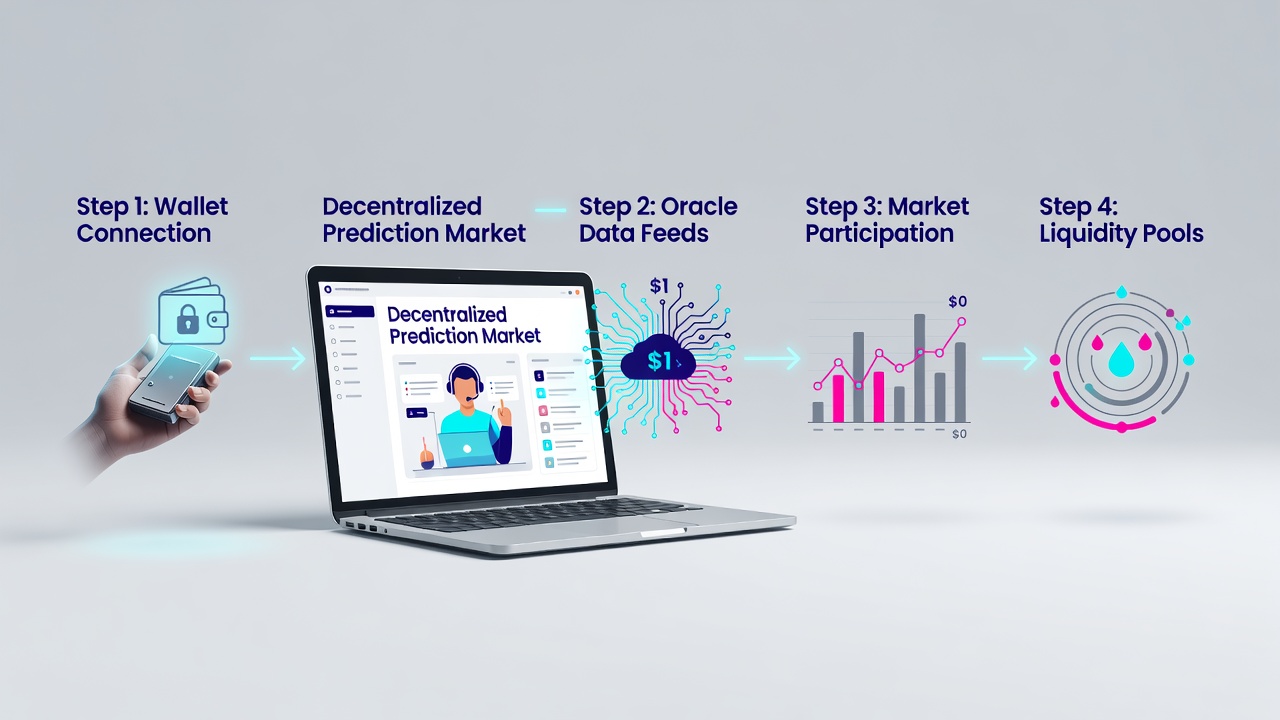
Oracles play a critical role by feeding real-world data into smart contracts for accurate outcome resolution. Reliable oracles minimize disputes and ensure market integrity. Popular integrations include Chainlink and other decentralized oracle networks that aggregate data from multiple sources to prevent manipulation. Liquidity provision involves supplying capital to pools, earning rewards from trading fees while managing impermanent loss risks.
Traders should monitor oracle performance metrics such as update frequency and historical accuracy before committing funds. Effective liquidity strategies enhance market efficiency and personal returns. For instance, providing liquidity during high-volatility events like elections can yield higher fee income but requires careful monitoring of price slippage.
Step-by-Step Participation on Platforms Like Polymarket
Getting started on Polymarket involves connecting a compatible wallet and funding with stablecoins. Users browse active markets, analyze probabilities, and place trades by buying outcome shares. The process emphasizes security through wallet signatures rather than centralized account creation.
- Research event details and historical accuracy using external data sources.
- Evaluate market liquidity and trading volume to avoid illiquid positions.
- Execute buys or sells via the interface while accounting for gas fees on the underlying blockchain.
- Monitor positions until resolution and claim winnings automatically through smart contracts.
- Review transaction history and adjust strategies based on past performance metrics.
Always start with small positions to understand platform nuances. Advanced users often script automated alerts for market movements or use multiple wallets for risk segmentation.
Risk Assessment Techniques for Intermediate Traders
Effective risk management is essential in volatile prediction markets. Techniques include position sizing based on conviction levels, diversifying across uncorrelated events, and using stop-loss equivalents through limit orders. Another key method involves calculating expected value by comparing your estimated probability against the market-implied odds.
Assess probabilities against external data sources such as academic studies or government reports and track your win rate over multiple trades. Avoid overexposure by capping portfolio allocation to prediction markets. Common pitfalls include confirmation bias where traders overweight favorable information and failing to account for tail risks in low-probability events.
Practical examples show that successful traders maintain detailed journals logging entry prices, rationale, and exit conditions. This data-driven approach allows refinement of defi strategies over time.
Comparing Top DeFi Prediction Protocols
Several protocols compete in this space, differing in user interface, supported events, and fee structures. Polymarket emphasizes user-friendly interfaces and high-volume political markets. Others focus on niche categories like sports or crypto events with enhanced oracle options and lower fees for liquidity providers.
Evaluate based on security audits, resolution speed, and community governance. Cross-platform arbitrage opportunities can arise from pricing discrepancies between similar markets. Consider factors such as total value locked, historical uptime, and developer activity when selecting a protocol for long-term use.
2026 Regulatory Considerations in DeFi Prediction Markets
Regulatory landscapes evolve rapidly. Traders must stay informed about compliance requirements in their jurisdictions. Platforms increasingly incorporate KYC elements or geographic restrictions to align with evolving rules around financial instruments and gambling classifications.
Resources like SEC.gov provide official guidance on digital asset classifications while CFTC.gov offers insights into event contract oversight. Always prioritize platforms with transparent legal frameworks and consult professionals for jurisdiction-specific advice.
Real-World Case Studies of Profitable Trades
One notable example involved accurate forecasting of regulatory announcements, yielding substantial returns through timely share accumulation in a market that resolved favorably within days. Another case highlighted successful hedging during economic data releases by balancing long and short positions across related markets, reducing overall portfolio volatility.
A third study examined traders who specialized in sports outcomes by combining statistical models with real-time news sentiment analysis. These examples underscore the value of thorough research, timing, and adaptability in defi strategies for consistent profitability.
Practical Checklists for Avoiding Common Pitfalls
- Verify oracle reliability and data sources before trading any market.
- Review historical resolution accuracy and dispute history on the platform.
- Calculate potential fees including gas costs and platform commissions.
- Maintain detailed trade logs for performance review and tax reporting.
- Stay updated on platform governance proposals that may affect market rules.
- Test strategies in low-stakes environments before scaling positions.
- Monitor broader market sentiment and macroeconomic indicators that could influence outcomes.
FAQs on DeFi Prediction Markets
What makes prediction markets different from traditional betting?
They use blockchain for decentralized, transparent resolution without intermediaries, allowing global participation and programmable incentives.
How do I choose the right platform?
Compare liquidity, event variety, security features, and oracle integrations aligned with your trading style and risk tolerance.
Are there tax implications?
Consult local regulations as profits may be taxable in many regions; maintain accurate records of all trades.
Can I use prediction markets for hedging?
Yes, they serve as effective tools for hedging against specific event risks in broader portfolios.
Conclusion
DeFi prediction markets offer powerful tools for advanced traders when approached with discipline and knowledge. By mastering oracles, risks, and platform specifics, you can integrate these into broader defi guides for consistent results. Continue learning and adapting to 2026 developments for sustained success in this evolving sector.

No comments yet. Be the first!