 CryptoChain Blog

Introduction to MEV Protection in DeFi
Decentralized finance has transformed trading, lending, and liquidity provision, but it also exposes users to sophisticated extraction tactics known as miner extractable value or MEV. In 2026, intermediate traders must understand these risks to safeguard their strategies against unnecessary slippage and losses. This guide provides an in-depth examination of MEV mechanics, focuses on sandwich attacks, and details actionable defenses including private RPC endpoints and intent-based solvers.
By implementing the right tools, users can maintain execution efficiency while minimizing exposure. We will explore real transaction scenarios, compare leading solutions, and offer configuration guidance tailored for wallets like MetaMask.
Understanding MEV Risks in Decentralized Finance
MEV arises when block producers or independent searchers reorder, front-run, or censor transactions within a block to capture additional profit. On public blockchains such as Ethereum and its layer-2 scaling solutions, the transparent mempool allows anyone to inspect pending transactions. This visibility creates opportunities for profit extraction that directly impact everyday traders executing swaps on decentralized exchanges.
The core issue stems from the open nature of transaction propagation. When a user submits a swap, it enters the mempool where bots scan for profitable patterns. Without protection, large or even medium-sized trades become targets, leading to execution prices far worse than the quoted rate at the time of submission. Over repeated trades, these small erosions compound into significant portfolio impacts.
Research from leading blockchain foundations highlights how MEV has evolved alongside DeFi growth. For further background on Ethereum's transaction model, consult Ethereum.org.
How Sandwich and Front-Running Attacks Operate on DEXes
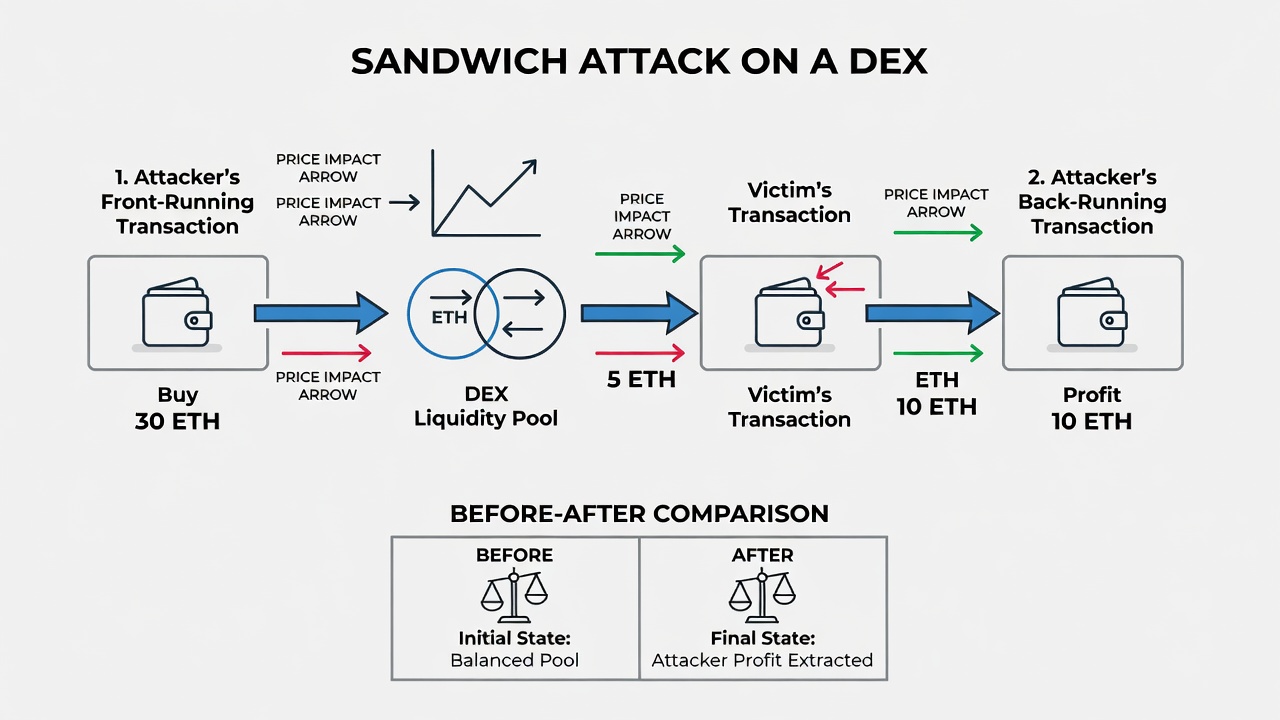
Sandwich attacks specifically target liquidity pool trades. An attacker detects a pending buy order for a token, submits their own buy transaction with a higher gas price to execute first, and then immediately places a sell order after the victim's trade completes. The result is an artificially inflated price during the victim's execution followed by a rapid reversal.
Front-running operates similarly but focuses on one-sided extraction, often in arbitrage or liquidation scenarios. Both exploits thrive on networks with high DeFi activity such as Ethereum mainnet, Arbitrum, and Optimism. Attackers utilize automated scripts that monitor multiple DEXes simultaneously, calculating optimal gas premiums to guarantee inclusion ahead of the target transaction.
Consider a concrete example: a trader initiates a 30 ETH swap for a mid-cap token on a popular automated market maker. The bot detects the opportunity, buys 5 ETH worth of the token milliseconds earlier, the original trade executes at the new higher price, and the bot sells its position. The victim absorbs roughly 0.8 percent additional slippage while the attacker pockets the spread minus fees.
Other Common MEV Exploits Beyond Sandwiches
While sandwiches dominate retail trader complaints, additional MEV vectors include liquidation sniping, where bots compete to liquidate undercollateralized positions first, and back-running, which profits from predictable price movements after a large trade. These tactics often overlap in complex DeFi strategies involving leveraged positions or yield farming.
Understanding the full spectrum helps users prioritize defenses. For instance, liquidation protection may require different configurations than simple swap shielding.
Emerging Defenses: Private RPCs and Intent Solvers
Private RPC services bypass the public mempool by forwarding transactions directly to block builders or specialized relays. This obscures trade details until final inclusion, drastically reducing the window for attackers. Intent solvers represent a newer paradigm where users declare desired outcomes, such as "swap X for at least Y tokens," and specialized networks optimize the route while mitigating MEV.
These technologies matured considerably by 2026, integrating seamlessly with existing wallets and supporting major networks. They allow traders to preserve strategy speed without sacrificing protection.
Tool Comparison: Flashbots Protect versus Eden Network
Flashbots Protect emphasizes customizable privacy levels and integrates simulation previews to forecast potential slippage. Eden Network adds priority mechanisms that balance speed and protection during periods of network congestion. Both platforms support Ethereum and several layer-2 chains, though their relay architectures differ in latency profiles and fee models.
Users evaluating options should consider factors such as supported chains, historical success rates against known attackers, and ease of wallet integration. Flashbots tends to appeal to those prioritizing simulation tools, while Eden suits traders focused on consistent inclusion times.
Wallet Configuration and Gas Optimization Tactics
Proper wallet setup forms the foundation of MEV defense. Begin by identifying a reliable private RPC provider and updating the network settings in your preferred wallet. In MetaMask, access the network management panel, select the active chain, and replace the default RPC URL. Save the changes and verify connectivity with a balance check before proceeding to live trades.
Gas optimization complements privacy measures. Instead of bidding aggressively on priority fees, employ estimators that factor in current MEV activity. Setting modest increments above the base fee reduces visibility to profit-seeking bots while still ensuring timely inclusion.
Step-by-Step Setup Instructions
- Research and select a protection service that matches your primary networks and trading volume.
- Obtain the private RPC endpoint from the provider's dashboard or documentation.
- Open your wallet application and navigate to advanced network settings.
- Input the new RPC URL, confirm the chain ID matches, and save the configuration.
- Perform a test transaction of minimal size to validate that execution occurs without public mempool exposure.
- Review transaction receipts for any unexpected slippage and adjust tolerance settings accordingly.
- Monitor performance over multiple trades and switch providers if latency or reliability issues arise.
Real Transaction Examples and Case Studies
One intermediate trader documented results across fifty swaps on a layer-2 DEX before and after adopting a private RPC. Pre-protection average slippage reached 1.2 percent on orders exceeding 10 ETH equivalent. Post-implementation, that figure dropped to 0.3 percent, preserving meaningful value over a monthly trading cycle. Another case involved an intent solver routing a complex multi-hop trade that avoided three potential sandwich opportunities detected by monitoring tools.
Potential Drawbacks and Cost-Benefit Tradeoffs
While effective, these tools introduce minor tradeoffs such as slightly increased confirmation times or dependency on third-party relays. Users must weigh these against the cumulative savings from avoided attacks. For high-frequency strategies, testing multiple configurations in parallel helps identify the optimal balance.
Frequently Asked Questions
Do protection tools add meaningful latency?
Most private RPC services introduce only marginal delays, typically under 200 milliseconds, which rarely impacts trade outcomes for non-high-frequency strategies. Intent solvers may add a brief optimization phase but often improve overall execution quality.
How do costs compare across solutions?
Many services offer free tiers for basic protection, with premium options available for advanced features. Evaluate based on your trading volume rather than fixed fees, focusing on net savings from reduced slippage.
Can intent solvers fully replace private RPCs?
Intent solvers complement private RPCs by handling complex routing decisions, yet many users combine both approaches for maximum defense against evolving attack vectors.
Are these protections effective across all networks?
Effectiveness varies by chain congestion and liquidity depth. Ethereum mainnet benefits greatly, while newer layer-2 networks may require additional testing to confirm consistent results.
What happens if a protected transaction still experiences slippage?
Residual slippage can stem from natural market movement rather than MEV. Reviewing transaction traces and adjusting parameters helps isolate true causes.
Conclusion
MEV protection has become essential for efficient DeFi participation in 2026. By implementing private RPCs, comparing established tools such as those available at Flashbots, and following proper wallet setups, traders can significantly reduce sandwich attack losses while preserving strategy performance. Continuous monitoring and adaptation ensure long-term resilience as the ecosystem evolves.

No comments yet. Be the first!