 CryptoChain Blog

Introduction to DeFi Statistical Arbitrage in 2026
Statistical arbitrage, or stat arb, leverages mean-reversion principles in DeFi markets where price discrepancies between correlated assets like ETH and stablecoins create opportunities. In 2026, automation through Python-based bots integrated with protocols such as Uniswap and Aave enables advanced users to execute pair trades at scale while mitigating risks like MEV and high gas fees. This approach builds on classic pairs trading by incorporating real-time on-chain metrics, advanced statistical tests, and automated execution layers that respond within seconds to market shifts. Traders who master these techniques can capture consistent alpha across volatile crypto environments, especially as DeFi liquidity deepens on both Layer-1 and Layer-2 networks.
The core idea remains identifying two assets whose prices historically move together. When temporary divergences appear, the bot enters a long-short position expecting convergence. In DeFi this translates to swapping between ETH and USDC or USDT pools while hedging exposure through lending protocols. Success depends on rigorous data pipelines, robust risk parameters, and continuous monitoring of network conditions.
Understanding Cointegration Analysis with On-Chain Data
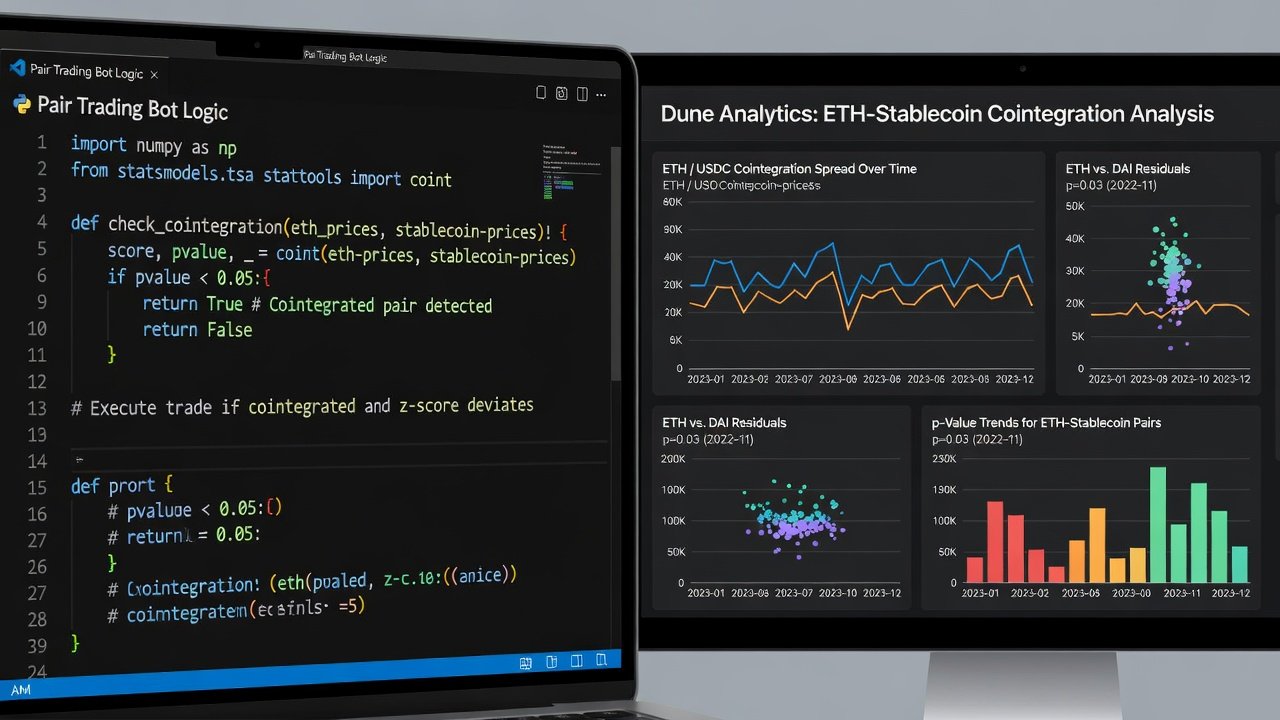
Cointegration identifies pairs where prices move together over time despite short-term deviations. Tools like Dune Analytics provide SQL queries for extracting historical DEX trade data, while Nansen offers labeled wallet insights for smart money flows. To begin, query daily or hourly closing prices from major liquidity pools on Ethereum, Arbitrum, and Base. Import the datasets into Python using pandas and apply the Engle-Granger two-step method or the Johansen test for multiple cointegrating vectors.
Detailed Steps for Robust Cointegration Testing
- Collect at least 500 observations to ensure statistical power; shorter windows increase false positives.
- Run the Augmented Dickey-Fuller test on individual price series to confirm non-stationarity, then test the residual spread for stationarity.
- Calculate the optimal hedge ratio via ordinary least squares and validate out-of-sample using rolling windows of 30-60 days.
- Incorporate on-chain volume filters so pairs with declining liquidity are excluded automatically.
Real-world ETH-stablecoin pairs often show cointegration during low-volatility periods, allowing bots to enter when z-scores exceed 2.0. For instance, the ETH/USDC spread on Uniswap v3 frequently reverts within 4-8 hours during stable market regimes, providing multiple daily signals.
Mean-Reversion Entry Rules and Risk Controls
Entry signals trigger when the price spread reverts to its historical mean. Exit occurs at mean reversion or predefined thresholds. Effective bots combine statistical thresholds with execution safeguards to survive flash crashes and liquidity shocks.
- Position Sizing: Allocate no more than 5% of portfolio per pair to avoid overexposure while scaling across 8-12 simultaneous pairs.
- Stop-Losses: Implement dynamic stops at 3 standard deviations from the mean, tightened further during high implied volatility periods.
- Volatility Filters: Pause trading during extreme gas spikes or network congestion detected via real-time RPC monitoring.
- Correlation Decay Alerts: Automatically reduce position size if 30-day rolling correlation drops below 0.85.
Building Python-Based Trading Bots
Integrate with DeFi via Web3.py and protocol-specific SDKs. A basic bot structure includes data ingestion, signal generation, and execution modules. Start by installing web3.py, pandas, statsmodels, and ccxt for unified exchange connectivity. The following snippet demonstrates a simplified cointegration check and signal generator:
import pandas as pd
from statsmodels.tsa.stattools import coint
from web3 import Web3

w3 = Web3(Web3.HTTPProvider('https://eth-mainnet.alchemyapi.io/v2/YOUR_KEY'))

def check_cointegration(prices1, prices2):
    score, pvalue, _ = coint(prices1, prices2)
    return pvalue < 0.05

# Fetch on-chain prices via contract calls and generate z-score signals
# Add logic for position sizing and MEV-protected transaction submission
Extend this foundation with asynchronous execution using asyncio to handle multiple chains concurrently. For production, wrap the bot in a Docker container and deploy on a VPS with redundant RPC endpoints.
Real Examples: ETH-Stablecoin Pairs and Performance Tracking
Consider the ETH/USDC pair on Ethereum mainnet. Historical backtests from late 2025 data show annualized returns of 18-25% with Sharpe ratios above 1.8 when using 15-minute rebalancing. Track metrics via custom dashboards logging fill rates, funding costs, and impermanent loss equivalents. On Arbitrum the same pair delivered tighter spreads and lower latency, improving win rates to 67% over a 90-day window. Performance tracking should include maximum drawdown, profit factor, and average holding period. Advanced users integrate Grafana visualizations that pull directly from on-chain event logs for live monitoring.
Comparison Table: Manual vs Automated Approaches
| Aspect | Manual Trading | Automated Bot |
|---|---|---|
| Speed | Minutes | Milliseconds |
| MEV Exposure | High | Low with private RPCs |
| Gas Optimization | Reactive | Batch transactions |
| Emotional Bias | Present | Eliminated |
| Scalability | Limited | Multi-pair, multi-chain |
Addressing MEV Protection and Gas Optimization
Use Flashbots Protect or similar private transaction relays to shield against sandwich attacks. Optimize gas by batching approvals and leveraging Layer-2 solutions like Arbitrum for reduced fees. Implement EIP-1559 base fee monitoring so transactions only submit when priority fees fall below a dynamic threshold. Common pitfalls include ignoring oracle delays and over-leveraging during black swan events; mitigate these by adding circuit breakers that halt all activity when the Fear & Greed index drops below 20.
Common Pitfalls and Mitigation Strategies
Avoid data snooping bias by using walk-forward optimization and out-of-sample validation across at least three market regimes. Test across multiple chains before scaling. Monitor for smart contract upgrades that alter pair dynamics. Additional pitfalls include API rate limits, RPC downtime, and sudden liquidity migration between pools. Build redundancy with fallback providers and automated alerts via Telegram or Discord webhooks.
FAQ: Scaling Strategies Across Multiple Chains
Q: How do I scale bots to Polygon and Base? A: Abstract chain-specific logic using a unified SDK and monitor cross-chain liquidity via aggregated oracles. Deploy separate instances per chain while sharing a central risk engine.
Q: What is the ideal rebalancing frequency? A: Start with hourly intervals and adjust based on realized volatility; higher frequency works on L2s while daily suits mainnet during congestion.
Q: How to handle regulatory considerations? A: Focus on permissionless protocols while maintaining transparent on-chain logging for compliance audits. Consult legal experts before deploying capital above certain thresholds.
Q: Can the same bot run on both spot and perpetual futures? A: Yes, extend the framework with perpetual funding rate data to capture additional yield when basis spreads widen.
In conclusion, automated statistical arbitrage in DeFi offers sophisticated traders a repeatable edge when executed with disciplined data analysis, robust code, and layered risk controls. By combining cointegration testing from Dune Analytics and Nansen with Python bots that respect MEV and gas realities, users can scale profitably across chains while avoiding the common traps that derail less prepared strategies.

No comments yet. Be the first!