 CryptoChain Blog
Introduction to On-Chain Statistical Arbitrage in 2026
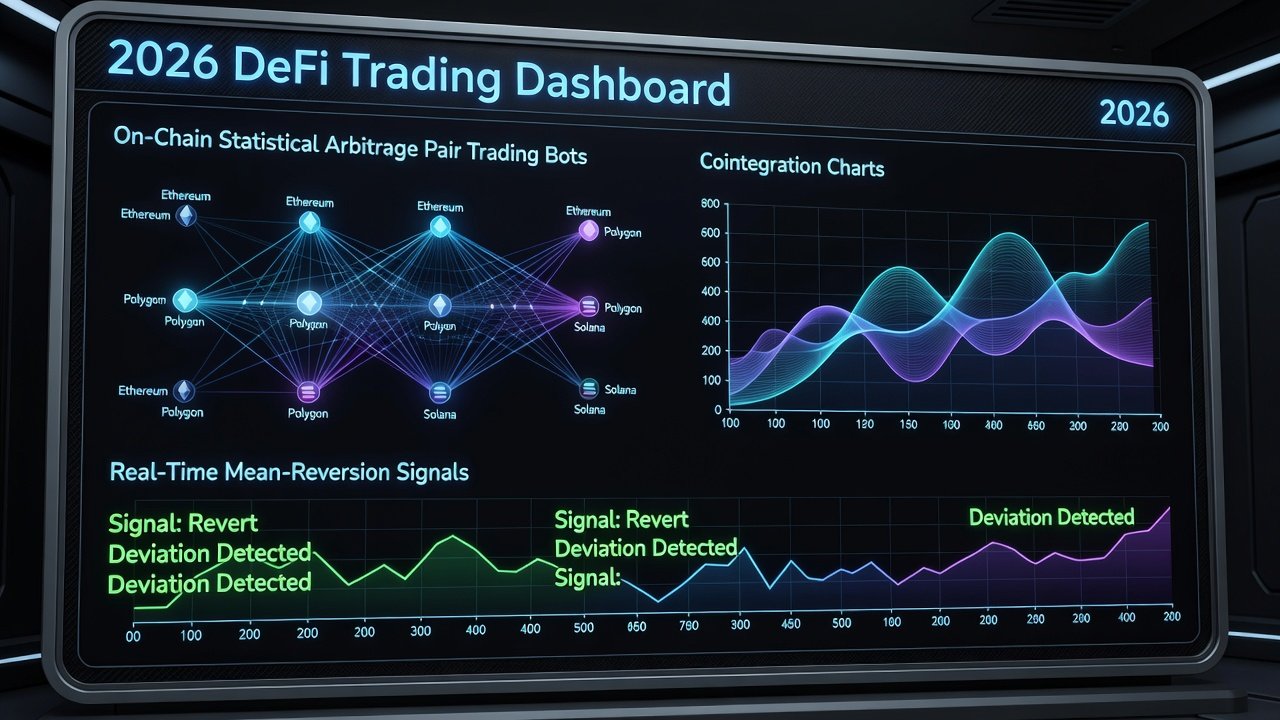
Statistical arbitrage in DeFi has evolved significantly by 2026, allowing traders to exploit temporary price inefficiencies between correlated cryptocurrency pairs through automated bots. Unlike traditional finance, on-chain execution leverages transparent blockchain data for real-time signal generation and execution. This approach focuses on cointegration testing to identify pairs with mean-reverting tendencies, enabling data-driven edges for traders seeking consistent returns in volatile markets. Pair trading bots automate entry and exit rules based on statistical deviations, reducing emotional decision-making and improving consistency across market cycles.
With the maturation of perpetual futures protocols and advanced analytics platforms, 2026 presents unique opportunities for systematic traders. Tools like Dune Analytics and Nansen empower users to query on-chain metrics such as liquidity flows and wallet behaviors, turning raw blockchain events into actionable trading signals. This guide covers the full lifecycle from pair selection to live deployment, with concrete examples tailored for GMX and dYdX environments.
Understanding Cointegration and Mean-Reversion in Crypto Pairs
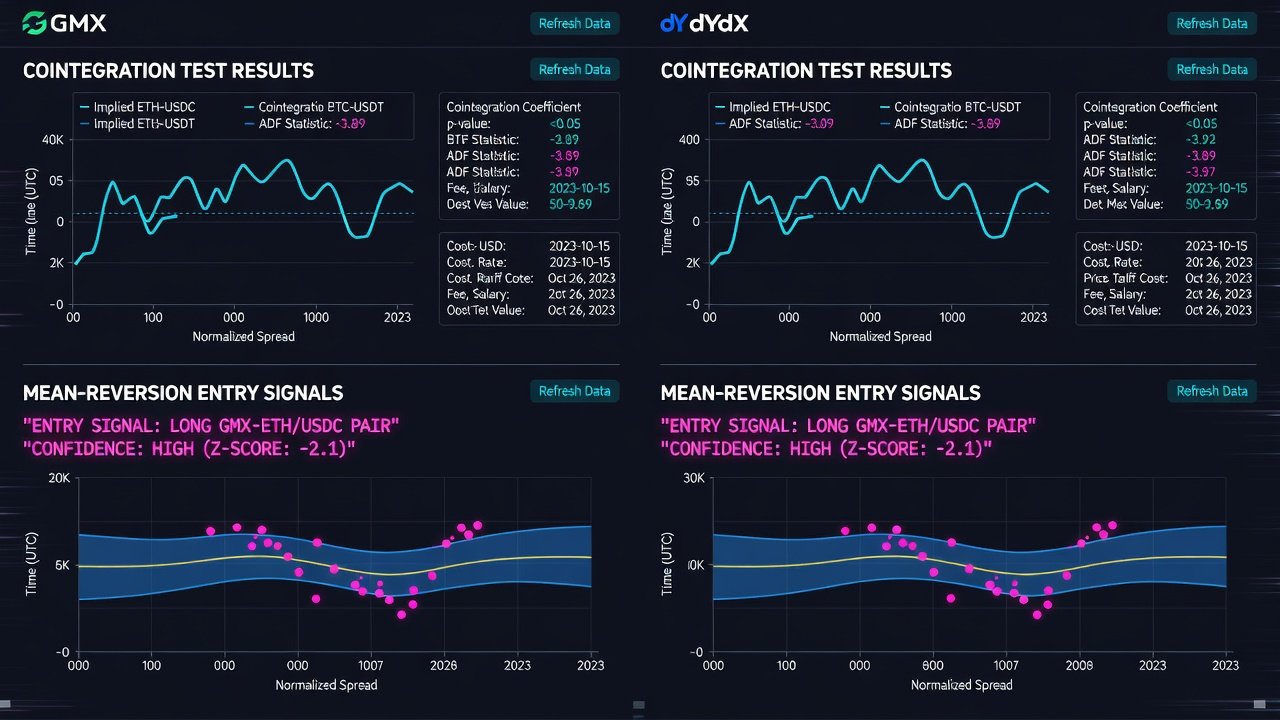
Cointegration testing forms the foundation of statistical arbitrage. It determines whether two assets share a long-term equilibrium relationship despite short-term divergences. Traders apply methods like the Augmented Dickey-Fuller test or Engle-Granger two-step procedure to validate pairs such as ETH/USDC or BTC/ETH perpetuals. For instance, a trader might analyze 180 days of price data from a liquidity pool to confirm that the spread between two assets oscillates around a stable mean rather than trending independently.
Once cointegrated pairs are identified, mean-reversion entry rules trigger trades when the spread deviates beyond a defined threshold, typically two standard deviations. Exit occurs as the spread reverts to its historical mean. This strategy thrives in DeFi due to 24/7 markets and granular on-chain data availability. Practical implementation involves calculating z-scores in real time and setting dynamic thresholds that adjust for volatility regimes observed in recent on-chain activity.
Leveraging Analytics Tools for Signal Generation
Integrating Dune Analytics allows custom queries on blockchain events, such as trading volume and liquidity pool imbalances, to generate alpha signals. Similarly, Nansen provides wallet labeling and flow tracking to anticipate pair movements before they appear in price data. These platforms help filter noise in high-frequency environments, enabling bots to act on validated statistical edges rather than raw price action alone.
Advanced users combine these tools with on-chain oracles to create composite indicators. For example, a query might track large wallet transfers between exchanges and DeFi protocols to predict mean-reversion opportunities in correlated assets. This data-driven layer adds robustness compared to purely technical analysis approaches.
Essential Tools and Tech Stack for Bot Development
Building reliable bots requires a solid tech stack. Python remains popular for its statistical libraries such as statsmodels and pandas for cointegration tests. Web3.py or ethers.js handle blockchain interactions, while frameworks like CCXT or protocol-specific SDKs connect to exchanges. For production, containerize the bot with Docker and deploy on cloud instances with low-latency connections to RPC endpoints.
Security practices include using hardware wallets for key management and implementing multi-signature approvals for large positions. Monitoring dashboards built with Grafana can track bot performance metrics like fill rates and slippage in real time.
Step-by-Step Bot Setup on GMX
Building a bot on GMX involves connecting to its perpetual exchange via API for automated position management. Start by selecting cointegrated pairs from GMX's liquidity pools, then code entry rules using mean-reversion thresholds. Risk controls include position sizing at 1-2% of portfolio per trade and stop-losses based on volatility bands. Integration with oracles ensures accurate price feeds, while smart contract interactions handle execution. Test thoroughly in simulation mode before live deployment.
Next, implement order routing logic that accounts for GMX's unique funding rate mechanics. Monitor open interest data to avoid entering positions during periods of extreme leverage imbalance. Finally, add logging and alerting via Telegram or Discord bots to notify operators of any anomalies during execution.
Configuring Pair Trading on dYdX
dYdX offers advanced perpetual trading features ideal for statistical arbitrage. Use its API to monitor spreads and execute trades programmatically. Define rules for scaling into positions during deviations and unwinding on reversion. Incorporate chain-specific gas optimizations for cost efficiency across supported networks. Traders often layer additional filters such as minimum liquidity thresholds to prevent entries into thin markets.
Backtesting Methods and Performance Validation
Robust backtesting uses historical on-chain data to simulate bot performance across multiple market regimes. Employ walk-forward optimization to avoid overfitting and incorporate slippage models to reflect real execution conditions. Metrics like Sharpe ratio and maximum drawdown guide strategy refinement. A practical example involves backtesting a BTC-ETH pair over 2025 data, comparing results with and without transaction cost assumptions to isolate the impact of fees.
Include stress tests for black swan events by replaying historical volatility spikes. This reveals whether the bot maintains risk parameters under extreme conditions. Document all assumptions clearly to facilitate future audits and improvements.
Common Pitfalls: Managing Slippage and Other Risks
Slippage remains a primary challenge in on-chain trading, especially during low-liquidity periods. Mitigate it by setting dynamic order sizing and using limit orders where possible. Additional risks include smart contract vulnerabilities and oracle failures; always diversify across chains and implement circuit breakers in bot logic. Other frequent mistakes involve ignoring funding rate costs on perpetual platforms and failing to recalibrate cointegration parameters after major protocol upgrades.
Scaling Strategies Across Multiple Chains
Expand bots to Layer-2 networks and alternative chains by modularizing code for different APIs. Monitor cross-chain correlations to identify new pairs while maintaining unified risk frameworks. Start with Ethereum mainnet and Polygon before branching into Arbitrum or Optimism deployments. Use unified data pipelines to aggregate signals across environments and avoid siloed decision-making.
Conclusion
On-chain pair trading bots represent a powerful evolution in DeFi statistical arbitrage for 2026 traders. By combining rigorous cointegration analysis with practical integrations on GMX and dYdX, participants can pursue systematic edges while navigating inherent risks through disciplined controls and continuous optimization.
FAQ on Scaling These Strategies
- How do I choose initial pairs? Begin with highly liquid assets showing historical cointegration over at least six months of data, validated through multiple statistical tests.
- What backtesting tools are recommended? Use Python libraries like statsmodels alongside on-chain data exports from Dune Analytics for realistic simulation environments.
- Can these bots run on multiple chains simultaneously? Yes, with proper API abstraction layers and centralized monitoring dashboards that aggregate performance across networks.
- How often should parameters be recalibrated? Review cointegration every 30 days or after major market events to maintain edge validity and adapt to shifting correlations.
- What regulatory considerations apply in 2026? Ensure compliance with evolving DeFi guidelines by maintaining transparent logging and avoiding strategies that could be classified as market manipulation.

No comments yet. Be the first!