 CryptoChain Blog
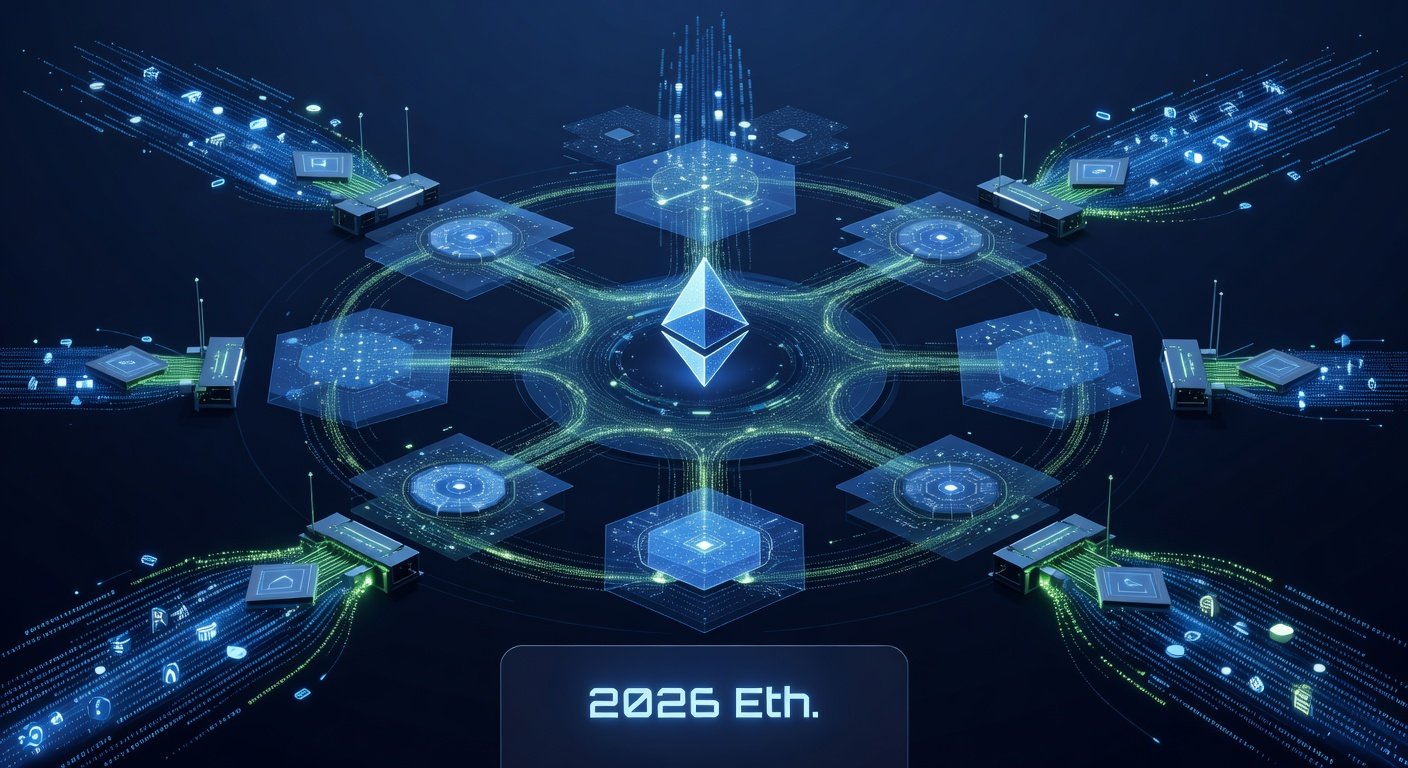
Introduction to Ethereum L2 Oracles in 2026
As Ethereum continues its evolution in 2026, Layer 2 solutions have become the primary battleground for scalability, enabling thousands of transactions per second while maintaining the security guarantees of the mainnet. Oracles play a pivotal role in this ecosystem by securely delivering off-chain data to smart contracts, powering everything from decentralized finance protocols to gaming applications and supply chain tracking. Developers and DeFi builders now seek faster, cheaper data feeds that can handle high-frequency updates without compromising on decentralization or accuracy. The search for practical updates amid ongoing ETH scalability pushes has intensified, as teams race to integrate real-world information such as asset prices, weather events, and sports outcomes into their dApps.
Without robust oracles, smart contracts remain isolated from the external world, limiting their utility in dynamic environments. In this comprehensive guide, we explore the latest innovations, provide actionable tutorials, and offer decision-making frameworks for selecting the right oracle solution across networks like Optimism, Base, and Scroll. Emphasis is placed on security best practices, latency optimization, and real-world implementation examples that help builders avoid common pitfalls.
Chainlink CCIP Expansions on L2 Networks
Chainlink remains the dominant oracle provider, with its Cross-Chain Interoperability Protocol (CCIP) seeing major expansions tailored specifically for Layer 2 environments in 2026. These updates allow developers to transmit verified data and arbitrary messages between Ethereum mainnet and various L2s with enhanced throughput and reduced settlement times. Chainlink achieves this through a decentralized network of node operators that aggregate data from multiple sources before delivering it on-chain, mitigating risks associated with single points of failure.
Recent advancements include native support for Optimism and Base, enabling seamless price feed subscriptions that update every few seconds. Builders can now leverage CCIP for cross-chain lending protocols where collateral values on one L2 influence borrowing limits on another. The protocol's programmable token transfers further allow conditional executions based on oracle data, opening doors to sophisticated DeFi strategies previously constrained by latency issues.
Emerging Protocols Like Pythy and Decentralized Alternatives
While Chainlink dominates market share, emerging decentralized oracle protocols such as Pythy are carving out significant niches by prioritizing lightweight architecture and community governance. Pythy utilizes a novel verification mechanism that combines zero-knowledge proofs with reputation-weighted data sourcing, delivering reliable feeds at lower operational overhead. This makes it particularly appealing for projects on cost-sensitive L2s like Scroll, where developers need frequent updates for niche assets such as tokenized real estate or carbon credits.
Other alternatives focus on specialized data domains, including sports oracles for prediction markets and IoT-integrated feeds for supply chain dApps. When evaluating these options, teams should consider factors like node distribution, historical uptime records, and ease of integration with existing Solidity codebases. Pythy's open-source tooling has accelerated adoption among smaller DeFi teams seeking to differentiate from mainstream solutions.
Cross-L2 Interoperability Advances
Interoperability between Layer 2 networks has advanced considerably, with oracles now serving as the connective tissue that enables fluid data exchange without expensive mainnet routing. Protocols can query data verified on Base and immediately apply it within an Optimism smart contract through standardized messaging layers. This reduces fragmentation and supports true composability across the Ethereum ecosystem.
Technical improvements include shared data schemas and optimistic verification bridges that confirm oracle responses across chains in parallel. For instance, a derivatives platform might reference volatility indexes from Scroll while settling trades on Base, all powered by a unified oracle layer. These advances also incorporate fallback mechanisms that automatically switch to secondary data providers during network disruptions, enhancing overall resilience.
Step-by-Step Tutorial: Integrating an Oracle on Optimism
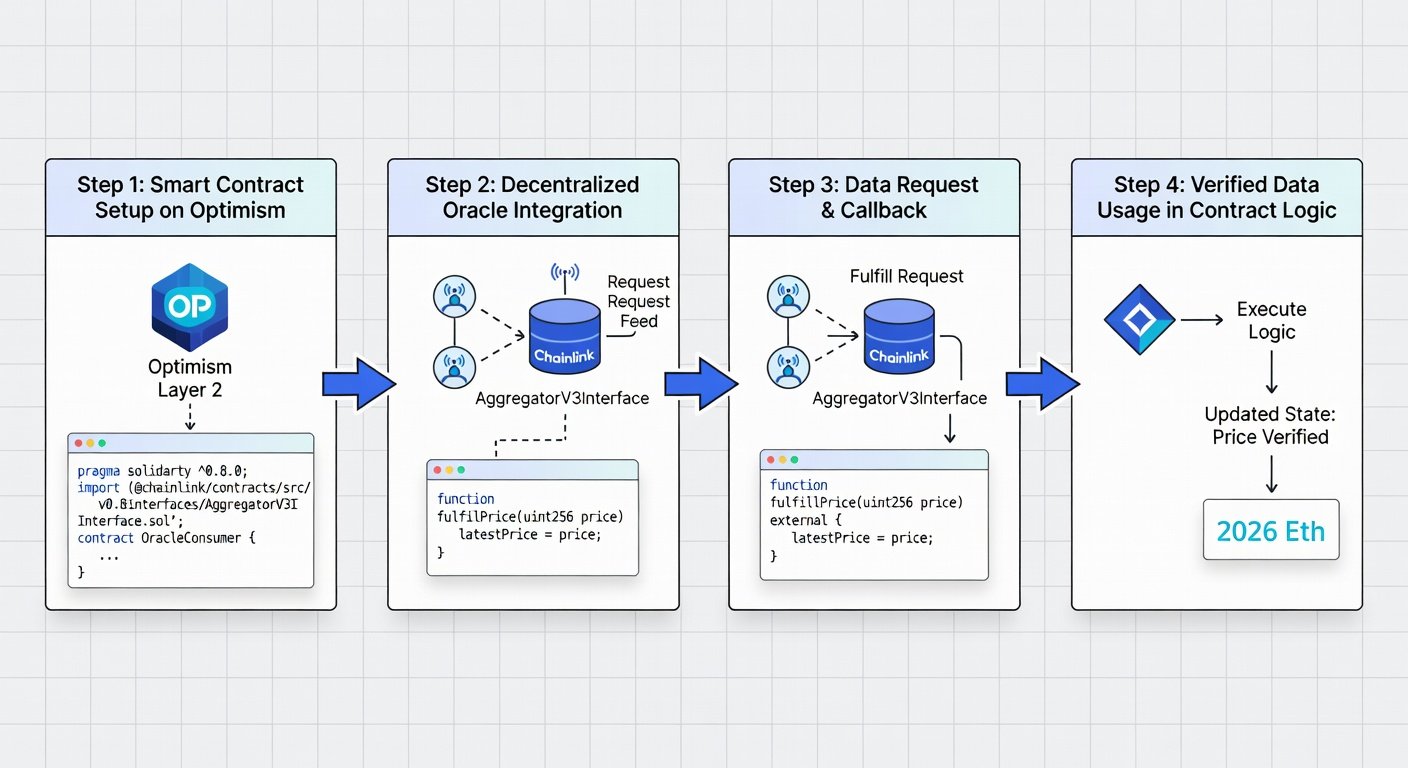
Integrating an oracle into an Optimism-based smart contract requires careful attention to gas optimization and security. Below is a detailed walkthrough using Solidity and the Hardhat development environment.
- Set up your project by initializing Hardhat and installing necessary packages for oracle interfaces and Optimism-specific plugins.
- Define the consumer contract with an interface that inherits from the oracle provider's standard request structure, specifying parameters like data type, update frequency, and callback address.
- Implement the request function that emits an event or directly calls the oracle contract, including sufficient gas limits for callback execution.
- Code the fulfill function to receive and validate incoming data, incorporating checks for staleness and signature verification to prevent tampering.
- Deploy the contract to the Optimism Sepolia testnet first, then verify it on the block explorer while monitoring transaction logs for successful data delivery.
- Extend the implementation with error handling logic that retries failed requests and logs metrics for latency analysis.
- Finally, conduct load testing by simulating multiple concurrent data requests to ensure the contract behaves reliably under production-like conditions.
This structured approach minimizes integration risks and provides a solid foundation for production deployments. Always audit the final code with established security firms before mainnet launch.
Fee Comparisons Across L2s Like Base and Scroll
Selecting the optimal L2 for oracle usage involves evaluating qualitative trade-offs in speed, security model, and operational characteristics. Base generally offers streamlined transaction processing that suits high-volume data polling scenarios, while Scroll's zero-knowledge architecture provides stronger guarantees for complex verification tasks. Developers often benchmark their specific dApp workloads across testnets to identify the best fit, considering factors such as data freshness requirements and expected call frequency.
Best practices include implementing caching strategies for non-critical feeds and using aggregated responses to consolidate multiple queries into single transactions. These optimizations help maintain performance as usage scales.
Real-World Case Studies from DeFi Protocols
Leading DeFi platforms illustrate the transformative impact of advanced L2 oracles. A prominent lending protocol deployed on Optimism integrated Chainlink CCIP to synchronize collateral valuations across Base and Scroll, resulting in faster liquidations and reduced bad debt during market volatility. The implementation allowed the protocol to offer cross-chain borrowing features that attracted significant liquidity inflows.
Another example involves a perpetual futures platform on Base that adopted Pythy for specialized commodity price feeds. By leveraging the protocol's low-latency capabilities, the team achieved more accurate funding rate calculations and improved user experience during peak trading hours. These case studies underscore the importance of matching oracle choice to specific use-case demands rather than defaulting to the most popular provider.
FAQ on Latency Troubleshooting
What causes high oracle latency on L2s?
Common culprits include network congestion during peak hours, suboptimal node selection by the oracle network, and inefficient callback handling in smart contracts. Mitigation strategies involve monitoring gas prices in real time and configuring priority routing to faster data providers.
How can I reduce costs in oracle calls?
Batch multiple data requests into single transactions where supported, utilize cached values for stable assets, and implement conditional logic that only fetches updates when price movements exceed predefined thresholds.
Are there risks with cross-L2 data?
Potential issues include temporary inconsistencies between chains and reliance on bridge security. Always incorporate multi-source validation and automated alerts for anomalous readings to safeguard protocol integrity.
What tools help monitor oracle performance?
Utilize on-chain analytics dashboards and custom scripts that track response times, success rates, and deviation metrics over extended periods to identify degradation early.
Conclusion
Ethereum L2 oracles in 2026 represent a mature yet rapidly evolving component of the blockchain stack, delivering the data infrastructure necessary for sophisticated decentralized applications. Through expansions in Chainlink CCIP, innovative protocols like Pythy, and improved cross-L2 interoperability, developers gain powerful tools to build secure and efficient dApps. By following the detailed integration tutorial, applying fee optimization insights, and learning from established case studies, teams can confidently navigate the landscape and contribute to the next wave of Ethereum innovation.
No comments yet. Be the first!