 CryptoChain Blog
Introduction to Ethereum L2 TVL in 2026
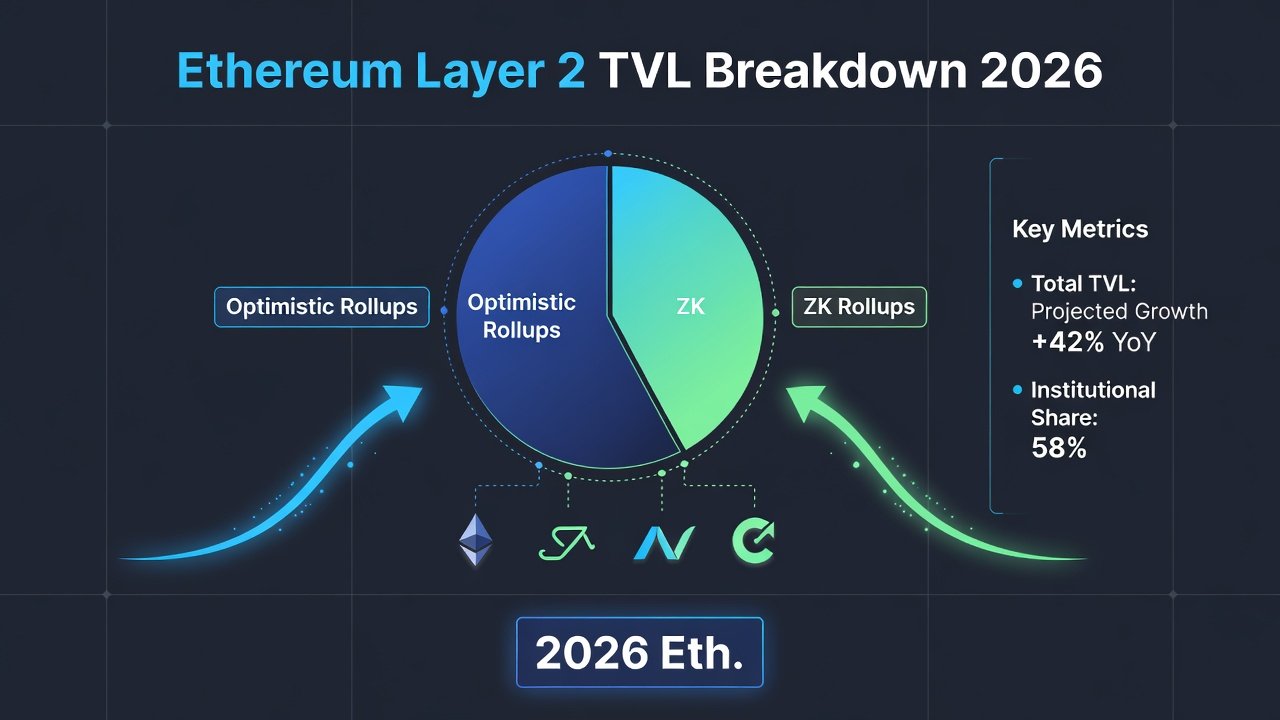
As Ethereum scales in 2026, Layer 2 solutions have solidified their role as the primary engines for network growth and usability. Total value locked across these L2s now captures a substantial portion of overall Ethereum ecosystem activity, reflecting both retail DeFi expansion and increasing institutional participation. Analysts rely on platforms such as L2Beat for accurate TVL tracking and Dune Analytics for granular on-chain metrics to understand these shifts. This comprehensive breakdown examines TVL evolution by rollup category, contrasts optimistic and zero-knowledge approaches across key performance indicators, and surfaces actionable signals for investors focused on ETH developments.
The year 2026 marks a maturation phase where L2 infrastructure supports complex financial instruments while maintaining low costs. Institutional players are allocating capital through tokenized treasuries and derivatives platforms, while DeFi protocols continue innovating around liquidity provision and yield strategies. Understanding these dynamics requires dissecting data beyond headline numbers to reveal underlying adoption drivers and potential risks.
Overall TVL Growth Trends and Market Context
Ethereum L2 TVL has demonstrated consistent upward momentum throughout 2026, propelled by network upgrades that enhance interoperability and reduce friction for cross-chain transfers. Growth has been particularly pronounced in sectors like real-world asset tokenization and perpetual futures trading. Data aggregators highlight that rollup-based ecosystems now process the bulk of Ethereum transactions, freeing the base layer for settlement and security duties.
Key drivers include improved user onboarding through account abstraction and broader integration with traditional finance rails. Investors tracking these trends should note seasonal patterns, such as spikes following major protocol launches or regulatory clarifications. Broader market sentiment around ETH also influences L2 capital flows, with bullish periods correlating to higher TVL retention rates.
Breakdown by Rollup Type
Optimistic rollups continue to dominate in total locked value due to their established developer tooling and extensive dApp libraries. These solutions batch transactions optimistically, assuming validity unless challenged, which supports high throughput for everyday DeFi operations. ZK rollups, by contrast, have accelerated adoption in niches requiring rapid finality and mathematical certainty, such as high-frequency trading venues and privacy-preserving applications.
Within optimistic categories, ecosystems built around fraud-proof mechanisms show diversified TVL across lending, borrowing, and automated market makers. ZK variants emphasize succinct proofs that enable efficient verification, attracting capital seeking robust security guarantees without reliance on external watchers. This segmentation allows investors to align portfolios with specific risk tolerances and use-case preferences.
Optimistic vs ZK Solutions: Detailed Comparison
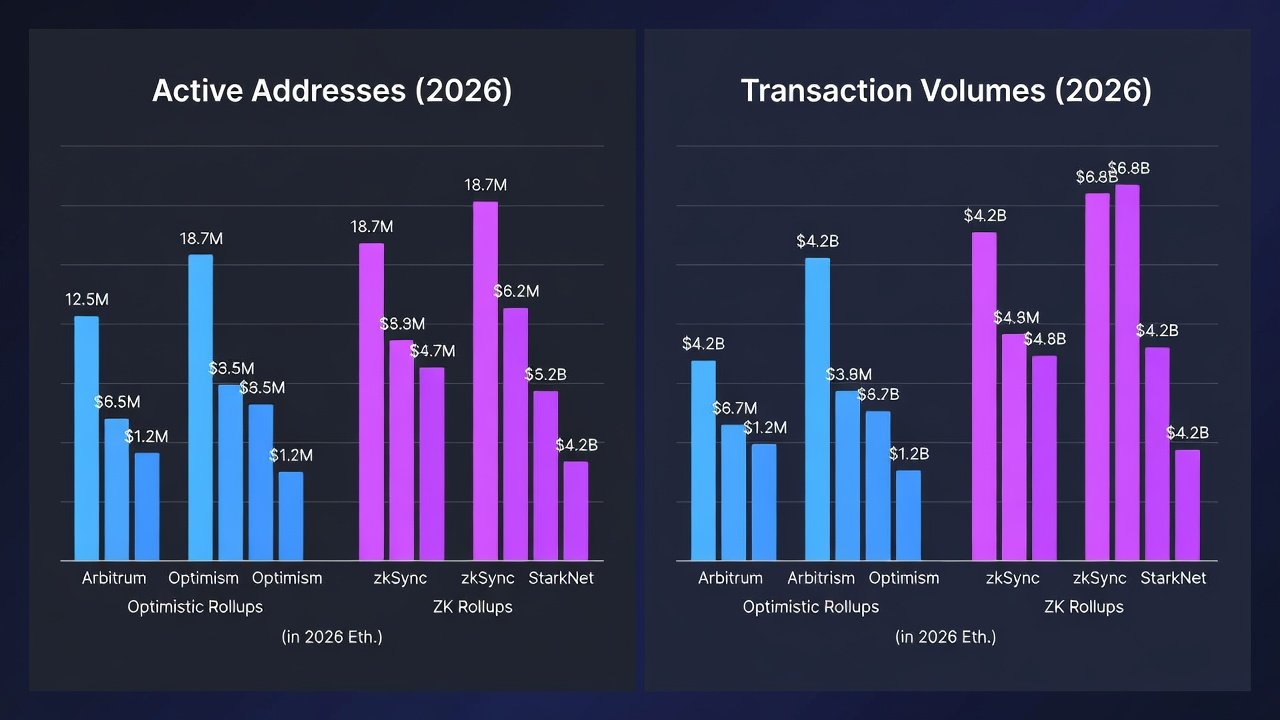
Active address counts provide a reliable gauge of organic engagement. Optimistic rollups often lead here because of their mature wallets and seamless bridging experiences that appeal to both retail and institutional users. Transaction volume metrics, however, tell a different story, with ZK platforms frequently posting higher daily counts as their proof systems handle complex computations more efficiently at scale.
Comparisons also extend to fee structures and developer experience. Optimistic chains benefit from EVM compatibility that simplifies migration from Ethereum mainnet, while ZK solutions require specialized compilers yet deliver superior scalability for future growth phases. Institutional inflows tend to favor chains demonstrating clear governance roadmaps and audit histories. Practical evaluation involves cross-referencing multiple Dune dashboards to isolate genuine usage from wash trading or temporary incentives.
Institutional Adoption Signals and TradFi Inflows
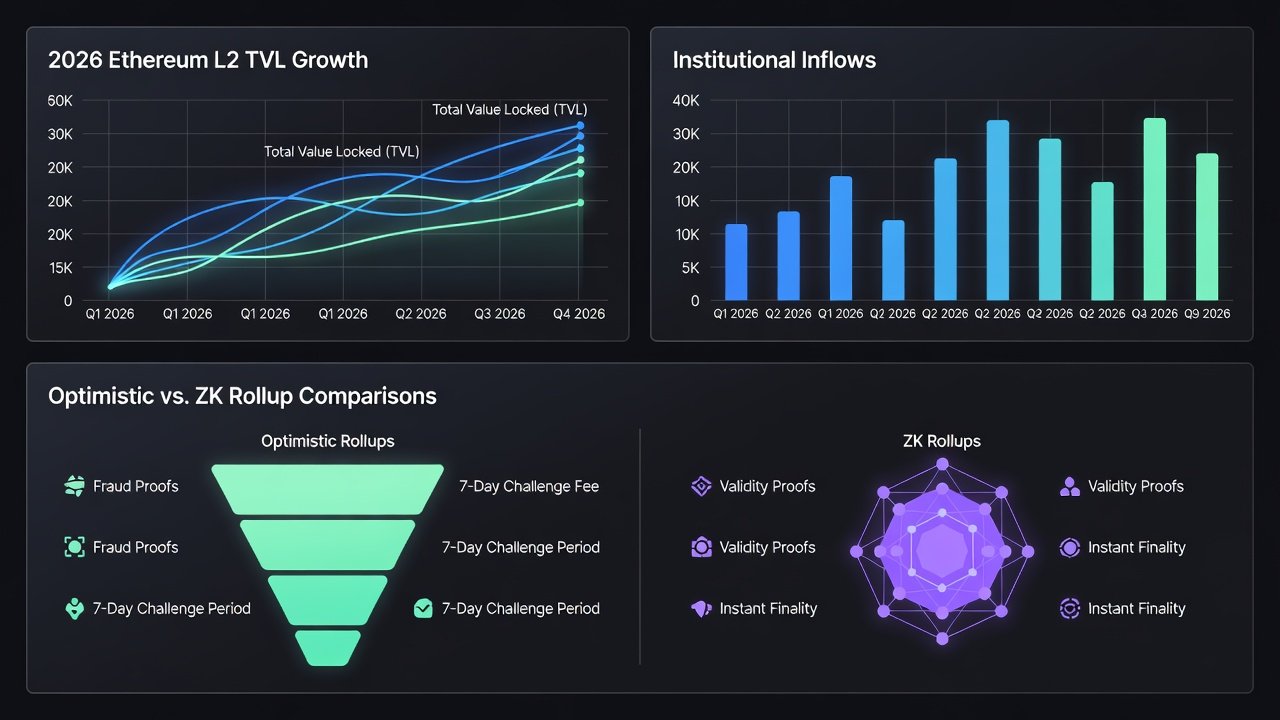
2026 has brought visible institutional interest through partnerships involving custody providers and compliance-focused protocols. Tokenized government securities and stablecoin issuances on L2s serve as entry points, allowing traditional entities to experiment with on-chain settlement without full exposure to volatility. These inflows manifest in concentrated TVL clusters around RWA-focused applications, signaling confidence in the underlying security models.
Monitoring wallet behaviors and bridge activity reveals early movers from banks and asset managers. Such trends underscore the shift from speculative DeFi toward infrastructure supporting real economic activity. Investors should evaluate governance participation and treasury management practices of leading protocols to anticipate sustained capital retention.
Emerging DeFi Opportunities and Protocol Innovations
DeFi on L2s continues to evolve with composable primitives that span multiple rollups. Opportunities arise in automated yield optimizers that dynamically allocate across optimistic and ZK environments based on real-time metrics. Privacy-enhanced trading venues powered by ZK technology open new avenues for institutional-grade confidentiality without sacrificing transparency.
Examples include perpetual DEXs achieving deeper liquidity pools and lending markets incorporating on-chain credit scoring derived from verifiable data. Cross-rollup bridges with enhanced security reduce fragmentation risks, enabling seamless portfolio management. Actionable strategies involve diversifying exposure across protocol types while prioritizing those with transparent fee models and active community governance.
Case Studies of Leading Rollups
Arbitrum illustrates how ecosystem funding and gaming integrations can sustain TVL leadership even amid competitive pressures. Its Orbit framework empowers custom chains that inherit security while tailoring economics to specific verticals. Base has captured significant retail flows through intuitive interfaces and viral social applications, demonstrating the power of consumer-facing design in driving adoption.
ZK-oriented projects like zkSync and Starknet showcase efficiency advantages in enterprise pilots involving supply-chain finance and verifiable credentials. Polygon zkEVM further exemplifies hybrid approaches that blend EVM familiarity with ZK benefits, attracting developers seeking future-proof scalability. These cases highlight the importance of evaluating both current metrics and long-term technical roadmaps.
Actionable Insights for Investors Tracking ETH Updates
Successful navigation requires systematic monitoring of L2Beat for TVL breakdowns and Dune for custom queries on address growth or volume spikes. Establish alerts for deviations from historical averages and correlate findings with broader ETH network statistics. Practical steps include allocating across multiple rollups, stress-testing bridge mechanisms, and participating in governance forums to influence protocol directions.
Compare risk profiles by reviewing audit reports and bug bounty programs. When assessing institutional signals, focus on verifiable partnerships rather than marketing announcements. Regular review of upgrade proposals ensures alignment with evolving scalability features that could impact TVL distribution.
Common Mistakes to Avoid When Interpreting L2 Metrics
- Conflating TVL with sustainable value without accounting for incentive-driven liquidity
- Overlooking bridge smart contract risks during periods of high cross-rollup activity
- Neglecting to factor in regulatory uncertainty that may affect institutional participation
- Relying solely on single-source data instead of triangulating L2Beat and Dune insights
- Ignoring token unlock schedules that could pressure TVL stability
Future Outlook and Strategic Considerations
Looking ahead, Ethereum L2s are positioned for further differentiation as modular architectures gain prominence. Investors positioned for both optimistic familiarity and ZK innovation stand to benefit from diversified exposure. Continuous education on emerging standards, such as shared sequencing and proof aggregation, will prove essential for informed decision-making.
FAQ
How is L2 TVL calculated and why does it matter?
TVL aggregates the value of assets deposited into smart contracts across protocols on each rollup. Accurate calculation avoids double-counting bridged funds and provides a proxy for economic activity, helping investors gauge protocol health and ecosystem maturity when reviewing L2Beat reports.
What do active addresses and transaction volumes reveal about user behavior?
Active addresses indicate unique participants engaging with dApps, while volumes reflect usage intensity. Together they distinguish organic growth from temporary spikes, guiding decisions on which rollups demonstrate lasting appeal for DeFi strategies.
Are optimistic rollups inherently riskier than ZK solutions?
Optimistic designs depend on challenge periods for security, introducing minor delay risks, whereas ZK solutions offer immediate cryptographic finality. Both models have matured considerably, making risk assessment dependent on specific implementations and governance quality rather than category alone.
How can investors identify genuine institutional inflows?
Look for patterns in large wallet clusters interacting with RWA protocols, combined with public announcements from established financial entities. Cross-reference with Dune Analytics queries focused on stablecoin movements and custody integrations for confirmation.
What practical steps help track ETH updates effectively?
Subscribe to official upgrade forums, set up on-chain monitoring tools, and review weekly summaries from L2Beat and Dune. Maintain diversified positions and periodically rebalance based on updated TVL and volume data to stay responsive to network changes.
No comments yet. Be the first!