 CryptoChain Blog

Introduction to ETH Staking on Layer 2 in 2026
In 2026, Ethereum's ecosystem has evolved dramatically, thanks to upgrades like Prague-Electra and the full rollout of danksharding. These advancements have made Layer 2 (L2) networks not just scaling solutions but viable platforms for direct ETH staking. No longer confined to the Ethereum mainnet's 32 ETH minimum and long lockups, L2 staking offers liquid options, higher yields from restaking, and seamless integration with DeFi protocols.
Whether you're a seasoned DeFi user or new to staking, this ultimate guide covers everything: from selecting the best L2 protocols to secure wallet setup, step-by-step staking processes, performance benchmarks, and critical risks. By the end, you'll be equipped to optimize your ETH for yields exceeding 5-10% APY while enjoying L2's low fees and speed.
Staking on L2 leverages rollups like Optimistic and ZK varieties, where ETH is bridged, staked via native protocols or restaking services like EigenLayer, and secured by the L2's sequencer and Ethereum's settlement layer. Recent Ethereum news highlights L2 TVL surpassing $100B, with staking liquidity pools driving innovation.
Why Stake ETH on L2 in 2026?
L2 staking addresses mainnet limitations: high gas costs, illiquidity, and slashing risks. Here's why it's a game-changer:
- Higher Yields: Restaking compounds rewards from EigenLayer AVSs (Actively Validated Services), pushing APYs to 8-15% vs. mainnet's 4%.
- Liquidity: Liquid staking tokens (LSTs) like stETH or L2-native equivalents allow trading or DeFi use without unstaking delays.
- Scalability: Fees under $0.01 per tx, enabling micro-stakes from 0.01 ETH.
- Security: Inherited from Ethereum, plus L2-specific fraud proofs and ZK validity.
Benchmarks from L2Beat show Arbitrum and Optimism leading with 99.9% uptime and $50B+ TVL in staking pools.
Top L2 Protocols for ETH Staking in 2026
Select based on TVL, APY, and features. Here's a comparison of leaders:
| Protocol | TVL (2026 Est.) | Avg. APY | Key Feature |
|---|---|---|---|
| Arbitrum | $30B | 7-12% | Native restaking via Orbit chains |
| Optimism (Superchain) | $25B | 6-11% | Seamless OP token boosts |
| Base | $15B | 8-14% | Coinbase integration for ease |
| zkSync Era | $12B | 9-13% | ZK proofs for max security |
Arbitrum dominates with its Stylus upgrade enabling EVM+ Wasm for efficient staking contracts. For restaking, EigenLayer's integration across L2s allows ETH to secure multiple networks simultaneously.
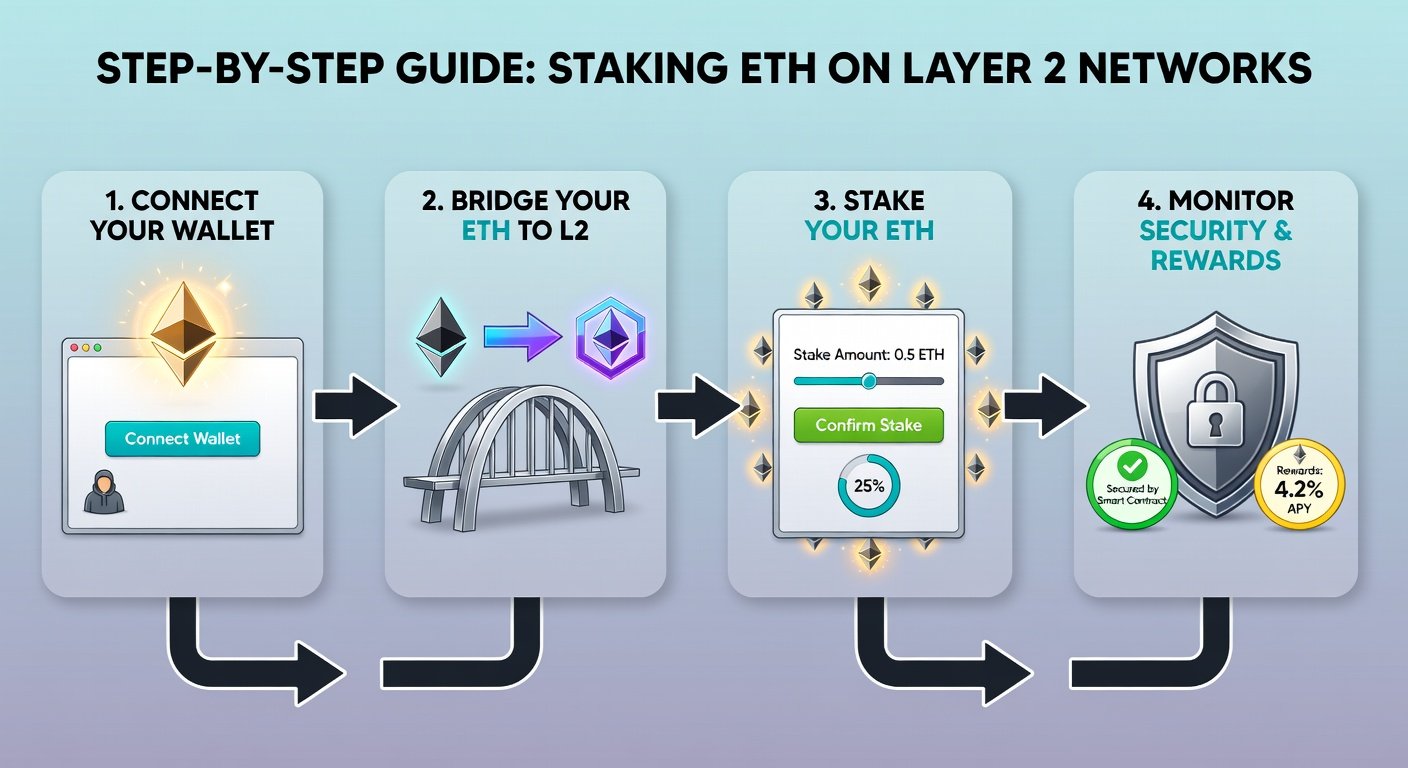
Step-by-Step Guide: How to Stake ETH on L2
Follow these practical steps for secure staking. We'll use Arbitrum as an example, but adapt for others.
Step 1: Choose and Set Up a Wallet
Use MetaMask or Rabby for multi-chain support. Enable L2 networks:
- Download MetaMask.
- Add Arbitrum One: RPC https://arb1.arbitrum.io/rpc, Chain ID 42161.
- Secure with hardware like Ledger: Connect via WalletConnect.
Pro Tip: Use a dedicated staking wallet with 2FA and multisig for >10 ETH stakes.
Step 2: Bridge ETH to L2
Transfer ETH from mainnet to L2 cheaply:
- Visit Arbitrum Bridge at bridge.arbitrum.io (confirm existence via official docs).
- Connect wallet, deposit ETH (7-day challenge period for Optimistic rollups).
- Wait 10-30 mins; use fast bridges like Across or Hop for <1 min.
Avoid peak hours to minimize mainnet gas (~$5-20).
Step 3: Select Staking Protocol and Stake
On Arbitrum, options include:
- Native Pools: Arbitrum Staking Hub – stake ETH for ARB rewards.
- Restaking: EigenLayer pod on Arbitrum – deposit for eETH.
- LSTs: Renzo or Kelp for ezETH.
- Connect to app.eigenlayer.xyz or protocol dashboard.
- Approve ETH spend, stake amount (min 0.1 ETH).
- Confirm tx (gas <$0.50). Receive LST immediately.
Step 4: Monitor and Optimize Yields
Use Dune Analytics dashboards or DeFiLlama for real-time APY. Auto-compound via Pendle or Yearn vaults on L2.
Risks and Security Best Practices
Staking isn't risk-free. Key threats:
- Slashing: Up to 50% loss for validator downtime/misbehavior (rare on L2, <0.1% incidents).
- Smart Contract Bugs: Audit reports from Ethereum.org stress verified contracts.
- Bridge Exploits: Use official bridges; history shows $500M+ losses, but 2026 multisig upgrades mitigate.
- Liquidity Risks: LST depegs during market stress (e.g., 2023 USDC event).
Mitigate with:
- Diversify across 3+ L2s.
- Stake <10% portfolio.
- Enable sequencer failovers.
- Insure via Nexus Mutual.
Restaking Innovations Driving 2026 Yields
Restaking, pioneered by EigenLayer, lets staked ETH secure off-chain services. In 2026:
- AVS diversity: Oracles, bridges, AI compute.
- L2-specific: Optimism's Superchain restaking shares security.
- Yields: Base layer 4% + restaking 5% = 9% blended.
- Benchmarks: EigenLayer TVL hits $40B, with 99.99% uptime.
Compare: Solo staking (4%) vs. L2 restaking (10%) – the gap widens with Ethereum's blobspace expansion.
Performance Benchmarks: Real-World Data
2026 Q1 data:
- Arbitrum: 12.5% APY, 2.5M daily stakes.
- zkSync: 13.2% (ZK premium), zero-knowledge security.
- Avg. Unstake Time: 1-7 days vs. mainnet 180.
Tools like L2Beat track sequencer decentralization, vital for long-term viability.
Common Mistakes to Avoid
- Ignoring challenge periods: Funds locked 7 days.
- Over-restaking: Correlation risks amplify losses.
- Phishing: Bookmark official sites only.
- Tax oversight: LST accruals are taxable events.
Conclusion
Staking ETH on L2 in 2026 democratizes high-yield DeFi, blending Ethereum's security with rollup efficiency. Start small, diversify, and monitor via trusted dashboards. With yields outpacing inflation and innovations like restaking, now's the time to level up your portfolio. Stay updated on Ethereum upgrades for even better opportunities ahead.

No comments yet. Be the first!