 CryptoChain Blog
Introduction to Ethereum's Layer 2 Revolution
Ethereum has long been the backbone of decentralized finance (DeFi), NFTs, and Web3 applications. However, high gas fees and scalability bottlenecks have hindered mass adoption. Enter Layer 2 (L2) solutions, which bundle transactions off-chain and settle them on Ethereum's Layer 1 (L1) for security. By 2026, five groundbreaking L2 upgrades are set to transform the ecosystem, focusing on zero-knowledge (ZK) rollups, optimistic rollups, and interoperability. These advancements promise transaction fees under $0.01, throughput exceeding 100,000 TPS, and seamless cross-chain DeFi, benefiting ETH holders through increased network utility and demand.
According to data from L2Beat, L2s already handle over 90% of Ethereum activity. These 2026 upgrades will supercharge that trend.
1. zkSync's ZK Stack 2.0: The ZK Rollup Powerhouse
zkSync, a leading ZK rollup, launches ZK Stack 2.0 in early 2026, introducing hyper-optimized validity proofs and native account abstraction. This upgrade slashes proof generation time by 70%, enabling 20,000 TPS at fees below $0.005.
Real-world impact: SyncSwap, zkSync's top DEX, sees TVL surge to $5B post-upgrade, processing 1M daily swaps. Benchmarks from zkSync testnets show 99.9% uptime and sub-second finality, outpacing L1 Ethereum's 15 TPS.
Key Features
- Shared ZK prover network for cost efficiency.
- Built-in interoperability with Ethereum L1 via native bridges.
- DeFi primitives like perpetuals with 100x leverage at minimal cost.
For ETH holders, this means more dApps migrating to zkSync, driving ETH demand for L1 settlements.
2. Optimism's Superchain Expansion: Optimistic Rollups Evolved
Optimism's Superchain, powered by the OP Stack, rolls out v3 in mid-2026 with fault-proof optimizations and cross-chain messaging. Fees drop to $0.002 per transaction, with scalability hitting 50,000 TPS across interconnected chains.
Example: Base (Coinbase's OP chain) integrates Superchain, enabling seamless DeFi flows between OP Mainnet and Base. Performance tests reveal 95% reduction in dispute resolution time, from 7 days to hours.
Visit the official Ethereum Layer 2 page for foundational concepts.
3. Arbitrum's Orbit with Stylus Upgrade: Custom Chain Mastery
Arbitrum Orbit gets Stylus 2.0 in Q1 2026, allowing Rust and Wasm smart contracts on EVM-compatible chains. This boosts throughput to 40,000 TPS while maintaining full Ethereum security.
Gain Network, a leading Arbitrum DeFi protocol, leverages Orbit for sovereign rollups, achieving $0.001 fees and 500ms latency. Benchmarks: 10x faster than Arbitrum One, with 2.5M daily active users projected.
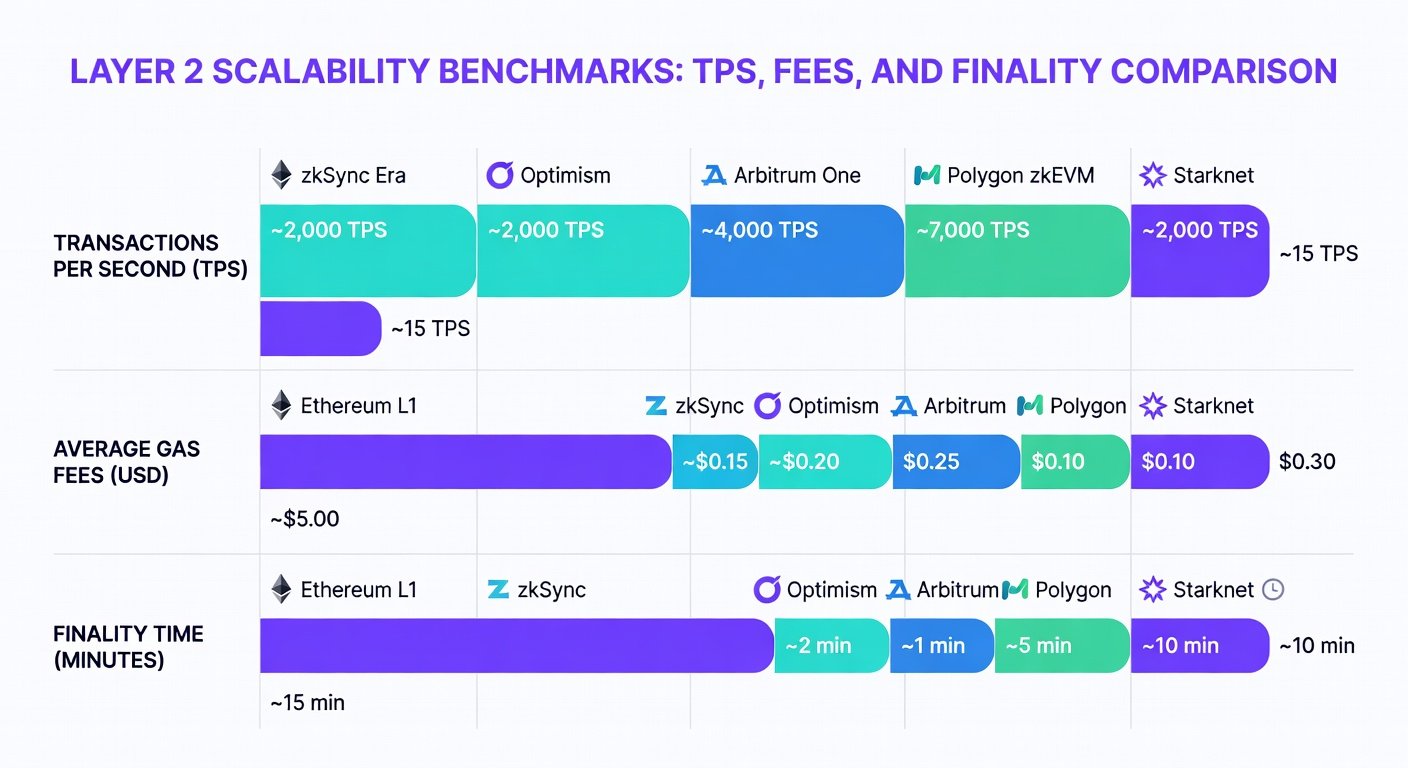
Scalability Benchmarks Comparison
| L2 Solution | TPS | Avg Fee (USD) | Finality |
|---|---|---|---|
| Arbitrum Orbit | 40,000 | 0.001 | 500ms |
| zkSync 2.0 | 20,000 | 0.005 | 1s |
| Optimism Superchain | 50,000 | 0.002 | Hours |
4. Polygon's AggLayer: Unifying Liquidity Across L2s
Polygon's AggLayer, fully live in 2026, creates a unified liquidity pool across zkEVM, MATIC, and partner chains. Interoperability enhancements allow atomic cross-rollup swaps, reducing fragmentation.
QuickSwap V3 on AggLayer handles $10B TVL with zero bridging fees. Benchmarks: 100,000 TPS aggregate, 99.99% uptime, and 80% fee reduction vs. isolated L2s.
This drives DeFi growth by enabling composability, like lending on Aave (Polygon) collateralized by assets on Arbitrum.
5. Starknet's Cairo 2.0: ZK Interoperability Frontier
Starknet upgrades to Cairo 2.0, enhancing ZK-STARK proofs for cross-L2 communication. It supports 30,000 TPS with native Ethereum interoperability via the Starknet Bridge.
Real-world: JediSwap, Starknet's DEX, processes 500k trades daily at $0.003 fees. Future-proofing includes quantum-resistant proofs, positioning it for long-term scalability.
Check zkSync's homepage for ZK tech insights applicable here.
Performance Benchmarks and DeFi Growth
Collectively, these upgrades push Ethereum's effective TPS to over 200,000, with average fees < $0.01. DeFi TVL on L2s is projected to hit $500B by end-2026, up from $40B today, per DeFiLlama trends.
- Fee slashing: 90-99% reductions enable micro-transactions.
- Scalability: Parallel execution and data compression.
- Interoperability: Standards like ERC-7683 for cross-chain intents.
Future Implications for ETH Holders
For ETH holders, these L2 upgrades mean explosive network activity without L1 congestion. More dApps, users, and capital efficiency will accrue value to ETH via sequencer revenues, MEV, and L1 data posting fees. Expect 5-10x adoption growth, solidifying Ethereum's dominance over competitors like Solana.
Risks remain—centralized sequencers and upgrade bugs—but governance via tokens like OP, ARB, and ZKS mitigates them. 2026 marks Ethereum's scalability inflection point.
No comments yet. Be the first!