 CryptoChain Blog
Introduction to 2026 NFT Regulatory Shifts
In the ever-evolving world of non-fungible tokens (NFTs), 2026 marks a turning point with stringent regulatory updates from major jurisdictions. The European Union's Markets in Crypto-Assets (MiCA) framework receives pivotal enhancements, while the U.S. Securities and Exchange Commission (SEC) rolls out clearer guidelines on digital assets. These changes aim to combat money laundering, ensure consumer protection, and standardize tax reporting, directly impacting NFT marketplaces like OpenSea, Blur, and Magic Eden.
Why does this matter? NFT trading volumes, which surged past $25 billion in 2021, have stabilized but face renewed scrutiny amid broader crypto regulations. Marketplaces must now integrate Know Your Customer (KYC) protocols, automated tax reporting, and compliance dashboards to avoid hefty fines. For collectors and traders, staying compliant means adapting strategies without halting momentum. This article dives deep into the updates, marketplace responses, and actionable tips to navigate 2026's NFT landscape.
EU MiCA Updates: A Comprehensive Overhaul for NFTs
The EU's MiCA regulation, initially effective from 2024, sees significant 2026 amendments tailored to NFTs. Classified as 'crypto-assets other than asset-referenced tokens or e-money tokens,' NFTs fall under lighter but still rigorous rules. Key updates include:
- Mandatory Issuer Disclosures: NFT projects must provide whitepapers detailing utility, risks, and reserve proofs, especially for collections exceeding €1 million in issuance.
- Secondary Market Oversight: Marketplaces acting as 'crypto-asset service providers' (CASPs) require licensing, with enhanced anti-money laundering (AML) checks.
- Consumer Safeguards: Cooling-off periods for high-value NFT purchases and clear labeling for speculative vs. utility NFTs.
These stem from the European Securities and Markets Authority (ESMA) push for harmonization. For more on MiCA's framework, visit the ESMA website.
Impact on marketplaces? Platforms must verify user identities for trades over €1,000, integrating tools like biometric verification. Non-EU marketplaces serving EU users risk geo-blocks, pushing global adoption of EU-compliant standards.
US SEC Guidelines: NFTs as Potential Securities
Across the Atlantic, the SEC's 2026 digital asset guidelines build on the Howey Test, clarifying when NFTs qualify as securities. High-profile cases like the SEC vs. OpenSea investigation in 2024 set precedents, leading to:
- Investment Contract Criteria: NFTs promising profits via issuer efforts (e.g., roadmap-dependent floor price pumps) trigger registration requirements.
- Tax Reporting Mandates: Platforms report gross proceeds via Form 1099-DA starting 2026, covering all NFT sales over $600.
- Custody Rules: Qualified custodians for institutional NFT holdings, with marketplaces offering segregated wallets.
The SEC emphasizes enforcement, with fines up to $2 million for non-compliance. Check official updates at the SEC.gov.
For traders, this means tracking cost basis meticulously, as wash sales may apply to identical NFTs. Marketplaces are racing to embed IRS-compliant tools, reducing user friction while meeting deadlines.
How Top NFT Marketplaces Are Adapting
NFT marketplaces are at the compliance forefront, rolling out features to align with MiCA and SEC rules. Here's a breakdown:
| Marketplace | KYC Implementation | Tax Reporting | Compliance Tools |
|---|---|---|---|
| OpenSea | Optional tiered KYC; mandatory for EU users > $10K volume | Integrated 1099-DA export; partnership with Koinly | Risk scoring dashboard; geo-fencing |
| Blur | Power-user KYC via Paradigm integration | Real-time tax calculator; API for accountants | AML flagging for suspicious bids |
| Magic Eden | Full KYC for cross-chain trades | Automated VAT calculation for EU | Smart contract audits on-chain |
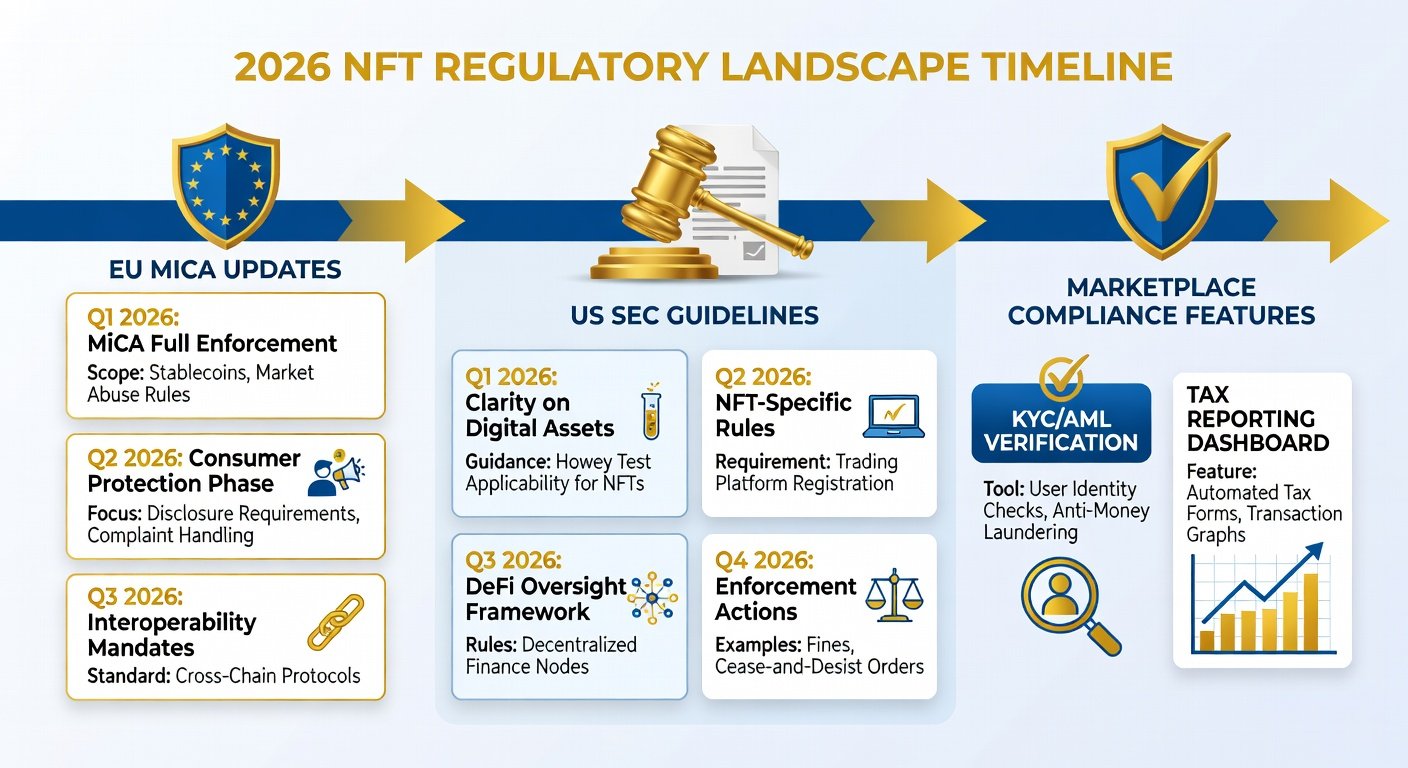
These adaptations aren't just checkboxes. OpenSea, for instance, launched 'Seaport Compliance Suite' in late 2025, featuring wallet screening against OFAC lists. Blur's focus on traders includes lending protocols with built-in tax previews. Smaller platforms like LooksRare may consolidate or pivot to niche compliant markets.
The Financial Action Task Force (FATF) 'Travel Rule' influences this too, requiring transaction data sharing between platforms. Learn more from the FATF homepage.
Practical Tips for NFT Collectors and Traders
Adapting doesn't mean pausing your strategy. Here's a step-by-step guide:
- Choose Compliant Platforms: Migrate to marketplaces with verified KYC (e.g., OpenSea Pro tier). Use multi-sig wallets for high-value holdings.
- Track Taxes Proactively: Employ tools like ZenLedger or NFT-specific trackers. Log every mint, trade, and airdrop with timestamps and USD values.
- Implement KYC Early: Verify identity once per platform to unlock premium features and avoid trade halts.
- Diversify Jurisdictions: Hold NFTs in compliant regions; use VPNs cautiously to evade geo-blocks.
- Monitor Utility vs. Speculation: Prioritize NFTs with real-world utility (e.g., gaming assets) to sidestep security classifications.
Common Mistakes to Avoid
- Ignoring cost basis: FIFO (First-In-First-Out) is default for taxes—don't assume LIFO.
- Anonymous trading: High-volume anon wallets trigger red flags and freezes.
- Overlooking EU VAT: Secondary sales may incur 20%+ taxes.
- Forgetting airdrops/staking: These are taxable events.
Future Outlook: Opportunities Amid Regulation
While regulations add hurdles, they foster legitimacy. Expect institutional inflows, with BlackRock eyeing tokenized NFTs. Marketplaces innovating compliance could dominate, rewarding early adopters.
FAQs on 2026 NFT Regulations
Q: Do all NFTs require KYC now?
A: No, but thresholds apply—e.g., €1,000 in EU, $600 in US for reporting.
Q: How do I calculate NFT taxes?
A: Proceeds minus cost basis; use FIFO. Tools auto-compute.
Q: Will regulations kill NFT hype?
A: Unlikely—compliance builds trust, attracting more users.
Conclusion
2026's NFT regulatory updates from MiCA and SEC aren't roadblocks but evolutions toward maturity. Marketplaces' swift KYC, tax, and compliance integrations ensure seamless trading. Collectors and traders who prepare—via compliant platforms, diligent tracking, and strategic shifts—will thrive. Stay informed, adapt smartly, and position your portfolio for the regulated NFT boom.


No comments yet. Be the first!