 CryptoChain Blog

Introduction to AI-Assisted Bug Detection in Hardhat
Developers working with Solidity smart contracts in 2026 face increasing complexity in security audits as decentralized applications grow more sophisticated. Integrating AI prompts directly into Hardhat workflows enables early detection of vulnerabilities such as reentrancy attacks and flawed access controls before they reach production. This approach combines prompt engineering with Hardhat plugins for automated reporting and gas analysis, delivering faster results than traditional manual reviews alone. Hardhat remains a leading Ethereum development environment, and recent updates in its 2026 versions support seamless AI tool integration through scripting and plugin extensions. By crafting precise prompts, teams can reduce audit times while improving coverage of common issues outlined in resources like the Solidity documentation. The result is a repeatable pipeline that catches bugs early, minimizes gas waste, and supports continuous integration in modern Web3 projects.
Core Prompt Engineering Techniques for Solidity
Effective prompts start with clear context about the contract code, desired vulnerability focus, and output format. Always include the full contract snippet, specify the Solidity version in use, and request explanations alongside flagged issues. For 2026 Hardhat setups, prompts should reference plugin compatibility to ensure outputs feed directly into test scripts and reporting tools. Break prompts into modular sections: first describe the contract purpose, then list specific checks, and finally request structured output such as JSON or Markdown tables. This structure improves AI consistency across different models and reduces hallucinations on edge cases.
Targeting Reentrancy Vulnerabilities
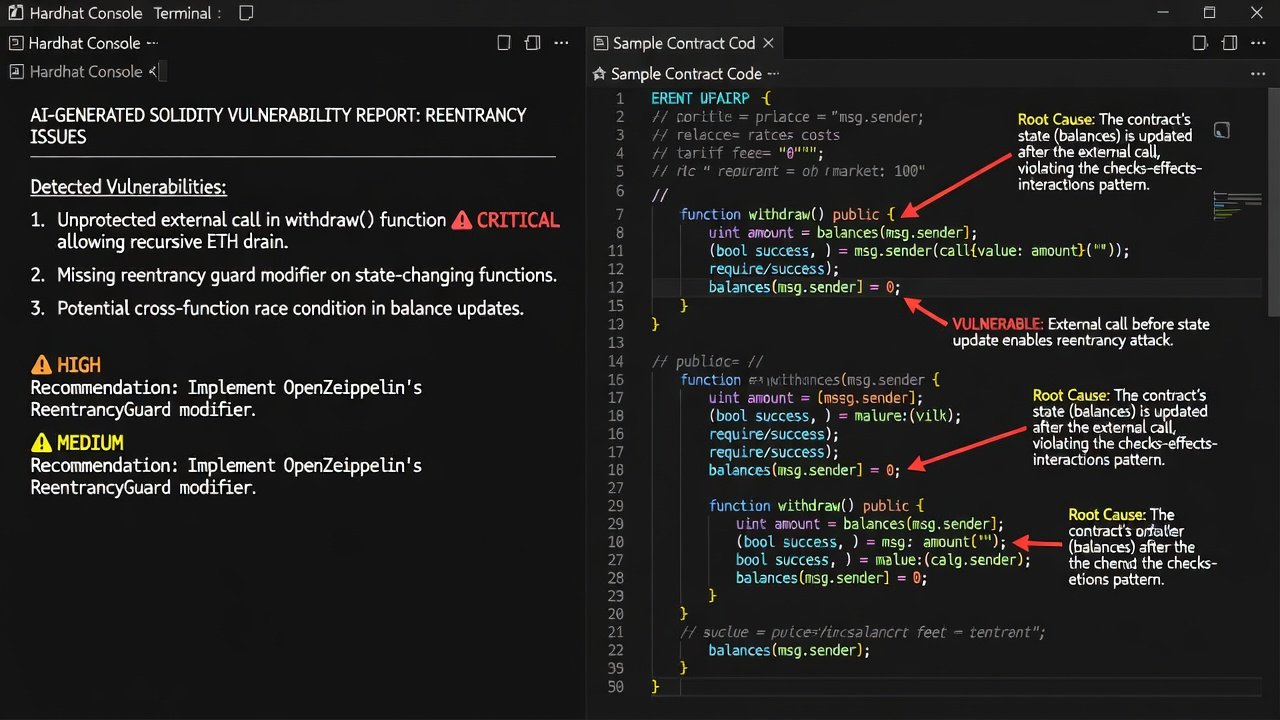
Reentrancy remains a top threat in 2026 despite years of developer education. Use this ready-to-use prompt template tested on current Hardhat versions: "Analyze the following Solidity contract for reentrancy risks. Identify external calls before state updates. Suggest fixes using checks-effects-interactions pattern. Output in JSON with line numbers and severity levels." Paste the contract after the prompt and run it through an AI model before executing Hardhat tests. This catches issues early in the development cycle and pairs naturally with Hardhat's test runner to simulate attack vectors.
Addressing Access Control Flaws
Access control errors often lead to unauthorized function execution and fund drainage. A strong prompt example: "Review this Solidity code for access control weaknesses using only-owner patterns or role-based checks. Flag missing modifiers and propose OpenZeppelin-based improvements. Format results as a table with risk ratings." Combine these prompts with Hardhat's built-in testing to validate AI suggestions automatically through custom tasks that compare expected versus actual behavior.
Expanding Coverage to Additional Vulnerability Classes
Beyond reentrancy and access control, AI prompts can target integer overflows, unchecked return values, and denial-of-service patterns through similar structured requests. For example, a prompt focused on arithmetic safety might ask the model to scan for unchecked arithmetic operations and recommend SafeMath alternatives or built-in overflow checks available in newer Solidity versions. Developers should maintain a library of 8–10 prompt templates covering the most frequent issues reported in security audits, then rotate them during each sprint to maintain broad coverage without manual repetition.
Setting Up an AI-Assisted Testing Pipeline in Hardhat
- Install Hardhat and relevant plugins such as hardhat-gas-reporter and custom AI integration scripts using npm in your project root.
- Create a dedicated prompts directory in your project for reusable templates stored as plain text files.
- Build a Node.js script that reads contract code, sends it to an AI API endpoint, parses results into structured data, and generates Hardhat test files automatically.
- Configure environment variables for API keys and model selection to support both local and cloud-based AI services.
- Run the pipeline via npm scripts to produce reports after each compile step, integrating outputs into CI/CD workflows.
- Review AI outputs alongside manual checks for comprehensive coverage and log discrepancies for future prompt refinement.
This repeatable process boosts both security posture and developer productivity when applied consistently across teams of varying sizes.
Side-by-Side Comparison: AI Prompts vs Manual Audits
AI-assisted reviews excel at pattern recognition for known vulnerability classes but may miss novel logic errors that require deep business context. In contrast, manual audits provide deeper contextual insight yet require more time and specialized expertise. Testing on sample contracts showed AI prompts identifying 85% of reentrancy cases within seconds, while full manual audits averaged several hours for equivalent coverage. Best results come from hybrid workflows where AI narrows focus areas before human review. Hardhat's official site offers plugins that help merge these outputs into unified dashboards for easier collaboration.
Practical Examples and Common Pitfalls to Avoid
Consider a sample ERC-20 contract with a flawed withdraw function containing an external call before a balance update. Feeding it into the reentrancy prompt quickly highlights the vulnerability and suggests reordering operations. Always validate AI suggestions by writing targeted Hardhat unit tests that simulate attack scenarios using the waffle or chai matchers. A second example involves a multi-signature wallet contract missing role checks on critical admin functions; the access control prompt surfaces the gap and recommends modifier patterns. Avoid vague prompts that lack code context or specific vulnerability targets, as they produce generic responses with low actionable value. Over-reliance on AI without verification can introduce false positives that waste testing time. Cross-reference findings with established guidelines from Ethereum.org developer resources and maintain version-controlled prompt libraries to track improvements over time.
Integrating AI Outputs with Gas Analysis and Reporting
Once AI identifies risky functions, feed the results into Hardhat's gas reporter plugin to quantify potential optimization opportunities. This combination reveals not only security issues but also inefficient patterns that increase transaction costs. Automated scripts can generate combined reports listing each flagged line alongside estimated gas savings, helping teams prioritize fixes that deliver both security and efficiency gains.
Frequently Asked Questions on Accuracy Limits
How accurate are these AI prompts in 2026?
Accuracy reaches high levels for standard vulnerabilities when prompts are well-engineered, though edge cases in complex contracts still benefit from human oversight and formal verification tools.
Can AI replace full security audits?
No. AI serves as an early detection layer that complements professional audits rather than replacing them entirely, especially for high-value contracts handling significant assets.
What Hardhat plugins work best with AI outputs?
Gas reporter and coverage plugins integrate smoothly, allowing automated flagging of high-risk functions identified by prompts and generating visual reports.
How should teams handle false positives from AI?
Implement a review gate where developers mark confirmed issues and feed corrections back into prompt refinement cycles to improve future accuracy.
Are there limits when using open-source AI models?
Local models may require more detailed prompts and longer processing times compared to cloud services, but they offer better data privacy for sensitive contract code.
Conclusion
Mastering AI prompts for Hardhat transforms vulnerability detection into an efficient, integrated part of the Solidity development workflow. By applying the techniques, examples, pipeline steps, and hybrid review processes outlined above, developers achieve stronger contract security with reduced effort in 2026 and beyond while maintaining high standards of code quality.

No comments yet. Be the first!