 CryptoChain Blog

Introduction to AI-Driven Solidity Audits in 2026
As smart contract complexity grows on Ethereum and layer-2 networks, developers increasingly rely on AI tools to catch vulnerabilities faster than traditional methods alone. This guide walks through selecting, configuring, and using the top AI auditing platforms available in 2026, complete with hands-on examples for common issues like reentrancy and access control flaws. By combining automated AI scans with manual code reviews, teams can achieve higher detection rates while managing gas costs and security trade-offs effectively. The evolution of machine learning models trained on millions of historical exploits now allows these platforms to identify subtle patterns that static analyzers often miss, making them essential for production-grade contracts.
Selecting Leading AI Auditing Platforms in 2026
Focus on platforms that support Solidity 0.8+ and integrate with popular frameworks. Key options include tools emphasizing machine learning models trained on historical exploit data and real-time on-chain patterns. Evaluate based on detection accuracy reports, ease of Hardhat or Foundry integration, and support for custom rule sets. When choosing, consider factors such as false positive rates on complex DeFi logic, support for proxy patterns, and the ability to export findings into issue trackers. Popular platforms often provide dashboards that visualize vulnerability heatmaps across your codebase, helping prioritize fixes during sprint planning.
Configuration Steps for Top Platforms
- Install the CLI tool via npm or direct binary download and verify the installation with a version check command.
- Authenticate with your API key from the provider dashboard, ensuring secure storage in environment variables.
- Configure project paths in a YAML file pointing to your contracts directory and specify excluded folders like test mocks.
- Set scan parameters for gas optimization alongside vulnerability detection, including thresholds for acceptable risk levels.
- Enable integration hooks for continuous scanning on every commit to catch issues early in the development cycle.
Always test configuration on a sample contract before full project scans to avoid configuration drift across team members.
Running Automated Vulnerability Scans
Start with a basic reentrancy example. The following contract demonstrates a vulnerable withdrawal function that allows attackers to drain funds through recursive calls before balance updates occur:
pragma solidity ^0.8.0;
contract VulnerableBank {
    mapping(address => uint) public balances;
    function deposit() public payable { balances[msg.sender] += msg.value; }
    function withdraw(uint amount) public {
        require(balances[msg.sender] >= amount);
        (bool success, ) = msg.sender.call{value: amount}("");
        require(success);
        balances[msg.sender] -= amount;
    }
}
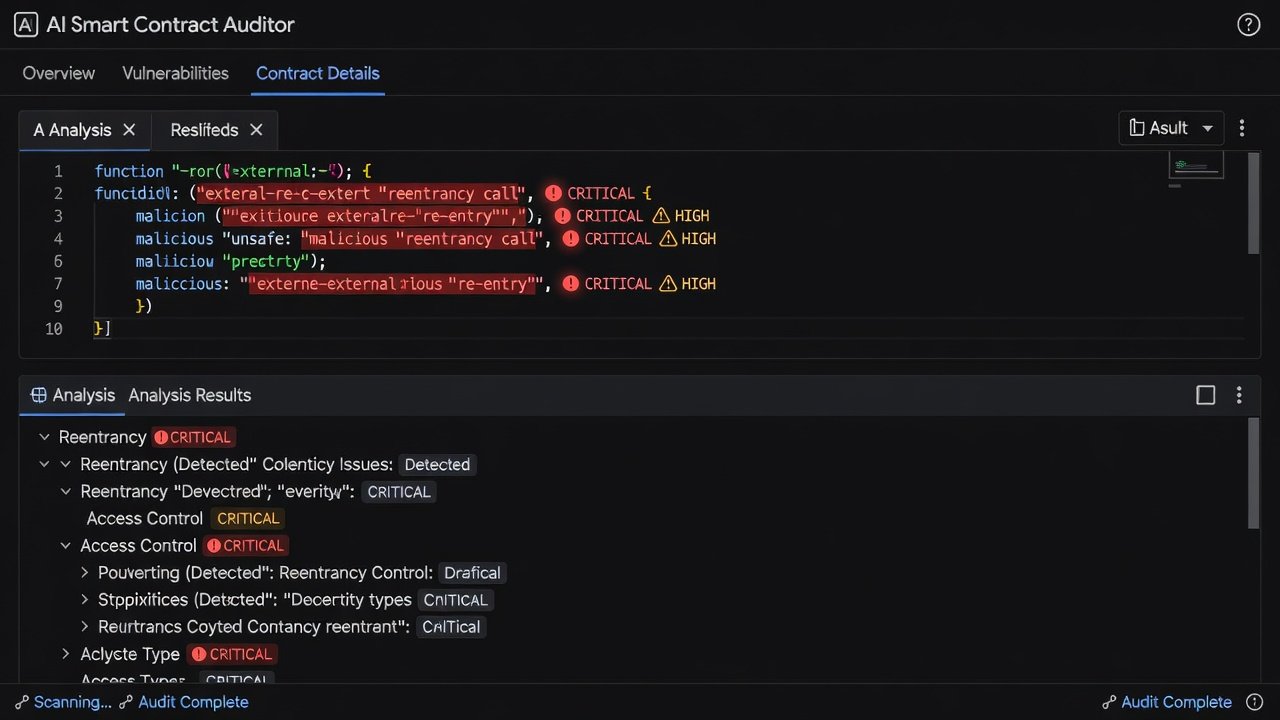
Upload this to your chosen AI auditor. The tool typically flags the external call before state update, highlighting reentrancy risk and suggesting a mutex lock pattern or checks-effects-interactions ordering.
Access Control Flaw Example
contract AccessControlExample {
    address public owner;
    function setOwner(address newOwner) public {
        owner = newOwner;
    }
    function criticalFunction() public {
        require(msg.sender == owner);
        // sensitive operations
    }
}
AI scans quickly identify missing onlyOwner modifiers or role-based checks, often recommending OpenZeppelin AccessControl library integration for scalable permission management.
Interpreting Results Alongside Manual Reviews
AI reports provide severity scores and suggested fixes. Cross-reference findings manually using tools like Slither or Mythril for confirmation. Look for false positives around complex proxy patterns or custom modifiers. A structured review process involves categorizing issues into high, medium, and low severity, then assigning them to developers based on expertise. This hybrid approach reduces the time spent on obvious bugs while focusing human attention on economic attack vectors that AI may underrepresent.
Gas and Security Trade-Offs
Adding AI-recommended checks such as reentrancy guards increases deployment gas by noticeable margins depending on contract size. Developers must weigh these costs against potential loss from exploits. For instance, implementing a reentrancy guard adds a small storage slot but prevents catastrophic drains. Prioritize critical fixes on high-value contracts while accepting minor optimizations on peripheral logic. Compare results against baseline scans from traditional static analyzers to quantify accuracy gains and decide where additional manual effort yields the best return.
Comparison of Detection Accuracy
2026 AI platforms show improved recall on reentrancy and access control issues versus rule-based tools alone. Teams report catching significantly more edge-case vulnerabilities when layering AI outputs. However, human oversight remains essential for business-logic flaws not present in training data. In practice, running parallel scans with both AI and classic tools like Hardhat plugins reveals complementary strengths, with AI excelling at novel attack patterns and traditional tools providing deterministic guarantees on known issues.
Integration with Hardhat and Foundry Workflows
- In Hardhat, add the AI plugin to hardhat.config.js and run via npx hardhat audit-ai after compiling contracts to ensure bytecode matches source.
- For Foundry, use the forge script extension or external CLI wrapper to scan compiled artifacts, then pipe results into markdown reports for pull request comments.
- Automate scans in CI pipelines by triggering on pull requests and failing builds if critical vulnerabilities are detected above a configurable threshold.
- Combine outputs with Foundry test coverage reports to correlate low-test areas with high-risk functions flagged by AI.
These integrations help maintain consistent security posture across distributed teams working on large monorepos.
Practical Tips for Common Vulnerabilities
Beyond the examples above, address integer overflows by enabling Solidity 0.8's built-in checks, but verify that AI tools correctly interpret SafeMath usage in legacy code. For oracle manipulation risks, configure the auditor to flag external price feed calls and suggest multi-oracle aggregation strategies. Always document accepted risks in a security assumptions file so future auditors understand context.
Conclusion
Integrating AI tools into Solidity security audits streamlines the process in 2026 while maintaining the rigor of manual analysis. Follow the steps above to configure platforms, test sample contracts, and balance security with gas efficiency for robust smart contract deployments. Continuous learning through community forums and updated model releases will keep your workflow current as threats evolve.
FAQ
How do AI tools handle custom modifiers in Foundry projects?
Most platforms allow uploading custom ABIs and training on project-specific patterns for improved accuracy, though initial calibration runs are recommended.
What are common integration challenges with Hardhat?
Path configuration and plugin version mismatches are frequent; always verify compatibility with your Solidity compiler version and test in a fresh environment.
Can AI replace full manual audits?
No, AI excels at pattern matching but requires human review for context-specific risks and economic exploits that depend on protocol incentives.
Are there recommended resources for learning more about Solidity security?
Consult the official Solidity documentation and Ethereum developer resources for foundational knowledge before diving into AI-assisted workflows.

No comments yet. Be the first!