 CryptoChain Blog

Introduction to Fuzz Testing in Solidity Development
In 2026, securing Solidity smart contracts demands more than traditional unit tests and manual audits. Fuzz testing has emerged as a powerful technique to automatically discover edge-case vulnerabilities by feeding contracts with randomized, malformed inputs. This approach helps developers identify issues like reentrancy flaws, integer overflows, and access control errors that static analysis often misses. As blockchain ecosystems grow more complex with cross-chain interactions and layer-2 scaling solutions, the attack surface for smart contracts expands significantly, making proactive security measures essential for any production deployment.
Developers targeting production-grade DeFi protocols or NFT marketplaces benefit greatly from integrating fuzzing into their workflows. By simulating millions of transaction scenarios, fuzz testing provides deeper assurance against exploits that could lead to fund losses. This article delivers a comprehensive guide covering tool setup, test writing, pipeline integration, comparisons with other methods, real-world examples, and forward-looking optimization strategies tailored for 2026 environments.
Understanding Fuzz Testing Fundamentals
Fuzz testing, or fuzzing, involves generating vast amounts of semi-random data to probe smart contract functions. Unlike property-based testing that relies on predefined invariants, fuzzers explore unexpected paths autonomously. For Solidity, this means targeting functions with inputs that might trigger unexpected state changes or revert conditions under extreme conditions.
Core Mechanisms Behind Fuzzing
Modern fuzzers employ mutation strategies, genetic algorithms, and coverage-guided feedback loops to prioritize promising input sequences. They monitor code execution paths in real time, adjusting subsequent inputs to maximize branch coverage and reveal hidden logic errors. This dynamic exploration contrasts sharply with static tools that analyze source code without execution.
Key benefits include uncovering hidden bugs early in development and complementing formal verification methods. When combined with tools like symbolic execution, fuzzing achieves comprehensive coverage of contract behavior across thousands of potential states.
Why Fuzz Testing Matters for Smart Contracts
Smart contracts operate in immutable environments where post-deployment fixes are costly or impossible without hard forks. Traditional testing often overlooks rare but catastrophic scenarios such as flash loan attacks or oracle manipulation sequences. Fuzz testing systematically stresses these boundaries, revealing weaknesses in access controls, arithmetic operations, and external call handling that manual reviews frequently miss.
Industry reports from 2025 highlight that fuzz-discovered vulnerabilities accounted for a notable portion of prevented exploits in audited protocols, underscoring its growing role in secure development lifecycles.
Setting Up Foundry and Echidna for Fuzz Testing
Foundry provides an efficient Rust-based framework for Ethereum development, including built-in fuzzing capabilities via its forge test command with fuzz modifiers. Echidna, developed by Trail of Bits, specializes in property-based fuzzing for EVM contracts and excels at stateful testing across multiple transactions.
Foundry Installation and Configuration
To get started with Foundry, install it via the official installer script and initialize a new project with forge init. Configure your foundry.toml file to enable fuzz runs with high iteration counts, such as setting fuzz_runs = 10000 for thorough exploration. Enable additional flags for invariant testing to maintain critical properties throughout campaigns.
Echidna Setup and Integration
For Echidna, clone the repository from its official source and ensure your contracts compile with compatible Solidity versions. Create a dedicated echidna.yaml file specifying contract targets, test limits, and corpus directories. Both tools integrate seamlessly with existing Hardhat or Foundry projects, allowing quick adoption without major refactoring. Troubleshooting common issues involves verifying EVM version alignment and increasing memory allocation for large-scale runs.
Link to authoritative resources: Learn core Foundry commands from the Foundry Book. Review Solidity language features at the official Solidity documentation.
Writing Effective Fuzz Tests with Practical Examples
Effective fuzz tests focus on invariants such as token balances never going negative or access controls remaining intact. In Foundry, annotate tests with fuzz to let the engine generate inputs automatically while using vm.assume to filter invalid cases.
Consider this expanded example for a simple token contract:
function testFuzz_Transfer(address from, uint256 amount) public {
    vm.assume(from != address(0) && amount > 0);
    uint256 initialBalance = token.balanceOf(from);
    token.transfer(from, amount);
    assert(token.balanceOf(from) == initialBalance - amount);
}
Echidna uses a configuration file to define targets and properties. Write a test contract implementing echidna_ prefixed functions that return booleans indicating pass/fail states. For advanced scenarios, incorporate multi-transaction sequences to simulate complex DeFi interactions like lending and liquidation flows.
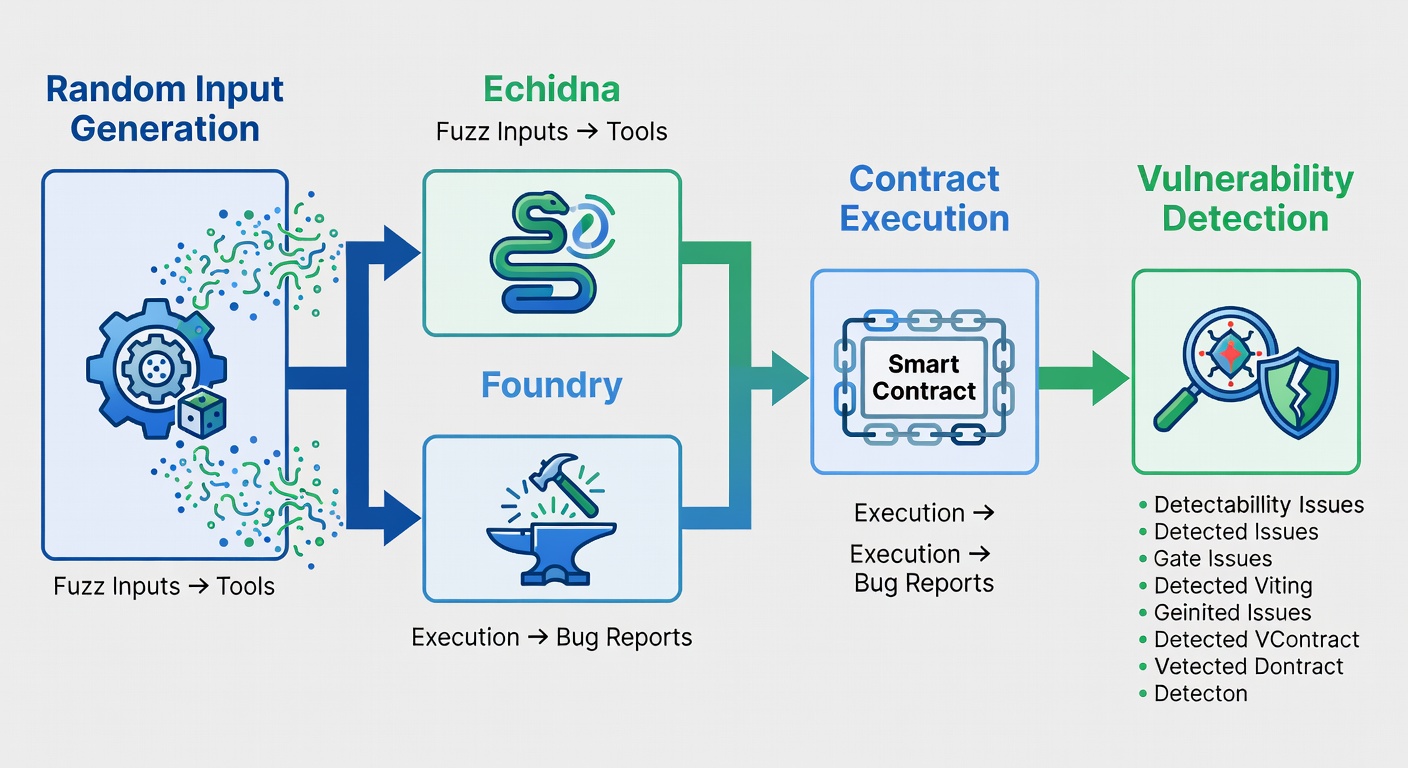
Iterate on your tests by analyzing coverage reports to refine input generators and focus on high-risk functions such as those handling external calls or time-dependent logic.
Integrating Fuzz Testing into CI/CD Pipelines
Automate fuzz testing by adding dedicated jobs in GitHub Actions or GitLab CI. Run Foundry fuzz tests on every pull request with configurable timeouts and failure thresholds. Echidna can be scripted to execute nightly campaigns on main branches for deeper exploration of stateful properties.
This integration catches regressions early and maintains security standards as code evolves. Include coverage thresholds to enforce minimum exploration depth, and store corpus artifacts for reuse across runs. Example workflow files demonstrate matrix testing across multiple Solidity versions for broad compatibility assurance.
Further guidance on continuous integration appears in Ethereum developer resources.
Comparing Fuzz Testing to Traditional Testing Methods
Traditional unit tests offer deterministic verification but struggle with combinatorial explosion of inputs. Fuzzing excels at discovering novel attack vectors through randomness and persistence.
- Unit tests: Fast feedback, limited scope, ideal for happy-path validation
- Static analysis: Quick pattern matching, prone to false positives on complex logic
- Symbolic execution: Exhaustive but computationally expensive for large contracts
- Fuzzing: High coverage of unexpected states, resource intensive yet scalable with modern hardware
Many teams now combine all three approaches for layered defense, using fuzzing specifically to augment gaps left by deterministic methods.
Real-World Case Studies of Bugs Caught by Fuzzing
Historical incidents, such as vulnerabilities in popular lending protocols, were identified through extended fuzz campaigns that revealed reentrancy paths missed by auditors. In one documented case, Echidna uncovered an integer underflow allowing unauthorized minting after millions of iterations.
Another example involved a governance contract where fuzzing exposed a timing attack enabling proposal manipulation under specific block conditions. These cases demonstrate how fuzzing surfaces issues invisible to conventional reviews, leading to patched code before mainnet deployment.
2026 Best Practices and Optimization Tips
Adopt hybrid fuzzing strategies that blend random generation with guided mutation based on code coverage. Leverage hardware acceleration where available and parallelize campaigns across multiple instances for faster results. Optimize by seeding initial corpora from known transaction histories and regularly updating tool versions for improved EVM compatibility.
Document all discovered issues to build institutional knowledge and schedule periodic reviews of test effectiveness. Incorporate custom mutators for domain-specific data types like addresses and timestamps to accelerate discovery of relevant edge cases.
Common Pitfalls and How to Avoid Them
Developers often under-allocate runtime, resulting in incomplete coverage. Always monitor metrics such as branch hits and adjust parameters accordingly. Another frequent mistake is ignoring state persistence between test runs, which Echidna handles better through its dedicated configuration options. Validate assumptions in fuzz tests rigorously to prevent false negatives.
Conclusion
Mastering fuzz testing equips Solidity developers with robust defenses against emerging threats in 2026. By implementing the techniques outlined, teams can deliver more resilient contracts and reduce post-deployment risks substantially while staying ahead of evolving security challenges in decentralized applications.
FAQ
How long should fuzz campaigns run? Start with 10,000–100,000 iterations and scale based on coverage metrics and contract complexity.
Can fuzzing replace audits? No, it complements professional audits for maximum security and should be part of a multi-layered strategy.
What hardware is recommended? Multi-core CPUs with at least 16GB RAM for efficient parallel testing and large corpus management.
How do I handle non-deterministic behavior in tests? Use Foundry's cheat codes to control block timestamps and randomness sources explicitly during campaigns.
Are there limits to fuzzing on very large contracts? Yes, consider modular testing of individual components first before full-system campaigns to manage resource demands effectively.


No comments yet. Be the first!