 CryptoChain Blog

Introduction to Secure Prediction Markets in Solidity
Prediction markets enable participants to trade on the outcomes of future events in a decentralized manner. In 2026, developers building these systems in Solidity must emphasize security to counter manipulation, oracle failures, and economic attacks. This comprehensive tutorial delivers practical guidance for creating robust prediction market contracts, covering market creation, oracle integrations, incentive designs, and modern testing frameworks. Following current best practices ensures contracts are gas-efficient and ready for professional audits.
Throughout this guide we explore real code patterns, decision frameworks, and defensive strategies that have proven effective on Ethereum mainnet and Layer-2 networks. By the end you will understand how to structure a production-grade contract that resists common attack vectors while remaining economical to deploy and interact with.
Market Creation Logic with Validation and Events
Every prediction market begins with a creation function that records essential parameters. Use a struct to store question text, resolution deadline, chosen oracle address, and resolution status. Emit events for off-chain indexing and enforce strict checks to prevent invalid markets.
struct Market {
    string question;
    uint256 endTime;
    address oracle;
    bool resolved;
    uint256 totalYes;
    uint256 totalNo;
}

mapping(uint256 => Market) public markets;
uint256 public marketCount;

event MarketCreated(uint256 indexed marketId, string question, uint256 endTime);

function createMarket(string calldata _question, uint256 _endTime, address _oracle) external {
    require(_endTime > block.timestamp + 1 hours, "End time too soon");
    require(_oracle != address(0), "Invalid oracle");
    markets[marketCount] = Market(_question, _endTime, _oracle, false, 0, 0);
    emit MarketCreated(marketCount, _question, _endTime);
    marketCount++;
}
Adding a minimum duration requirement and non-zero oracle check reduces accidental or malicious misconfigurations. Consider also storing a unique identifier derived from a hash of the question to prevent duplicate markets on the same event.
Implementing Role-Based Access Controls
Granular permissions are essential. Import OpenZeppelin’s AccessControl contract and define separate roles for administrators, oracles, and pausers. This separation limits blast radius if any single role is compromised.
import "@openzeppelin/contracts/access/AccessControl.sol";
import "@openzeppelin/contracts/security/Pausable.sol";

contract PredictionMarket is AccessControl, Pausable {
    bytes32 public constant ORACLE_ROLE = keccak256("ORACLE_ROLE");
    bytes32 public constant PAUSER_ROLE = keccak256("PAUSER_ROLE");

    constructor() {
        _grantRole(DEFAULT_ADMIN_ROLE, msg.sender);
        _grantRole(PAUSER_ROLE, msg.sender);
    }

    function pause() external onlyRole(PAUSER_ROLE) { _pause(); }
}
Always revoke unnecessary roles after deployment and consider using a timelock controller for admin actions in high-value markets.
Oracle Integrations for Reliable Outcome Resolution
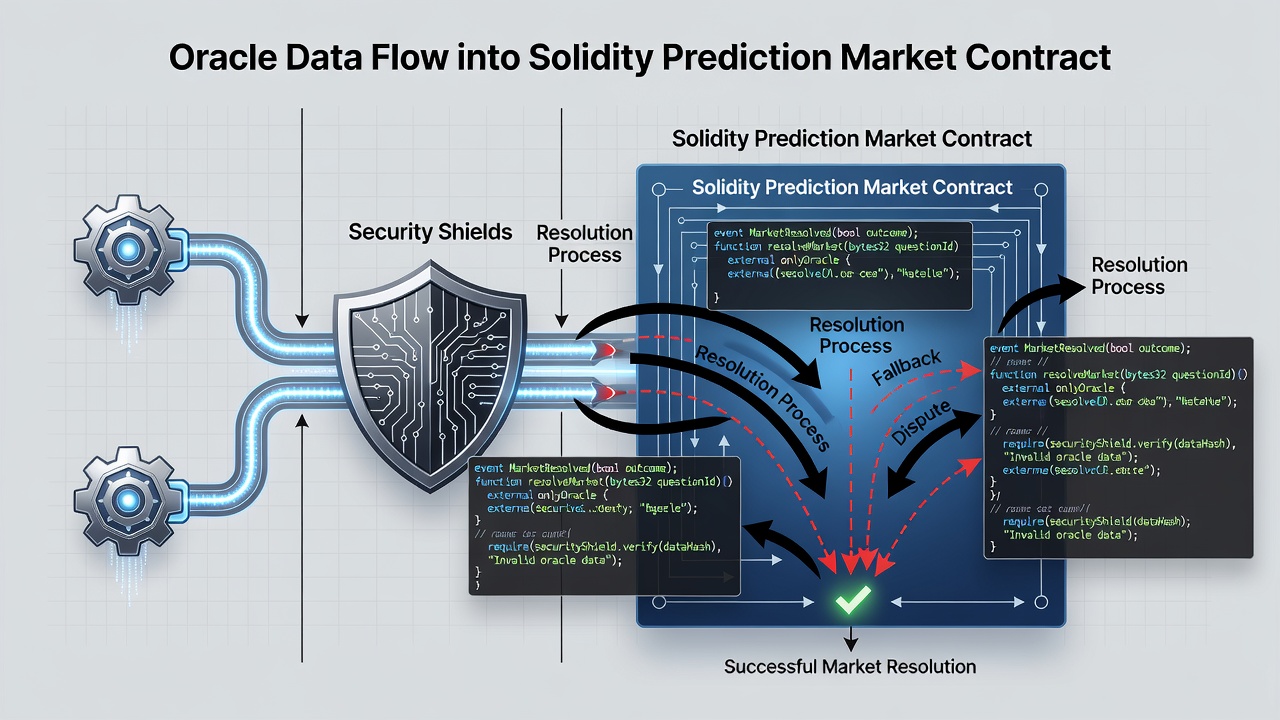
Outcome resolution determines payouts and is the most security-critical component. Centralized oracles are fast yet introduce trust assumptions, while decentralized networks such as Chainlink Data Feeds provide cryptographic guarantees. A hybrid approach often balances speed and trustlessness.
Here is a resolution function restricted to the oracle role that also updates token balances for later claiming:
function resolveMarket(uint256 _marketId, bool _outcome) external onlyRole(ORACLE_ROLE) whenNotPaused {
    Market storage m = markets[_marketId];
    require(block.timestamp >= m.endTime, "Market still active");
    require(!m.resolved, "Already resolved");
    m.resolved = true;
    // additional payout accounting logic
}
Comparison of Resolution Methods
- Centralized oracle – low latency, single point of failure, suitable for low-stake markets.
- Chainlink decentralized oracle – high security, higher gas cost, best for high-value markets.
- Multi-oracle consensus – requires majority agreement, mitigates individual failures but adds complexity.
Choose the method according to market size and required finality speed. Document your choice clearly in the contract NatSpec comments for auditors.
Incentive Mechanisms and Economic Defenses
Strong economic incentives discourage manipulation. Require participants to stake tokens when reporting outcomes and slash stakes for proven incorrect reports. Implement a bonding curve or flat staking requirement that scales with market volume.
Additional defenses include commit-reveal schemes for bet placement to prevent front-running and time-weighted average price mechanisms for large positions. These patterns reduce the profitability of last-minute oracle attacks.
Automated Testing and Fuzzing Strategies
Modern development in 2026 relies on Foundry and Hardhat with extensive fuzzing. Write property-based tests that explore edge cases such as zero-balance resolution, oracle role revocation mid-market, and reentrancy during payout claims.
Example Foundry test skeleton:
function testResolveOnlyOracle() public {
    vm.prank(oracle);
    market.resolveMarket(0, true);
    assertTrue(market.markets(0).resolved);
}
Run invariant tests continuously in CI pipelines and simulate mainnet fork scenarios with realistic gas prices.
Gas Efficiency Best Practices
Storage writes dominate gas costs. Use immutable and constant variables wherever possible, pack structs tightly, and batch multiple updates in single transactions. Replace repeated mappings with transient storage when supported by the EVM. These optimizations can reduce deployment costs by more than 30 percent compared with naive implementations.
Economic Attack Vectors and Mitigation
Common vectors include oracle bribery, flash-loan amplified positions, and griefing through repeated small bets. Mitigate each by combining access control, staking requirements, and circuit breakers that pause markets when anomalous volume is detected.
Audit Readiness and Deployment Checklist
Before mainnet deployment, complete static analysis with Slither, formal verification of critical functions, and at least two independent manual audits. Reference authoritative resources including Solidity documentation and Ethereum developer resources. Maintain a public audit report and implement a bug bounty program.
FAQ: Common Deployment Pitfalls
- How should oracle downtime be handled? Implement a fallback multi-sig resolution path with a minimum delay.
- What prevents front-running of bets? Use commit-reveal or private mempool transactions.
- Are there recommended gas limits? Always test on a mainnet fork at current network conditions.
- How to upgrade contracts safely? Use proxy patterns with rigorous initialization checks.
Conclusion
Secure prediction market contracts require deliberate design across creation logic, access control, oracle choice, incentives, and testing. By applying the 2026 practices outlined above, developers can deliver contracts that are both gas-efficient and resistant to manipulation, ready for professional audits and real-world usage.


No comments yet. Be the first!