 CryptoChain Blog

Introduction to Flash Loan Security in DeFi
Flash loans have become a powerful tool in decentralized finance, allowing users to borrow large amounts of capital without collateral as long as the loan is repaid within the same transaction. However, this same mechanism has enabled sophisticated attacks on vulnerable smart contracts. In 2026, developers must prioritize robust defenses when building protocols in Solidity. This guide covers the mechanics of flash loans, real attack vectors, and practical coding patterns to prevent exploits. Understanding these threats is essential for anyone developing or auditing DeFi applications. By combining reentrancy protection with reliable price feeds and transaction validation, teams can significantly reduce risk. The goal is to equip Solidity developers with concrete, implementable strategies that address both classic and emerging threats in the evolving DeFi landscape.
Flash loan attacks continue to evolve, with attackers leveraging new composability features across layer-2 networks and cross-chain bridges. Staying ahead requires not only awareness of past incidents but also proactive adoption of layered security measures that have proven effective in production environments.
How Flash Loans Work in Practice
A flash loan is initiated through a lending protocol that provides temporary liquidity. The borrower calls a function to receive funds, executes arbitrary logic in a callback, and must repay the principal plus any fees before the transaction ends. If repayment fails, the entire operation reverts. This atomic nature makes flash loans ideal for arbitrage but dangerous when contracts lack proper safeguards. Common protocols like Aave and dYdX facilitate these loans on Ethereum and layer-2 networks. Developers should review official documentation at ethereum.org for the latest EVM behaviors. In practice, the flash loan contract calls a user-defined receiver contract, which must implement a specific interface to handle the borrowed assets and execute the desired logic before returning the funds.
The entire process occurs in a single block, meaning no external price movements can be exploited outside the transaction context. This creates opportunities for manipulation when oracles or liquidity pools are not properly hardened.
Common Attack Vectors Targeting Solidity Contracts
Attackers typically exploit inconsistencies in price oracles, missing reentrancy guards, or weak access controls. A classic vector involves borrowing funds to manipulate a low-liquidity pool, updating an on-chain price, and draining another contract that relies on that price. Another frequent issue arises when contracts allow external calls without proper state updates first. Reentrancy remains a top concern even in 2026, despite widespread awareness. Additional vectors include flash loan-enabled governance attacks where borrowed tokens temporarily sway voting outcomes, and oracle manipulation through repeated borrowing across multiple protocols in one transaction.
Understanding these patterns allows developers to anticipate how an attacker might chain multiple DeFi primitives together to bypass naive security checks.
Core Defensive Patterns for 2026
Effective protection starts with the Checks-Effects-Interactions pattern. Always validate conditions, update state, then interact with external contracts. Combine this with OpenZeppelin’s ReentrancyGuard modifier, available via OpenZeppelin documentation. Price oracle validation is equally critical. Use time-weighted average prices (TWAP) from Chainlink or similar providers to resist manipulation. See Chainlink’s developer resources for current oracle best practices. In addition, developers should implement strict access control using role-based permissions and consider circuit breakers that pause sensitive functions during detected anomalies.
Implementing Reentrancy Guards and Modifiers
Here is a basic hardened contract skeleton in Solidity 0.8+:
pragma solidity ^0.8.20;
import "@openzeppelin/contracts/security/ReentrancyGuard.sol";
import "@openzeppelin/contracts/access/Ownable.sol";

contract SecureLending is ReentrancyGuard, Ownable {
    mapping(address => uint256) public balances;

    function deposit() external payable {
        balances[msg.sender] += msg.value;
    }

    function withdraw(uint256 amount) external nonReentrant {
        require(balances[msg.sender] >= amount, "Insufficient balance");
        balances[msg.sender] -= amount;
        (bool success, ) = msg.sender.call{value: amount}("");
        require(success, "Transfer failed");
    }
}
Extending this pattern, developers can create custom modifiers that combine reentrancy protection with additional checks such as minimum time delays between critical operations or require multi-signature confirmation for high-value actions.
Adding TWAP Oracle Validation
Integrate a TWAP check before executing sensitive logic:
function getTWAPPrice(address token) internal view returns (uint256) {
    // Call Chainlink aggregator and compute average over time window
    // Implementation details depend on the specific oracle feed
}
Always compare the current price against the TWAP and reject transactions showing abnormal deviation. A practical implementation involves storing historical price points at regular intervals and calculating the average over a chosen window, such as the last 30 minutes or one hour, depending on the asset’s volatility profile.
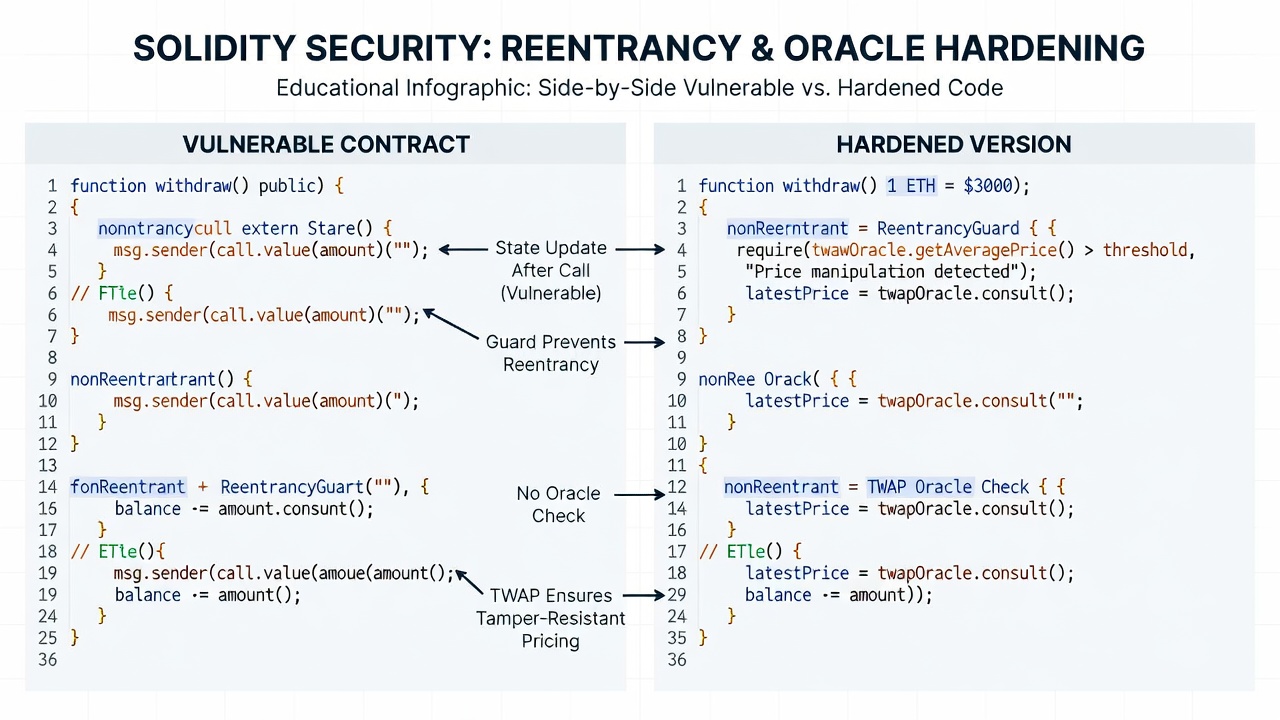
Vulnerable vs Hardened Contract Comparison
Vulnerable contracts often call external functions before updating balances. Hardened versions enforce state changes first and use modifiers to block reentrant calls. Testing both versions side-by-side reveals how small changes prevent major losses. For example, a vulnerable withdraw function might transfer funds before reducing the user’s recorded balance, opening the door to recursive calls that drain the contract multiple times. The hardened version subtracts the balance first, ensuring subsequent calls see the updated state immediately.
Transaction Simulation and Testing Strategies
Before deployment, simulate flash loan scenarios using tools such as Foundry or Hardhat. Write tests that attempt malicious reentrancy and price manipulation. Monitor gas usage and ensure all paths revert correctly under attack conditions. Step-by-step, developers should first fork mainnet state at a recent block, then execute a flash loan in the test environment, inject malicious callbacks, and verify that all protective modifiers trigger as expected. Automated fuzzing can further uncover edge cases that manual tests miss.
Access Control Modifiers and Best Practices
Beyond reentrancy, proper access control prevents unauthorized parties from invoking privileged functions. Use Ownable or Roles-based systems to restrict administrative actions. Consider adding a timelock for sensitive parameter changes so the community has time to react to any proposed updates.
Mistakes to Avoid When Hardening Contracts
- Skipping oracle deviation checks during low-liquidity periods
- Placing external calls before state updates
- Over-relying on a single price feed without fallback mechanisms
- Ignoring gas griefing vectors in callback functions
- Failing to test with realistic flash loan amounts
Real-World Incidents and Lessons Learned
Several high-profile exploits demonstrated the cost of insufficient validation. Reviewing post-mortems helps teams avoid repeating the same mistakes in new protocols. Key takeaways include the necessity of comprehensive oracle redundancy and the value of on-chain monitoring that alerts teams to unusual borrowing patterns in real time.
Frequently Asked Questions
- How do flash loans differ from traditional loans? They require no collateral and must be repaid atomically.
- Is Solidity 0.8+ sufficient for security? The language itself helps, but proper patterns and audits remain essential.
- Which oracles are recommended in 2026? Chainlink and similar decentralized feeds provide the strongest resistance to manipulation.
- Should every contract implement flash loan protection? Any contract that interacts with external liquidity or price data benefits from these defenses.
- How often should security audits be performed? At minimum before mainnet deployment and after any significant upgrade.
Conclusion
Securing contracts against flash loan attacks requires layered defenses. By implementing reentrancy guards, TWAP checks, and rigorous simulation testing, developers can build resilient DeFi protocols. Stay updated with the latest Solidity practices at soliditylang.org and conduct regular audits. Continuous education and proactive testing remain the most effective ways to protect user funds in the dynamic world of decentralized finance.


No comments yet. Be the first!