 CryptoChain Blog

Introduction to Secure Solidity Libraries
In 2026, smart contract development demands high modularity and security to mitigate risks like reentrancy and arithmetic errors. Secure Solidity libraries allow developers to reuse audited code, reducing duplication while maintaining robust standards. This guide covers leveraging established tools, crafting custom modules, and following deployment best practices for Ethereum and Layer-2 environments. Libraries promote separation of concerns, enabling contracts to focus on business logic. As the ecosystem evolves with new compiler versions and scaling solutions, understanding these patterns is essential for building reliable decentralized applications that handle real-world value transfers.
The demand for secure libraries has grown alongside the expansion of DeFi protocols, NFT marketplaces, and cross-chain bridges. Developers must prioritize reusability without introducing vulnerabilities that could lead to exploits. This tutorial-style article provides practical examples, step-by-step instructions, and comparisons to help you integrate libraries effectively in current development workflows.
Why Secure Libraries Matter in 2026
Reusing code through libraries minimizes attack surfaces by centralizing critical functions in well-tested modules. Established options undergo continuous audits by security firms, providing confidence in production deployments across thousands of projects. Custom libraries tailored to specific needs further enhance efficiency without compromising safety, especially when handling complex financial logic or governance mechanisms.
Without secure libraries, developers risk repeating common vulnerabilities that have led to significant losses in past incidents. In 2026 environments, where transaction volumes remain high on networks like Ethereum mainnet and optimistic rollups, modular design also improves maintainability and allows for easier upgrades when new standards emerge. For instance, libraries can encapsulate math operations to prevent overflow issues that plagued early contracts, while access control libraries enforce permissions that protect against unauthorized fund movements.
Moreover, libraries reduce bytecode bloat in individual contracts, which is crucial for gas efficiency on high-demand networks. By separating reusable logic, teams can audit once and deploy confidently across multiple projects, saving time and resources in fast-moving development cycles.
Leveraging Established Libraries Like OpenZeppelin
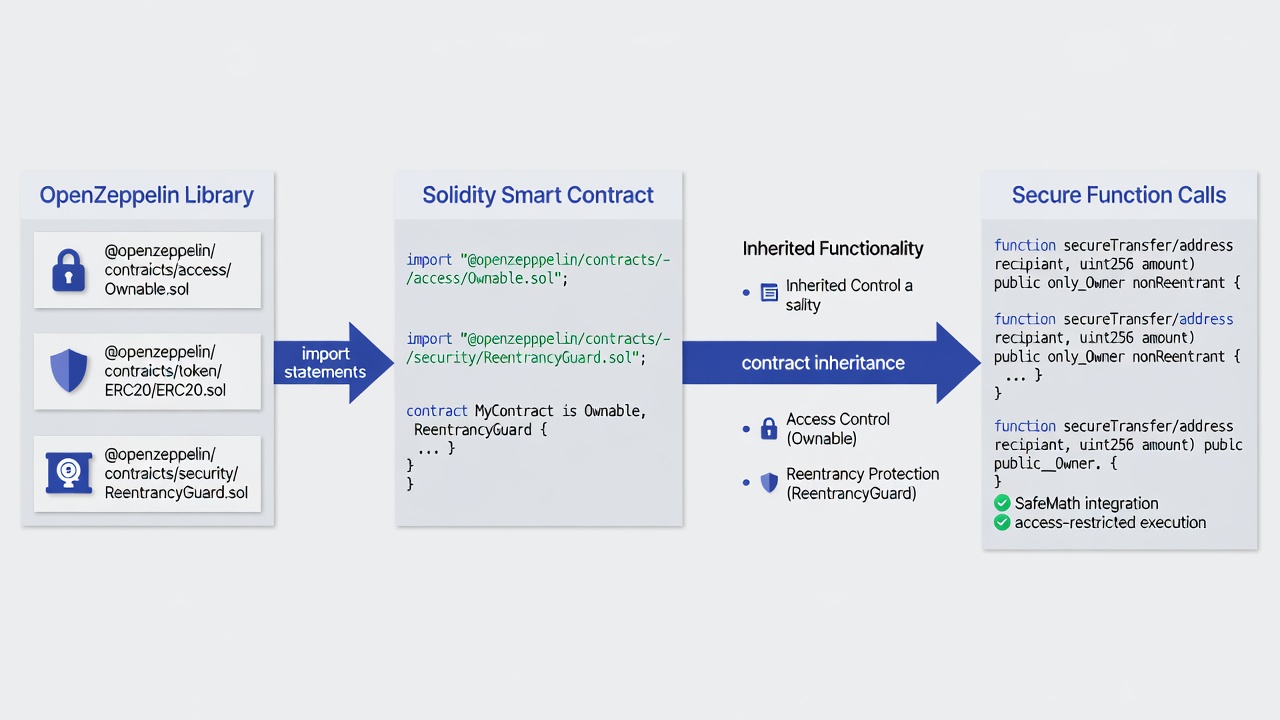
OpenZeppelin remains the gold standard for secure components. Developers can import contracts for tokens, access control, and utilities directly into projects via package managers. This reduces the need to write foundational code from scratch and leverages community-vetted implementations that have been battle-tested over years.
Start by installing via npm and importing in your Solidity files. For example:
import "@openzeppelin/contracts/access/Ownable.sol";
import "@openzeppelin/contracts/token/ERC20/ERC20.sol";
import "@openzeppelin/contracts/security/ReentrancyGuard.sol";
This approach integrates implementations for roles, ownership, and token standards. Explore more at OpenZeppelin. Additional guidance is available through Ethereum resources on library patterns.
Advanced usage includes composing multiple OpenZeppelin modules for complex scenarios like pausable contracts combined with role-based permissions. Always pin specific versions in your package.json to ensure reproducibility across development, testing, and production environments. You can also extend these libraries by inheriting and overriding functions for project-specific customizations while preserving core security guarantees.
Integration typically involves adding the dependency, configuring your Hardhat or Foundry setup, and verifying the imported contracts compile without conflicts. Regular updates from OpenZeppelin address new EVM changes, making it vital to monitor their release notes for 2026 compatibility.
Creating Custom Secure Math Libraries
Arithmetic operations require overflow protection, particularly in financial applications. Build a custom library using SafeMath patterns updated for Solidity 0.8+ where the compiler includes built-in checks but additional wrappers add clarity and custom error handling.
library SecureMath {
    function add(uint256 a, uint256 b) internal pure returns (uint256) {
        uint256 c = a + b;
        require(c >= a, "Addition overflow");
        return c;
    }
    function sub(uint256 a, uint256 b) internal pure returns (uint256) {
        require(b <= a, "Subtraction underflow");
        return a - b;
    }
    function mul(uint256 a, uint256 b) internal pure returns (uint256) {
        if (a == 0) return 0;
        uint256 c = a * b;
        require(c / a == b, "Multiplication overflow");
        return c;
    }
    function div(uint256 a, uint256 b) internal pure returns (uint256) {
        require(b > 0, "Division by zero");
        return a / b;
    }
}
Integrate by using the library in your contract with the 'using' keyword for seamless calls. This pattern extends to division and modulo operations with appropriate zero checks to prevent runtime failures. Custom math libraries can also incorporate fixed-point arithmetic for precision in yield calculations or token distributions, providing greater control than generic implementations.
Implementing Access Control Modules
Role-based access prevents unauthorized actions in multi-user contracts. Extend basic ownership with granular roles for multi-signature or admin hierarchies that support delegation and revocation.
Step-by-step integration:
- Define roles in a dedicated library with constants for admin, operator, and viewer levels.
- Assign roles during contract deployment using a mapping structure.
- Enforce checks via modifiers that revert with descriptive errors.
- Implement events for role changes to enable off-chain monitoring.
- Test role assignments in isolated unit tests before mainnet deployment.
Code example for a basic role library includes functions for granting, revoking, and checking permissions while emitting logs for transparency. This modular approach allows easy extension to support time-based roles or multi-signature requirements common in DAO governance.
Best Practices for Library Deployment
Deploy libraries as standalone contracts or embed them directly depending on size and reuse frequency. Always verify source code on explorers and use proxy patterns for upgradability where needed. Consider immutable variables for configuration that should never change post-deployment.
Additional practices include thorough documentation of library interfaces, avoiding storage variables that could cause collisions, and conducting gas profiling during integration to identify optimization opportunities without sacrificing security. Use libraries in internal functions to minimize external call overhead, and document all assumptions about caller contexts to prevent misuse in derived contracts.
Performance Comparisons
Library-linked calls incur minimal overhead compared to inlined code. Benchmarks show negligible gas differences in typical use cases, favoring security over micro-optimizations. External library calls add a small delegatecall cost but reduce overall contract bytecode size, which can lower deployment expenses on networks with high base fees.
- Inline functions: Faster execution but larger contract size and higher deployment costs.
- Linked libraries: Slightly higher per-call gas but better modularity and easier maintenance across projects.
- Embedded libraries: Balance between the two approaches for medium-sized modules, ideal for repeated math or validation logic.
Real-world testing on testnets reveals that library usage often results in net savings when contracts are reused or upgraded frequently, as smaller bytecode leads to cheaper deployments.
Common Pitfalls to Avoid
- Using unverified third-party libraries from untrusted repositories that may contain hidden backdoors or outdated code.
- Ignoring compiler version compatibility, which can lead to unexpected behavior during upgrades or cross-chain deployments.
- Neglecting storage collisions in upgradeable setups when libraries interact with proxy storage layouts.
- Overlooking visibility modifiers that expose internal functions unintentionally to external callers.
- Failing to handle edge cases such as maximum integer values in math operations or zero-address checks in access control.
- Skipping comprehensive documentation that leaves future maintainers unaware of security assumptions.
Testing Strategies
Employ fuzzing and formal verification tools alongside unit tests. Simulate edge cases like extreme values, concurrent calls, and network-specific gas limits to validate library robustness. Tools such as Foundry and Hardhat provide frameworks for comprehensive test suites that cover both happy paths and failure modes.
Integration tests should mimic real deployment scenarios, including interactions with multiple contracts and upgrade processes. Regular audits by independent firms complement automated testing for production readiness. Incorporate invariant testing to ensure libraries maintain security properties across varied inputs and states.
FAQs on Upgradeability and Gas Implications
How does upgradeability affect libraries?
Proxy patterns allow logic updates while preserving state. Libraries can be replaced via admin functions if designed modularly, but care must be taken to maintain consistent interfaces and avoid breaking existing integrations. Transparent proxies are preferred in 2026 for their simplicity in library swaps.
What are the gas implications in 2026 environments?
Library usage adds slight calldata costs but reduces overall bytecode size, often lowering deployment fees. Test on current networks for precise metrics, as Layer-2 solutions introduce additional variables in cost calculations.
Can libraries be used across different chains?
Yes, provided compiler versions and EVM compatibility align. Always re-verify and test on target chains to account for any opcode differences or gas schedule variations.
Consult official resources at Solidity Documentation for deeper compiler insights and advanced library features.
Conclusion
Secure Solidity libraries empower developers to build resilient contracts efficiently. By combining proven tools with custom modules and rigorous testing, projects achieve superior security and maintainability in 2026. Following the outlined steps and avoiding common pitfalls positions developers for long-term success in the evolving blockchain landscape. Continuous learning and adaptation to new tools will remain key as the ecosystem matures.

No comments yet. Be the first!