 CryptoChain Blog

Introduction to Foundry for Secure Development
Foundry has become the go-to toolchain for Solidity developers prioritizing security in 2026. Its Rust-based architecture delivers lightning-fast compilation, built-in fuzzing, and seamless integration with static analysis tools. This tutorial walks through a complete workflow for building and verifying a sample smart contract while minimizing vulnerabilities before deployment. Developers benefit from Foundry’s property-based testing capabilities, which uncover edge cases that traditional unit tests miss. By combining fuzz testing with cheatcodes and automated checks, teams can simulate real-world attack scenarios safely. The framework’s speed allows running tens of thousands of test cases in seconds, making comprehensive security verification practical even for complex protocols. In addition, Foundry supports deterministic builds and reproducible environments, which auditors appreciate when reviewing contract behavior across multiple runs. Modern DeFi protocols and NFT marketplaces increasingly rely on Foundry to meet rigorous security standards demanded by institutional investors and regulatory bodies. Adopting this toolchain early reduces the risk of costly exploits that have plagued the ecosystem in previous years.
Project Setup and Initial Configuration
Begin by installing Foundry via the official installation script available on the project website. Run the command curl -L https://foundry.paradigm.xyz | bash followed by foundryup to ensure the latest version. Once installed, initialize a new project with forge init secure-contract. This creates the standard directory structure including src/, test/, and lib/ folders along with a default foundry.toml configuration file. Developers should immediately update the configuration to specify Solidity version 0.8.26, enable the optimizer with runs set to 200, and define remappings for clean imports. Add security-focused dependencies such as OpenZeppelin contracts using forge install OpenZeppelin/openzeppelin-contracts. This foundation supports robust access control, reentrancy protections, and pausable functionality from the start. You can also install additional libraries like solmate for gas-efficient primitives if your project requires minimal overhead. Verify the installation by running forge --version and ensure your local environment matches the CI environment to avoid discrepancies during automated builds. It is recommended to create a dedicated .env file for RPC endpoints and private keys while keeping them excluded from version control.
Writing and Testing a Sample Secure Contract
Consider a simple vault contract that allows deposits and withdrawals with a withdrawal limit and owner-controlled emergency functions. Implement it with proper modifiers, event emissions, and balance tracking. The contract should enforce strict balance checks and emit events for transparency and off-chain monitoring. Here is an expanded version of the contract with additional safeguards:
pragma solidity ^0.8.26;

import "@openzeppelin/contracts/access/Ownable.sol";

contract SecureVault is Ownable {
    mapping(address => uint256) public balances;
    uint256 public constant MAX_WITHDRAW = 10 ether;
    bool public paused;
    event Deposit(address indexed user, uint256 amount);
    event Withdraw(address indexed user, uint256 amount);
    event Paused(address indexed account);

    modifier whenNotPaused() {
        require(!paused, "Contract is paused");
        _;
    }

    function deposit() external payable whenNotPaused {
        require(msg.value > 0, "Deposit must be positive");
        balances[msg.sender] += msg.value;
        emit Deposit(msg.sender, msg.value);
    }

    function withdraw(uint256 amount) external whenNotPaused {
        require(balances[msg.sender] >= amount, "Insufficient balance");
        require(amount <= MAX_WITHDRAW, "Exceeds max withdrawal");
        balances[msg.sender] -= amount;
        payable(msg.sender).transfer(amount);
        emit Withdraw(msg.sender, amount);
    }

    function emergencyWithdraw() external onlyOwner {
        payable(owner()).transfer(address(this).balance);
    }

    function pause() external onlyOwner {
        paused = true;
        emit Paused(msg.sender);
    }
}
Compile the contract using forge build to verify syntax and dependencies. If compilation succeeds, proceed to writing tests that cover both happy paths and adversarial scenarios. Each function should have dedicated test coverage including boundary conditions such as zero-value deposits and maximum withdrawal attempts.
Property-Based Testing and Fuzzing Custom Invariants
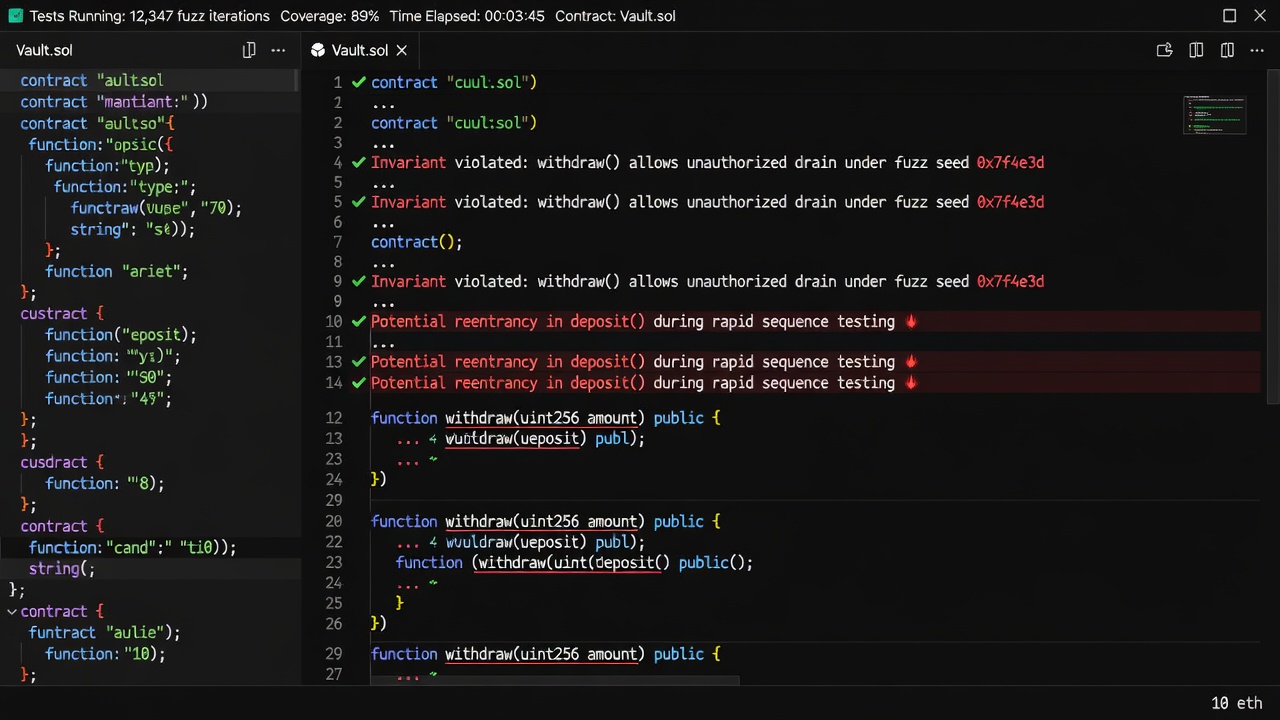
Foundry excels at fuzz testing through its built-in support for property-based testing. Create a test file that defines invariants such as total contract balance always matching the sum of user balances and total supply never exceeding contract balance. Use forge test --fuzz-runs 10000 to run thousands of randomized scenarios automatically. Custom invariants are declared in a separate test contract inheriting from Test. Assertions ensure state consistency across all fuzz inputs. This approach catches arithmetic errors, access control flaws, and reentrancy vulnerabilities early in the development cycle. Developers should also implement differential testing by comparing results against a reference implementation written in a higher-level language when possible. For the vault example, one invariant might assert that after any sequence of deposits and withdrawals the contract balance equals the sum of all recorded user balances. Running extensive fuzz campaigns helps surface rare but critical bugs that manual unit tests would never reach.
Responsible Use of Cheatcodes for Edge-Case Simulation
Cheatcodes like vm.prank, vm.deal, vm.warp, and vm.roll enable precise simulation of attacker behavior and network conditions. Use them to test reentrancy guards, time-dependent logic, and balance manipulation without deploying to a live network. For example, a test might prank an attacker address, deal it ether, and attempt a reentrant call to verify the vault’s protection mechanisms. Always wrap cheatcode usage in dedicated test functions and avoid them in production code. This keeps tests realistic while maintaining auditability and reproducibility. Overusing cheatcodes without corresponding real-world validation can mask issues that only appear on mainnet, so cross-reference results with forked network tests using forge test --fork-url. Another useful pattern involves using vm.expectRevert to confirm that unauthorized calls are properly rejected.
Integrating Static Analysis in the Workflow
Run Slither or Mythril directly through Foundry scripts or npm packages. Add a scripts/analyze.sh that executes slither . --checklist --sarif after every build. This catches common issues such as unchecked calls, integer overflows, and access control misconfigurations automatically. Combine static analysis with Foundry’s gas reports generated by forge test --gas-report to identify expensive functions that could be optimized for both security and efficiency. Schedule periodic full audits by exporting reports in SARIF format for integration with tools like GitHub Code Scanning. Teams should review findings weekly and maintain a living document of resolved issues to demonstrate due diligence to external auditors.
Automating Security Checks in CI Pipelines
Configure GitHub Actions to run forge test, fuzzing, and static analysis on every pull request. Include steps that fail the pipeline if coverage drops below 95% or if any invariant test fails. A sample workflow YAML file can define jobs for build, test, fuzz, and analyze stages with matrix testing across multiple Solidity versions. This ensures security remains a gatekeeper rather than an afterthought. Teams following this practice report significantly fewer post-deployment incidents and faster remediation cycles when issues are caught pre-merge. Adding notifications via Slack or email when pipelines fail keeps the entire team accountable for maintaining high security standards throughout the development lifecycle.
Comparisons with Alternative Toolchains
- Hardhat: Excellent plugin ecosystem and mature debugging tools but slower fuzzing compared to Foundry’s native implementation and less emphasis on invariant testing out of the box.
- Truffle: Mature deployment scripts and migration system but lacks built-in property testing, requiring additional libraries and custom setup for comprehensive fuzz coverage.
- Remix: Ideal for quick prototyping and visual debugging yet insufficient for comprehensive invariant verification at scale or automated CI integration.
Foundry’s speed advantage becomes especially valuable when running 10,000+ fuzz iterations per test suite, often completing in under a minute what other frameworks take several minutes to achieve. Many teams now use Foundry exclusively for testing while retaining Hardhat for deployment scripts when necessary.
Common Pitfalls and FAQ
Q: How do I handle external contract dependencies in tests?
A: Use forge install and reference them via remappings in foundry.toml to ensure consistent resolution across environments.
Q: Can cheatcodes introduce false positives?
A: Yes. Always validate results against multiple scenarios and avoid over-reliance on single cheatcode sequences without corresponding real-world simulation.
Q: What is the recommended fuzz run count for production contracts?
A: Start with at least 10,000 runs and increase to 100,000 for high-value contracts handling significant value.
Q: How should I structure test files for maintainability?
A: Organize tests by contract functionality and keep invariant definitions in dedicated abstract contracts that multiple test suites can inherit.
Q: What happens if static analysis flags false positives?
A: Review each finding manually, suppress confirmed false positives with inline comments, and document the rationale for future reviewers.
Q: Should I run tests on a forked mainnet?
A: Yes, especially for contracts interacting with external protocols. Use forge test --fork-url with recent block data for realistic conditions.
Q: How do I measure test coverage in Foundry?
A: Use the built-in coverage report with forge coverage and aim for at least 95% branch coverage on all critical paths.
Additional resources are available at the Foundry Book and the Solidity documentation. For advanced static analysis patterns, refer to the Slither repository and the official OpenZeppelin documentation.
Conclusion
Adopting Foundry in 2026 equips developers with a powerful, security-first toolkit. By mastering project setup, fuzz testing, cheatcodes, static analysis, and CI automation, teams can ship contracts with greater confidence and fewer vulnerabilities. The combination of speed, native property testing, and extensibility makes Foundry the preferred choice for modern secure Solidity development. Continuous learning and regular updates to the toolchain will keep your projects resilient against evolving threats in the blockchain space.

No comments yet. Be the first!