 CryptoChain Blog
Introduction to Secure Randomness in Solidity
Generating truly random numbers in Solidity smart contracts remains a core challenge for decentralized applications in 2026. Commit-reveal schemes, while once popular, expose vulnerabilities like frontrunning and coordination issues. This guide examines advanced alternatives that prioritize security, efficiency, and practicality for use cases such as gaming, lotteries, and NFT minting. Developers must understand the trade-offs between on-chain entropy sources and oracle-based solutions. Each method discussed includes implementation patterns, Foundry test examples, and considerations for preventing manipulation. As blockchain ecosystems mature, the demand for robust randomness grows with the rise of play-to-earn games and decentralized finance protocols that rely on unpredictable outcomes for fairness.
Randomness is foundational to many smart contract applications because it determines winner selection, loot distribution, and even protocol parameters. Poor randomness implementations have led to exploits costing millions in the past, underscoring the need for updated approaches in 2026. This tutorial provides concrete code snippets and deployment steps to help developers move beyond legacy methods confidently.
Limitations of Traditional Commit-Reveal Schemes
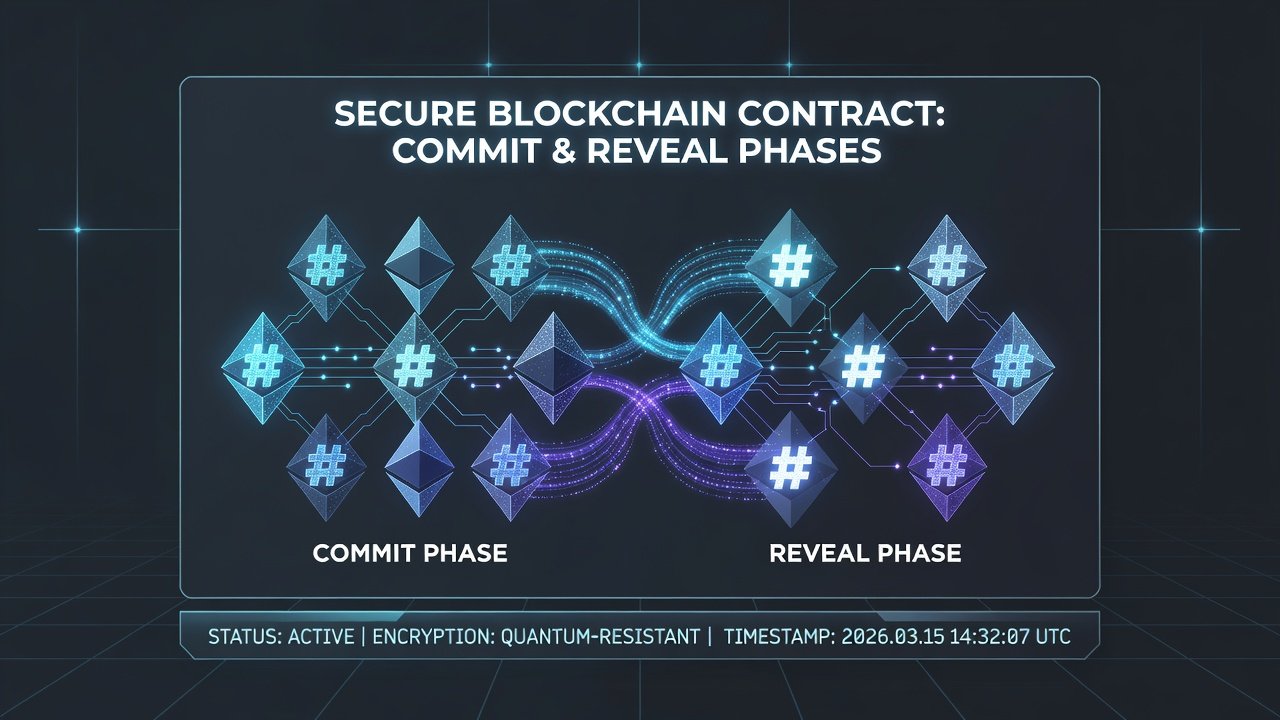
Commit-reveal relies on users submitting hashed commitments before revealing values. While effective against some attacks, it suffers from gas overhead during reveals and risks of last-mover advantages. In high-stakes environments, attackers can monitor the mempool to frontrun reveals. Modern alternatives reduce these risks by leveraging verifiable external data or block properties. Additional drawbacks include the requirement for all participants to stay online for the reveal phase, which creates coordination failures in large-scale lotteries, and the potential for griefing attacks where users submit invalid reveals to waste gas.
Blockhash-Based Randomness Generation
Using recent blockhashes provides lightweight on-chain randomness. The approach hashes the current block's hash with a nonce to derive a pseudo-random value. This technique is attractive for its zero external dependencies but carries predictability risks if a miner or validator can influence block ordering.
function getRandomNumber(uint256 nonce) public view returns (uint256) {
    return uint256(keccak256(abi.encodePacked(blockhash(block.number - 1), nonce)));
}
Developers should avoid using the immediate previous blockhash in competitive settings. Instead, sample from multiple historical blocks or mix with transaction-specific data like msg.sender. This method works well for low-value raffles but should never secure high-value assets without additional safeguards.
Integrating Chainlink VRF for Verifiable Randomness
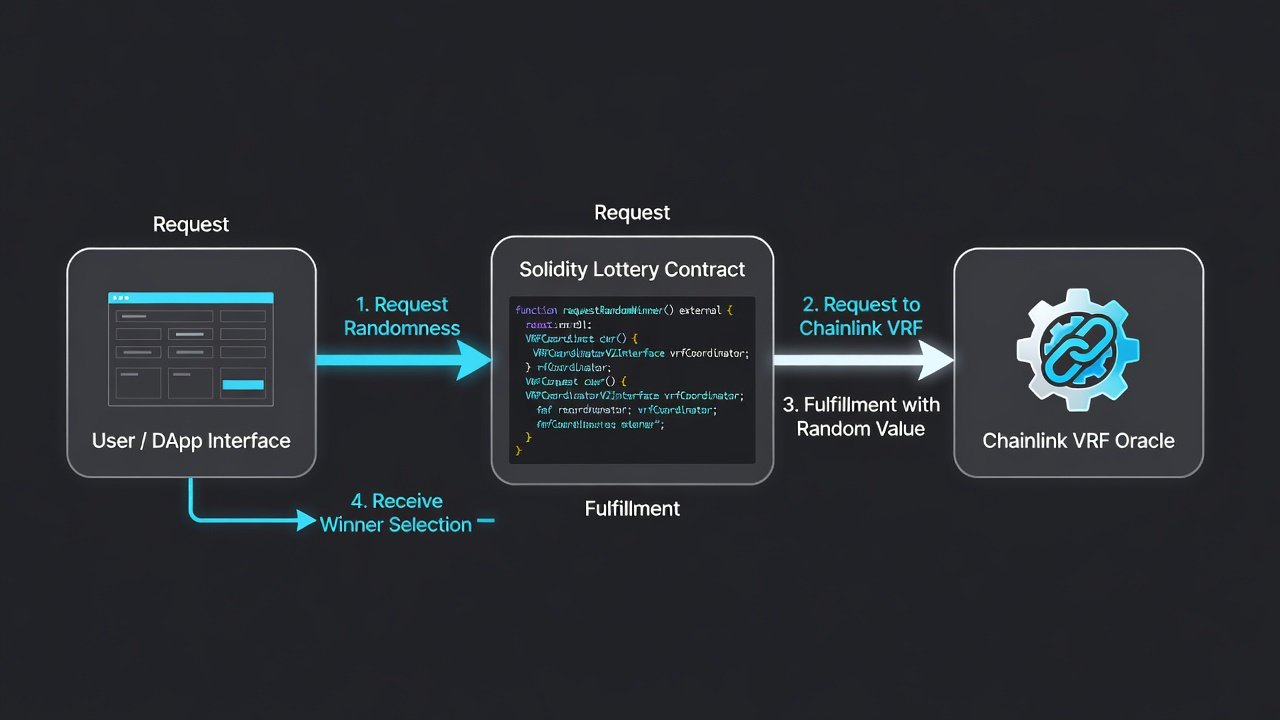
Chainlink VRF delivers cryptographically secure randomness via oracles. Requests are fulfilled off-chain with proofs verifiable on-chain. Key benefits include resistance to manipulation and seamless integration with existing Ethereum infrastructure. Learn more about Chainlink VRF on the official documentation site. The VRF process begins when a contract emits a randomness request event. An off-chain oracle then generates a random value, signs it with a private key, and returns the result along with a cryptographic proof. On-chain verification ensures the value was not tampered with.
Implementation involves inheriting from VRFConsumerBaseV2 and requesting randomness with a subscription ID. Gas costs vary but remain predictable compared to multi-round commit-reveal flows. Subscription management requires funding the Chainlink balance regularly to avoid request failures during peak network activity.
function requestRandomWords() external onlyOwner returns (uint256 requestId) {
    requestId = s_vrfCoordinator.requestRandomWords(
        keyHash, s_subscriptionId, requestConfirmations, callbackGasLimit, numWords
    );
}
Foundry Test Example for VRF Integration
function testVRFRandomness() public {
    uint256 requestId = vrfConsumer.requestRandomWords();
    // Simulate oracle fulfillment with mock proof
    vrfCoordinator.fulfillRandomWords(requestId, address(vrfConsumer));
    assert(vrfConsumer.randomResult() != 0);
}
Testing should cover subscription funding errors, insufficient confirmations, and callback gas limit reverts to ensure production readiness.
Cryptographic Commitment Schemes with Zero-Knowledge Proofs
Advanced options incorporate zk-SNARKs or similar proofs to commit to randomness without immediate revelation. These provide strong guarantees against bias while maintaining privacy. Developers can use libraries like circom for circuit design, then verify proofs within the contract. This approach suits high-security lotteries but increases deployment complexity and verification gas costs. A typical flow involves generating a commitment off-chain, submitting the proof on-chain, and only revealing the random seed after verification succeeds.
Preventing Frontrunning and Ensuring Fairness
- Monitor transaction ordering via private mempools or Flashbots integration to hide pending reveals.
- Use time delays or commit windows to obscure user intent until after the randomness source is fixed.
- Combine multiple entropy sources for hybrid solutions that reduce single-point failures.
- Implement commit-reveal hybrids where the contract itself commits first using block data.
Gas Considerations Across Methods
Blockhash methods consume minimal gas, typically under 5,000 units per call. VRF requests incur oracle fees plus callback costs that fluctuate with network conditions, while zk-proof verification can exceed 100,000 gas depending on circuit size. Optimize by batching requests where possible and caching results for subsequent draws. Always benchmark new implementations on a local Foundry fork before mainnet deployment.
Audit Checklists for Each Approach
- Verify entropy sources cannot be influenced by block producers or validators through historical analysis.
- Test edge cases including chain reorgs, failed oracle calls, and subscription funding shortfalls.
- Review access controls on request functions to prevent unauthorized randomness generation.
- Simulate high-load scenarios with Foundry fuzzing to uncover gas griefing vectors.
- Confirm that revealed values cannot be predicted or biased before the reveal window closes.
- Ensure events emit sufficient data for off-chain monitoring and user verification.
Real-World Use Cases: Gaming and Lotteries
In blockchain gaming, VRF powers fair loot drops and battle outcomes that players trust. Lotteries benefit from verifiable results that participants can independently audit through on-chain proofs. Reference Ethereum developer resources for broader smart contract patterns. NFT projects often combine blockhash with VRF to reduce costs while maintaining security for rare trait reveals. These patterns have become standard in 2026 for any application where perceived fairness drives user adoption.
Step-by-Step Deployment Guidance
1. Set up a Foundry project and install necessary dependencies including Chainlink contracts.
2. Implement the chosen randomness contract with proper events and access modifiers.
3. Write comprehensive tests covering happy paths, failure modes, and fuzz inputs.
4. Deploy to testnet and verify oracle subscriptions or blockhash sampling logic.
5. Conduct external audits focusing on the randomness entropy quality and economic incentives.
6. Monitor post-deployment performance with dashboards tracking request success rates.
Common Pitfalls and How to Avoid Them
One frequent mistake is relying solely on the current block timestamp, which miners can influence. Another is neglecting to handle cases where VRF fulfillment fails due to insufficient LINK tokens. Always implement fallback mechanisms and clear error messages. Developers should also avoid hardcoding request parameters that may become outdated as network conditions evolve.
FAQ: Choosing the Right Randomness Method
How do I decide between blockhash and VRF?
Blockhash suits low-stakes prototypes or internal testing; VRF is preferred for production applications requiring provable fairness and auditability by end users.
What are common pitfalls in randomness implementations?
Over-reliance on a single blockhash or failing to handle oracle downtime can compromise security and lead to lost user funds or trust.
Are there gas-optimized hybrid approaches?
Yes, using blockhash for initial seeding and VRF for final resolution balances cost and security effectively in most gaming contracts.
Can I use RANDAO directly in Solidity?
Post-merge Ethereum exposes RANDAO values via the beacon chain, but direct access remains limited; most developers prefer oracle abstractions for simplicity.
How often should I rotate VRF keys or subscriptions?
Review subscription balances weekly and rotate keys after major contract upgrades or suspected key exposure events.
Conclusion
Selecting the appropriate randomness solution depends on security requirements, gas budgets, and application scale. By moving beyond basic commit-reveal, developers can build more robust decentralized systems in 2026 and beyond. Start with the method that matches your threat model and iterate with thorough testing.

No comments yet. Be the first!