 CryptoChain Blog

Introduction to Secure Solidity Development
Writing secure smart contracts remains one of the most critical skills for developers entering the blockchain space in 2026. With the continued evolution of Ethereum and layer-2 solutions, even small oversights can lead to significant vulnerabilities that affect user funds and project reputation. This comprehensive guide focuses on foundational habits using Solidity 0.8.26, emphasizing input validation, access control, and avoiding common pitfalls through clear examples and a complete build walkthrough. Security is not an afterthought; it must be integrated from the first line of code. New developers should prioritize audited libraries and automated testing tools to reduce risks before deployment. In today's environment, where decentralized applications handle billions in value, understanding these basics helps prevent exploits that have historically cost projects millions. By mastering these principles early, beginners can build contracts that withstand audits and real-world usage.
Setting Up Your Development Environment
Begin by installing Foundry, the preferred framework for modern Solidity projects due to its speed and comprehensive tooling. It provides fast compilation, testing, and deployment capabilities that surpass older tools like Truffle. Create a new project with the command forge init my-secure-contract and ensure your foundry.toml specifies Solidity version 0.8.26 for the latest safety features like built-in overflow and underflow checks. Next, configure your remappings to include OpenZeppelin dependencies seamlessly. Install OpenZeppelin Contracts via Foundry using forge install OpenZeppelin/openzeppelin-contracts. These libraries offer battle-tested implementations for access control, token standards, and security guards that save countless hours of custom coding. Update your IDE with Solidity extensions for syntax highlighting and linting to catch issues during development. Always work in a version-controlled environment with Git to track changes and enable collaborative reviews.
Input Validation Best Practices
Always validate user inputs to prevent unexpected behavior and potential denial-of-service attacks. Use require statements for clear error messages and revert conditions early in function execution. Consider this deposit function example that enforces multiple checks:
function deposit(uint256 amount) external payable {
    require(amount > 0, "Amount must be greater than zero");
    require(msg.value == amount, "Ether sent does not match amount");
    require(amount <= 1000 ether, "Deposit exceeds maximum limit");
    balances[msg.sender] += amount;
    emit Deposit(msg.sender, amount);
}
This approach catches invalid data immediately and provides users with actionable feedback. Combine with custom modifiers for repeated checks across multiple functions to reduce code duplication. Input validation also extends to array lengths and string inputs, where unchecked data can lead to gas griefing or storage bloat. Always sanitize data from external calls and consider using libraries like OpenZeppelin’s SafeMath alternatives, though native 0.8.26 handling reduces many risks.
Access Control Fundamentals
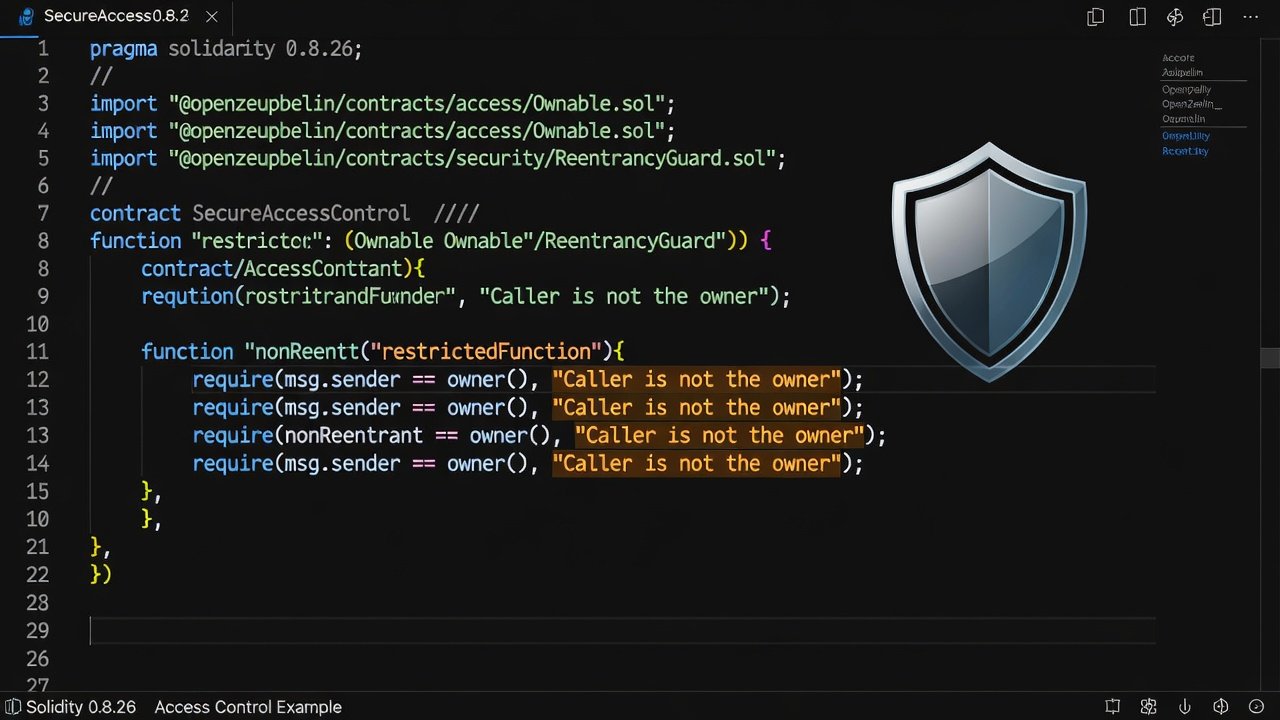
Implement role-based permissions using OpenZeppelin’s Ownable or AccessControl contracts rather than custom logic that may contain flaws. Never rely on hardcoded addresses for ownership, as this creates single points of failure and complicates upgrades. Here is an expanded vault example:
import "@openzeppelin/contracts/access/Ownable.sol";
import "@openzeppelin/contracts/security/ReentrancyGuard.sol";

contract SecureVault is Ownable, ReentrancyGuard {
    mapping(address => uint256) private balances;
    function deposit() external payable {
        balances[msg.sender] += msg.value;
    }
    function withdraw(uint256 amount) external nonReentrant onlyOwner {
        require(balances[msg.sender] >= amount, "Insufficient balance");
        balances[msg.sender] -= amount;
        (bool success, ) = payable(msg.sender).call{value: amount}("");
        require(success, "Transfer failed");
    }
}
Upgrade to role-based control for multi-signature or admin scenarios as your contract grows, allowing granular permissions like pauser roles without full ownership transfer.
Common Pitfalls and Avoidance Strategies
Developers frequently encounter several recurring issues that can be mitigated with disciplined coding. Key pitfalls include:
- Reentrancy attacks: Always follow the checks-effects-interactions pattern or integrate ReentrancyGuard from OpenZeppelin to block recursive calls.
- Integer overflow and underflow: Solidity 0.8.26 prevents most automatically, but explicit range validation remains essential for business logic.
- Unchecked external calls: Always capture and verify return values from low-level calls like call or delegatecall to handle failures gracefully.
- Front-running vulnerabilities: Implement commit-reveal schemes or use transaction ordering protections for sensitive operations such as auctions.
- Gas griefing through loops: Avoid unbounded loops over user-controlled arrays; instead, use pagination or pull-over-push payment patterns.
Reviewing historical incidents shows that most exploits stem from combinations of these issues rather than novel zero-days.
Step-by-Step Walkthrough: Building a Basic Secure Contract
Follow these detailed steps to create a simple secure escrow contract from scratch.
- Initialize the project with Foundry and lock Solidity to 0.8.26 in the configuration file.
- Inherit from Ownable and import ReentrancyGuard plus any necessary token interfaces.
- Define state variables for balances and deadlines with appropriate data types.
- Implement deposit and release functions incorporating full input validation and events for off-chain tracking.
- Add a cancel mechanism protected by time locks and access modifiers.
- Write comprehensive unit tests covering edge cases such as zero amounts, unauthorized access, and reentrancy attempts using Foundry’s cheat codes.
- Execute
forge test --match-contract EscrowTest -vvlocally to verify all security invariants pass. - Simulate deployment on a local fork of mainnet to check gas costs and interactions with existing protocols.
This methodical approach ensures the contract is robust before any public exposure.
Practical Tips for OpenZeppelin and Foundry
Leverage OpenZeppelin’s modular design to avoid reinventing security primitives that have already undergone extensive community review. Regularly consult their official documentation for updates on new modules like governor or timelock controllers. Use Foundry’s fuzz testing and invariant checks to uncover hidden bugs that unit tests might miss. Additional authoritative resources include the Foundry Book for scripting advanced scenarios and the Solidity documentation for language-specific best practices. Integrate static analyzers such as Slither via Foundry plugins for automated vulnerability scanning during continuous integration pipelines.
Testing and Security Auditing
Beyond basic unit tests, implement property-based testing to assert invariants like total supply never exceeding minted amounts. Schedule manual code reviews and consider professional audits for contracts managing significant value. Tools integrated with Foundry allow differential testing between versions to confirm fixes do not introduce regressions.
Deployment Safety and Gas Considerations
Before deploying, perform a final audit simulation using Foundry scripts and verify source code on block explorers. Monitor gas usage during tests to optimize functions without sacrificing validation or access controls. Deploy first to testnets and gradually increase exposure. In 2026, focus on efficient patterns while remembering that gas optimization should never compromise core security checks.
Frequently Asked Questions
How do I safely deploy my first contract?
Start on a testnet, use verified source code, and enable contract verification immediately after deployment. Review the Ethereum security guidelines for detailed checklists and follow a staged rollout strategy.
What about gas costs in 2026?
Focus on efficient patterns; gas optimization should never compromise validation or access controls. Tools like Foundry help measure costs accurately during development, allowing informed trade-offs.
Should beginners use upgradeable contracts?
Start with immutable contracts to reduce complexity. Upgradeability adds attack surfaces and requires additional proxy patterns that demand deeper expertise.
Conclusion
Mastering secure Solidity development in 2026 starts with disciplined habits around validation, access control, and thorough testing. By following the steps outlined and integrating OpenZeppelin with Foundry, beginners can build contracts that stand up to real-world scrutiny. Continue learning through official resources and practice on testnets to refine these skills over time.

No comments yet. Be the first!