 CryptoChain Blog

Introduction to Time-Locked Transactions in Solidity
Time-locked transactions enable developers to enforce delays on function execution within smart contracts, ensuring that certain actions only become available after a predefined moment. As of 2026, these patterns remain critical for applications such as token vesting, DAO governance delays, escrow releases, and scheduled treasury operations on Ethereum and layer-2 networks. This comprehensive tutorial delivers practical, security-focused guidance for implementing time locks that resist manipulation, front-running, and other exploits prevalent in live environments.
Developers often search for tutorials that go beyond basic syntax to address real deployment challenges. This guide covers timestamp validation techniques, integration with modern access control libraries, detailed comparisons of timing methods, gas-efficient patterns, and extensive testing strategies. By the end, you will have reusable code templates and a clear decision framework for choosing the right approach in production contracts.
Core Concepts: Timestamps Versus Block Numbers
Solidity provides two primary mechanisms for referencing time: block.timestamp and block.number. block.timestamp returns the Unix timestamp assigned by the block producer, offering direct calendar alignment. block.number records the sequential height of the block and advances more predictably across networks.
The choice between them involves trade-offs. block.timestamp can vary by up to 15 seconds due to validator behavior, creating a narrow attack window for sophisticated actors. block.number eliminates some variance but requires developers to estimate average block times when mapping to real-world dates. In 2026 practice, most audited contracts default to block.timestamp while enforcing strict bounds checks, such as requiring new timestamps to be at least 30 seconds in the future and no more than two hours ahead of the previous block. This hybrid validation reduces manipulation risk without sacrificing usability.
Consider a simple comparison function that logs both values for debugging:
function compareTiming() external view returns (uint256 ts, uint256 bn) {
    ts = block.timestamp;
    bn = block.number;
}
Step-by-Step Implementation Using OpenZeppelin Libraries
OpenZeppelin’s AccessControl and Ownable contracts provide secure role management that pairs naturally with time-lock logic. Begin by importing the latest stable versions and extending the contract with both ownership and a custom time-lock modifier.
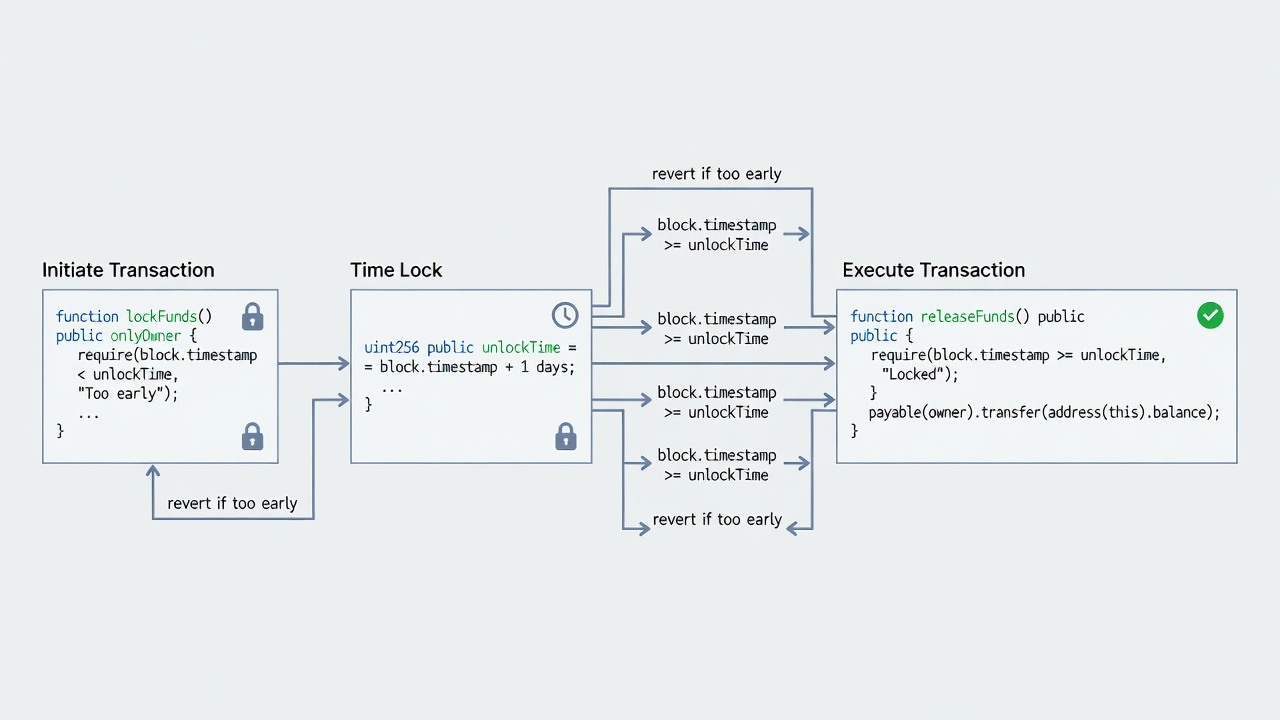
A production-ready vault example includes constructor validation, a setter restricted to the owner, and a withdrawal function protected by the time lock:
pragma solidity ^0.8.20;
import "@openzeppelin/contracts/access/Ownable.sol";
import "@openzeppelin/contracts/security/ReentrancyGuard.sol";

contract SecureTimeLockedVault is Ownable, ReentrancyGuard {
    uint256 public unlockTime;
    uint256 public constant MIN_DELAY = 1 hours;

    event UnlockTimeUpdated(uint256 newTime);

    constructor(uint256 _unlockTime) Ownable(msg.sender) {
        require(_unlockTime > block.timestamp + MIN_DELAY, "Delay too short");
        unlockTime = _unlockTime;
    }

    function setUnlockTime(uint256 _newTime) external onlyOwner {
        require(_newTime > block.timestamp + MIN_DELAY, "Invalid future time");
        unlockTime = _newTime;
        emit UnlockTimeUpdated(_newTime);
    }

    modifier onlyAfterUnlock() {
        require(block.timestamp >= unlockTime, "Still locked");
        _;
    }

    function withdraw(address payable recipient, uint256 amount)
        external
        onlyOwner
        onlyAfterUnlock
        nonReentrant
    {
        require(address(this).balance >= amount, "Insufficient balance");
        (bool success, ) = recipient.call{value: amount}("");
        require(success, "Transfer failed");
    }
}
Preventing Common Exploits in Depth
Timestamp manipulation remains a primary vector. Attackers controlling block production can push timestamps slightly forward. Counter this by always adding a minimum delay buffer and rejecting any proposed unlock time that deviates more than a few hours from expected values. Front-running is mitigated by using commit-reveal schemes for sensitive parameters and by requiring a minimum notice period before execution.
Additional defensive patterns include:
- Storing the last valid timestamp and rejecting large backward jumps
- Combining time locks with multi-signature requirements for any schedule changes
- Emitting detailed events for off-chain monitoring of proposed delays
- Implementing circuit breakers that pause time-locked functions during detected anomalies
Gas Optimization Techniques for 2026 Deployments
Gas costs on Ethereum mainnet and popular L2s continue to reward efficient storage patterns. Cache block.timestamp in memory when the same value is checked multiple times within one transaction. Pack unlock times into existing storage slots when the contract already uses uint256 variables. Avoid state writes inside modifiers by moving updates to explicit functions called only when necessary. These small changes can reduce deployment costs by 10-15 percent and lower per-transaction overhead for frequent operations such as vesting releases.
Real-World Use Cases and Decision Framework
Time locks appear in token vesting contracts that release 25 percent of allocated tokens every quarter after a one-year cliff. DAO governance systems enforce a 48-hour execution delay after successful votes, giving token holders time to exit if they disagree with outcomes. Cross-chain bridges use time locks to create challenge periods during which fraudulent withdrawals can be disputed.
When choosing between timestamp and block-number approaches, evaluate the required precision. Calendar-based vesting favors timestamps with validation. Relative delays measured in blocks suit environments where block times are highly consistent, such as certain layer-2 rollups. Always document the rationale in NatSpec comments so future auditors understand the design intent.
Security Checklist
- Validate every user-supplied timestamp against both past and future bounds
- Inherit from OpenZeppelin contracts before layering custom time logic
- Test on forked mainnet states that replicate 2026 validator behavior
- Include minimum and maximum delay constants with clear comments
- Run static analysis tools and schedule at least two independent audits
- Monitor deployed contracts for unusual timestamp variance via events
Testing Strategies and Edge-Case Handling
Comprehensive testing requires both unit tests with Hardhat time manipulation and integration tests on public testnets. Simulate network forks by advancing blocks manually and verifying that time locks still enforce intended delays. For leap seconds, note that Unix timestamps simply ignore them; no extra code is needed. During major network upgrades that alter block times, maintain an owner-controlled emergency override protected by a separate multi-sig wallet.
FAQ: Edge Cases and Best Practices
How should contracts handle leap seconds?
Unix timestamps do not account for leap seconds, so Solidity contracts treat every second uniformly. No special handling code is required.
What happens during network forks or hard forks?
Block timestamps may briefly diverge after a fork. Use conservative delay buffers and restrict schedule changes to multi-signature governance calls.
Can block.number fully replace timestamps?
It works for relative delays when average block times are stable, but absolute calendar dates still require timestamp conversion with careful estimation.
How do I handle contracts on networks with variable block times?
Apply wider validation windows and rely on oracle-fed time sources only when absolutely necessary, while keeping the primary check on-chain.
For further authoritative guidance, review the OpenZeppelin documentation, the Ethereum developer resources, and the Solidity language documentation. Following these practices produces time-locked contracts that remain secure and maintainable throughout 2026 and beyond.


No comments yet. Be the first!