 CryptoChain Blog
Introduction to Parametric Insurance on Blockchain
Parametric insurance represents a major shift from traditional indemnity-based models by automatically triggering payouts based on predefined conditions rather than loss assessments. In 2026, Solidity remains the dominant language for Ethereum-based smart contracts, but security vulnerabilities continue to cause significant losses across DeFi protocols. This case study explores building a robust parametric insurance contract focused on weather-related events, emphasizing security measures that address common attack vectors such as reentrancy, oracle manipulation, and unauthorized access. Developers must prioritize secure coding patterns to protect user funds and maintain protocol integrity. Key elements include robust access controls, reliable oracle integration, comprehensive event logging, and rigorous testing frameworks like Foundry. The following sections provide a complete walkthrough from architecture design to deployment, including practical code examples and mitigation strategies drawn from recent industry incidents.
Contract Architecture Overview
The core contract structure separates concerns into distinct modules: premium collection, policy management, oracle interaction, and claim processing. A typical setup begins with an ERC-20 token for premiums and uses mappings to track active policies. The contract inherits from OpenZeppelin’s Ownable and Pausable contracts for basic governance and emergency controls. State variables track policy details such as coverage amount, trigger threshold, and expiration. Events are emitted for every critical action to enable off-chain monitoring and audits. To illustrate, consider a base contract skeleton that defines structs for Policy and uses modifiers for role checks. This modular design allows independent upgrades to individual components while preserving overall system security. Additional layers can include a separate treasury contract to hold premiums and a governance module for parameter updates.
Premium Calculation Logic
Premiums are calculated dynamically based on risk parameters including historical weather data, coverage duration, and geographic exposure. The function accepts inputs like location hash and coverage period, then applies a formula incorporating base rate multiplied by risk multiplier. Here is an expanded example that incorporates seasonal adjustments and minimum premium floors:
function calculatePremium(uint256 coverageAmount, bytes32 location, uint256 duration) public view returns (uint256) {
    uint256 baseRate = 50; // basis points
    uint256 riskMultiplier = getRiskMultiplier(location);
    uint256 seasonalFactor = getSeasonalFactor(block.timestamp);
    uint256 premium = (coverageAmount * baseRate * riskMultiplier * seasonalFactor * duration) / 100000000;
    return premium < MIN_PREMIUM ? MIN_PREMIUM : premium;
}
This approach allows transparent pricing while enabling updates to risk models through governance. In practice, teams often integrate off-chain risk models that feed updated multipliers via secure oracles, ensuring premiums reflect real-time climate data without exposing the contract to manipulation.
Automated Claim Triggers Using Oracles
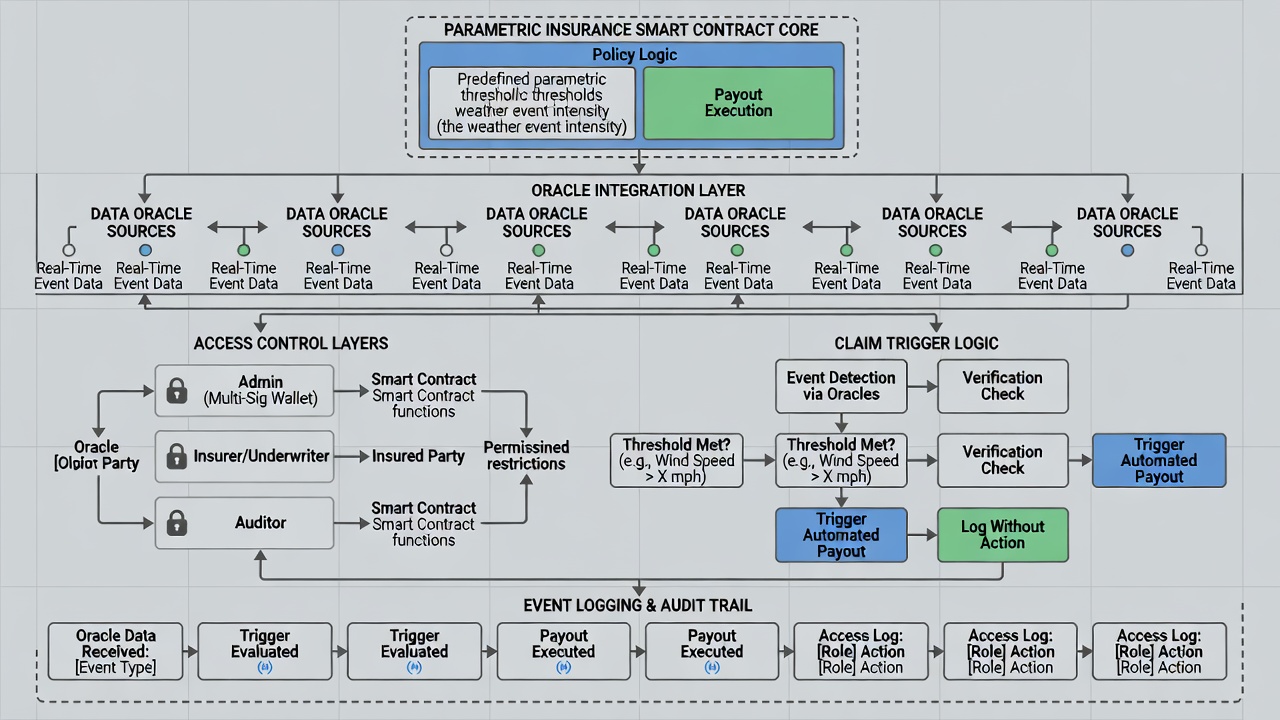
Integration with decentralized oracles like Chainlink enables real-time data feeds for triggers such as rainfall exceeding 50mm or wind speeds above 80km/h. The contract registers a Chainlink request and processes the response in a callback function that verifies the data source and timestamp before executing payout. Developers should implement request IDs, callback gas limits, and data validation checks. For instance, the fulfill function checks that the returned value matches expected ranges and originates from an authorized node before releasing funds.
Mitigation of Common Risks Like Oracle Manipulation
Oracle manipulation remains a primary threat. Mitigation strategies include using multiple oracle sources with median aggregation, implementing minimum response delays, and adding circuit breakers that pause payouts during anomalous data spikes. Developers should also validate data freshness by checking block timestamps against expected intervals. A concrete example involves comparing three independent weather oracles and only accepting the median value within a 10% deviation threshold. Additional safeguards include time-weighted average prices where applicable and fallback mechanisms that revert claims if data confidence scores fall below acceptable levels. Historical incidents, such as flash loan attacks on price feeds, underscore the need for these layered defenses.
Access Controls and Event Logging for Audits
Role-based access control limits sensitive functions such as updating risk parameters to authorized addresses only. All state changes emit detailed events including actor address, parameters changed, and block number. This facilitates forensic analysis during security audits. Implementation typically uses OpenZeppelin AccessControl with roles defined as constants. Example roles include:
- Owner role for contract upgrades and parameter adjustments
- Oracle role restricted to verified data providers
- Emergency pauser role for rapid response to incidents
- Claims processor role for manual overrides in edge cases
Event logging should cover every state transition with indexed parameters for efficient querying by monitoring tools.
Testing with Foundry for Edge Cases
Foundry provides fast fuzz testing and invariant checks essential for insurance logic. Test suites cover scenarios such as duplicate policy creation, oracle timeout failures, and extreme weather data inputs. Invariant tests verify that total premiums always exceed potential payouts under defined conditions. Practical commands include forge test --match-contract InsuranceTest -vvv for verbose output and forge fuzz with custom seed values to explore rare edge cases. Integration tests simulate full policy lifecycles including premium deposits, oracle callbacks, and payout distributions across multiple users.
Step-by-Step Deployment Workflow
Deploying a production-ready contract requires careful sequencing. First, compile contracts using Foundry’s forge build command. Next, deploy to a testnet like Sepolia and verify source code on Etherscan. Configure oracle job IDs and fund the LINK token balance. Run integration tests simulating full policy lifecycle before moving to mainnet. Finally, deploy to mainnet with a timelock for governance actions. Each step should include gas optimization reviews and post-deployment monitoring scripts that alert on unexpected events.
Comparisons to Traditional Insurance Protocols
Unlike centralized platforms that rely on manual claims processing, on-chain parametric contracts deliver near-instant settlements. However, they require robust oracle infrastructure. Projects such as Chainlink demonstrate how decentralized data networks reduce single points of failure compared to legacy systems. In contrast to protocols like Ethereum based DeFi insurance pools, traditional insurers face delays from paperwork and adjusters. The on-chain model also enables greater transparency through publicly verifiable code and event logs.
Best Practices and Common Pitfalls
Additional best practices include regular third-party audits, bug bounty programs, and formal verification of critical functions. Common pitfalls to avoid are insufficient input sanitization, lack of reentrancy guards on withdrawal paths, and over-reliance on single oracle providers. Always implement checks-effects-interactions patterns and maintain up-to-date dependency versions from OpenZeppelin.
FAQs on Regulatory Compliance and Real-World Failures
How does this approach address regulatory compliance?
Smart contracts must incorporate KYC modules and comply with jurisdiction-specific insurance licensing. Legal wrappers around the protocol often handle policy issuance while the on-chain component manages automation. Teams frequently consult legal experts to ensure alignment with evolving frameworks in major markets.
What real-world failure scenarios should developers avoid?
Past incidents include oracle downtime during extreme events and reentrancy attacks on withdrawal functions. Implementing circuit breakers and comprehensive audits helps prevent similar outcomes. Another frequent issue is insufficient testing of edge-case weather data that triggers unexpected payouts.
Conclusion
Building secure insurance smart contracts in Solidity demands meticulous attention to architecture, oracle security, and testing. By following the patterns outlined in this 2026 case study, developers can create resilient protocols that deliver reliable parametric coverage while minimizing exploit risks. Continued education through resources like Foundry documentation ensures teams stay ahead of emerging threats.
No comments yet. Be the first!