 CryptoChain Blog

Introduction to DeSci Tokenomics in 2026
Decentralized science, or DeSci, is transforming how research funding and intellectual property are managed through blockchain technology. In 2026, onchain analytics provide unprecedented visibility into token economics, helping analysts evaluate sustainable models for scientific advancement beyond traditional DeFi or real-world asset frameworks. Tokenomics in DeSci focus on aligning incentives between researchers, funders, and communities. Key elements include token utility in data marketplaces, dynamic supply mechanisms, and governance participation tracked via blockchain explorers and analytics platforms. This deep dive examines how these models support open research, fractional IP ownership, and transparent incentive distribution while highlighting metrics that separate viable projects from speculative ones.
Analysts increasingly use onchain data to assess whether token designs truly accelerate scientific discovery or merely replicate hype cycles seen in earlier crypto sectors. Sustainable tokenomics prioritize long-term utility over short-term speculation, ensuring that token flows correlate with verifiable research outputs such as published papers, dataset contributions, and successful grant milestones.
Core Metrics for Onchain Analysis
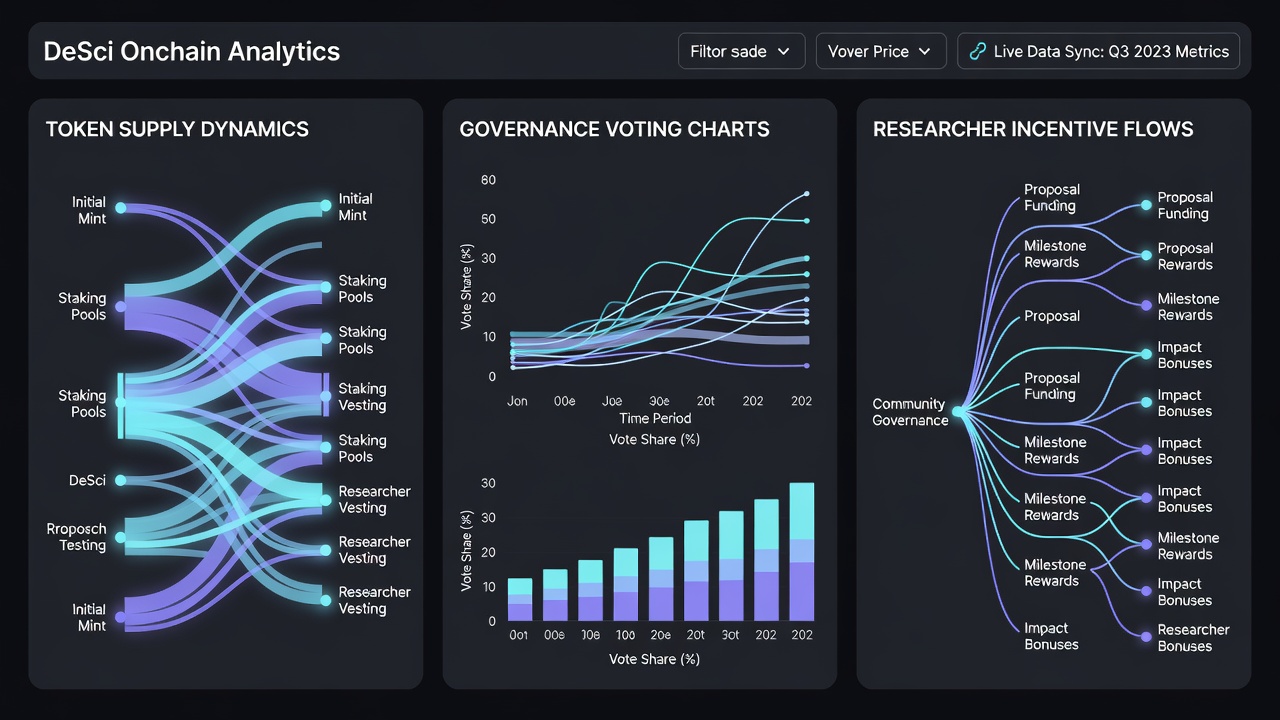
Analysts rely on several onchain indicators to assess DeSci projects. Token utility often centers on access to curated datasets or funding pools, where holders can stake tokens to unlock premium scientific resources or participate in peer-review bounties. Supply dynamics reveal inflation controls or burn mechanisms tied to research milestones, such as automatic token burns upon successful patent filings or citation thresholds. Governance participation is measured through voting power distribution, proposal success rates, and delegation patterns that indicate whether power remains decentralized. Tools like Dune Analytics and Arkham Intelligence enable detailed queries into wallet activity and token flows, allowing users to track treasury movements and researcher reward distributions in real time.
Additional metrics include velocity of tokens within data marketplaces and the ratio of locked versus circulating supply. These figures help determine if a project maintains equilibrium between rewarding early contributors and preserving value for future scientific participants.
Case Studies of Leading DeSci Protocols
Prominent protocols demonstrate varied approaches. One example involves IP tokenization platforms where research outputs are fractionalized into NFTs, allowing shared ownership and royalty distribution among global collaborators. Researchers receive tokens proportional to their contribution, with smart contracts automatically allocating portions to institutions and funders upon commercialization. Another focuses on data marketplaces that reward contributors with tokens for uploading verified scientific datasets, using oracle integrations to confirm data quality before minting rewards. These models highlight how vesting schedules differ: some use linear unlocks over 24 months to prevent dumps, while others tie releases to peer-reviewed publications or successful replication studies. In one notable case, a protocol linked token releases to citation counts tracked onchain, creating a direct feedback loop between academic impact and economic incentives.
Ethereum Foundation resources offer foundational insights into smart contract patterns used in these protocols, including upgradeable treasury designs that adapt to evolving research needs.
Steps to Track Researcher Incentives Onchain
- Identify project smart contracts using block explorers and verify their source code on public repositories for transparency.
- Query token transfer events linked to researcher wallets, filtering for patterns that show consistent reward inflows tied to activity timestamps.
- Analyze staking and reward distribution patterns to confirm that incentives favor active contributors rather than passive holders.
- Monitor governance votes for alignment with scientific goals, checking whether proposals related to funding allocation receive broad participation.
- Cross-reference with offchain publications for real-world impact by matching wallet addresses to author identifiers on academic platforms.
- Review treasury outflows to ensure funds support actual lab work, equipment purchases, or open-access publishing fees instead of marketing alone.
Comparing Vesting Schedules Across Projects
Vesting structures vary significantly across DeSci initiatives. Shorter cliffs may encourage early participation but risk volatility if large unlocks coincide with market downturns. Longer schedules promote sustained commitment by spreading releases over multiple years and conditioning portions on milestone achievements such as grant approvals or dataset validations. Analysts compare these against token utility strength in marketplaces to predict longevity. For instance, projects with milestone-based vesting often demonstrate stronger retention of core contributors because tokens only become liquid after tangible scientific progress is recorded onchain.
Actionable Checklist for Spotting Red Flags
- Concentrated token holdings in few wallets without transparent team disclosures or multisig requirements for treasury control.
- Utility limited to speculative trading rather than data access or funding, evidenced by low marketplace transaction volume despite high token circulation.
- Governance dominated by a single entity with minimal community input, visible through repeated veto power or low voter turnout on key proposals.
- Supply inflation exceeding research output milestones, where new tokens are minted faster than verifiable papers or datasets are produced.
- Lack of verifiable links between token rewards and peer-reviewed results, such as missing oracle feeds connecting publications to onchain events.
- High velocity of tokens leaving researcher wallets shortly after distribution, indicating potential sell pressure rather than long-term holding for governance.
National Institutes of Health guidelines provide benchmarks for evaluating scientific integrity in tokenized projects and help contextualize whether onchain incentives align with ethical research practices.
Integrating Tokenomics with Real-World Scientific Outputs
Successful integration requires bridging onchain metrics with offchain validation. For instance, tokens can fund open-access papers or lab equipment, with outcomes tracked through citation networks and patent filings. Projects that embed automated royalty splits upon commercialization demonstrate higher researcher retention because contributors see direct financial benefits from their work. Analysts should examine correlation between governance decisions and subsequent increases in published outputs or collaborative grants to confirm that token-driven incentives translate into measurable scientific advancement.
Tools and Platforms for Advanced Onchain Analytics
Beyond basic explorers, specialized platforms allow deeper queries into DeSci ecosystems. Custom dashboards can track token flows between research DAOs and individual contributors, while API integrations with academic databases enable hybrid analysis combining blockchain events with publication metadata. Regular audits of smart contract logic ensure that vesting and reward functions operate as intended without hidden centralization risks.
FAQs on DeSci Tokenomics
How do data marketplaces function in DeSci?
They enable tokenized access to datasets, with payments in native tokens that support ongoing research contributions and quality verification through community or oracle mechanisms.
What supply dynamics are sustainable?
Models with capped supplies and milestone-based minting tend to align better with long-term scientific progress by preventing unchecked dilution.
Are there risks in governance participation?
Low turnout can lead to centralization; analysts monitor delegation patterns and proposal diversity to assess overall health of the decision-making process.
How can analysts verify real-world impact?
By linking wallet activity to public research identifiers and tracking downstream metrics such as citations or follow-on funding secured through tokenized IP.
arXiv preprint server serves as a key reference for emerging DeSci research papers and provides context for evaluating tokenized incentive effectiveness.
Conclusion
DeSci tokenomics in 2026 demand rigorous onchain scrutiny to ensure sustainable funding and impactful IP tokenization. By applying these analytics frameworks, stakeholders can identify robust projects that truly advance science while avoiding common pitfalls that undermine long-term viability.

No comments yet. Be the first!